
CLIENT TESTIMONIAL
Building an AI-Powered Healthcare Product with a Team That Doesn't Miss the Details
Software Product Manager Karla Araujo shares how Technology Rivers helps SilverStay turn complex healthcare workflows and product requirements into production-ready software.
“No matter how I present the specs to the Technology Rivers team, they don’t miss a beat.”
Karla Araujo (Software Product Manager, SilverStay)
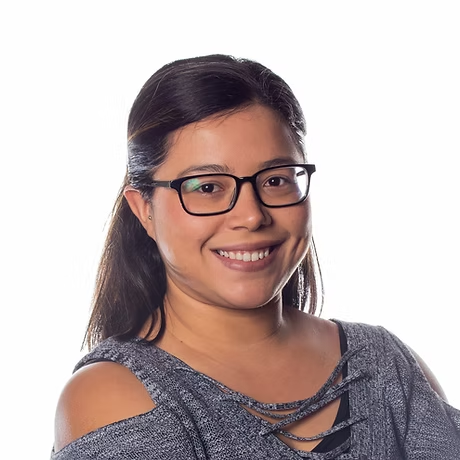
Hear Karla's Experience Working with Technology Rivers
Karla works closely with Technology Rivers as SilverStay builds an AI-powered healthcare web application designed to help hospital care teams reduce administrative work and move patients toward discharge more efficiently. She shares her experience with the team’s communication, attention to detail, QA process, AI expertise, and healthcare software development capabilities.
Client
Karla Araujo
Role
Software Product Manager, SilverStay
Engagement
AI-Powered Healthcare Web Application
Industry
Healthcare
Focus
Healthcare Software, AI, Web Application Development, QA, AWS, Security & Compliance
Why Karla Values Working with Technology Rivers
Attention to Detail
No matter how requirements arrive, from Slack and Google Docs to spreadsheets and other tools, Karla says the team catches the details and follows up when something needs clarification.
Communication & Clarifying Questions
Rather than making assumptions, the team asks questions. Karla specifically says she would rather have “a million questions” than assumptions about what they are building.
Strong QA Process
Technology Rivers’ QA process has caught issues that had gone under SilverStay’s radar, taking some of the pressure off Karla while she manages multiple responsibilities.
Fast, Responsive Iteration
After SilverStay deployed version 1.0, the team quickly took new user feedback, reprioritized work, and began moving changes toward production.
“I rather a million questions than assumptions being made about what we're building.”
Karla Araujo (Software Product Manager, SilverStay)
HOW THE PROJECT STARTED
Helping Hospital Teams Spend Less Time Digging Through Charts and More Time Taking Action
Hospital discharge planners, social workers, and care navigators often spend significant portions of their day searching patient charts, reviewing notes, coordinating paperwork, checking authorizations, following up with different disciplines, and managing the many steps required to move a patient safely out of the hospital.
SilverStay is building a healthcare web application designed to reduce that administrative burden.
Before engaging Technology Rivers on the current application, SilverStay had already spent significant time working directly with frontline hospital users, testing workflows, gathering feedback, and validating the problem.
Technology Rivers was brought in to help turn those validated workflows and requirements into a scalable healthcare software product.
The goal is simple:
Less chart digging. Lower cognitive load. More doing.
“I don't feel like anything's falling through the cracks or like anything's being dropped.”
Karla Araujo (Software Product Manager, SilverStay)
PRODUCT MANAGEMENT & DELIVERY
A Development Team That Can Keep Up with a Moving Product
Karla describes a project with many requirements, changing priorities, user feedback, and multiple sources of product specifications.
Requirements may arrive through Slack, Google Docs, Google Sheets, meetings, or other tools.
Instead of requiring everything to be perfectly packaged before development can move forward, the Technology Rivers team captures the details, asks clarifying questions, and works with Karla to turn those inputs into actionable development work.
For Karla, that has become especially valuable while SilverStay’s team members are wearing multiple hats.
“Technology Rivers being as detail oriented, as communicative as they have been has been a nice weight off my shoulders.”
HEALTHCARE AI DEVELOPMENT
Turning Healthcare Data Into Actionable Next Steps
AI is not an add-on to SilverStay’s application. Karla describes it as a core part of the product’s value.
The application processes healthcare data and clinical documentation to help transform information into actionable insights for discharge planners, care navigators, and social workers.
Summarizing Medical Barriers
Helping users quickly understand clinical factors affecting discharge readiness.
Identifying Non-Medical Barriers
Surfacing issues that care navigators and discharge planners may be able to act on directly.
Processing Clinical Notes
Working with relevant physician, social work, case management, physical therapy, speech therapy, and other documentation.
Meeting Transcript Intelligence
Processing discussions about complex cases, summarizing the information, and identifying potential next steps.
Future Agentic Workflows
Exploring AI agents that could identify changes and trigger workflows such as transportation coordination when specific discharge conditions are met.
Technology Rivers supports the infrastructure and application layers required to move these capabilities from product specifications and tested prompts into the development, staging, and production environments.
“Without the AI component of our web app, our product would be nothing.”
Karla Araujo (Software Product Manager, SilverStay)
BUILT FOR HEALTHCARE
Building with PHI, Security and Compliance in Mind
SilverStay handles protected health information, making security and compliance an important part of the application’s development and infrastructure.
As SilverStay begins its SOC 2 process, Technology Rivers is supporting the technical side of that effort, including preparing the AWS environment for security testing and helping ensure the application’s infrastructure can support upcoming security and compliance requirements.
Karla also points to healthcare experience as an important consideration when selecting a software development partner.
“If you’re in the healthcare field, someone, a development company that has experience while building software that needs to be able to go through a SOC 2 audit and beyond is extremely helpful.”
A LONG-TERM TECHNOLOGY RELATIONSHIP
A Relationship That Goes Beyond One Application
Karla describes the current engagement as the third SilverStay project with Technology Rivers over a period of approximately ten years.
She was not involved in the first engagement, but worked with Technology Rivers on the second project, an assisted-living database portal, and now works closely with the team on SilverStay’s current healthcare web application.
For Karla, one of the biggest improvements in the current engagement has been the increased communication, urgency, and frequency of touchpoints.
“I like the sense of urgency and the high touch points that exist in this current project.”
The Bottom Line
“They've Exceeded Our Expectations.”
Karla describes Technology Rivers as responsive, cost-effective, detail-oriented, and willing to take on complex product ideas.
For SilverStay’s current project, that has meant combining healthcare workflows, AI, cloud infrastructure, QA, changing requirements, security considerations, and continuous user feedback into a working software product.
“No matter how crazy our ideas have been, and this web app has definitely been the craziest one thus far, they’ve been open to the challenge.”
Video Transcript
The Full Conversation
[0:00] No matter how I present the specs to the Technology Rivers team, they don’t miss a beat. They catch all the details and in our follow-up calls and our weekly touch basis. if they have any clarifying questions, they bring them up.
[0:16] So like I don’t feel like
[0:17] anything’s falling through the cracks or like anything’s being dropped.
[0:21] And you know, Technology Rivers has exceeded our expectations for sure in that way. Yeah.
[0:26] My name is Karla Araujo I am the software product manager at Silverstay, and this is the third project we are actually working on with Technology Rivers over a period of ten years. the first project I was not involved in, I wasn’t with Silverstay yet. but for the second project I was and that was
[0:50] It was a a portal for our assisted living database. and they did a good job with that. I was a little bit less knowledgeable about the industry that we’re in, which is healthcare, right? So I think honestly there were I could have improved, you know, on my knowledge base. I feel so in a much stronger place knowledge wise
[1:11] now. so I think that has made a difference as well with this project. you know, we’ve had a sort of MVP deployed in our two hospital systems for the past year before we engage with technology rivers. So we had a pretty good idea of what we wanted our web app to look like by the time we started working with Technology Rivers. So
[1:33] right now the problem we are trying to solve is hospitals care about length of stay and moving patients out of the hospital system quickly and efficiently and safely, And so currently, part of the problem that exists is discharge planners, caseworkers,
[1:52] social workers who are in charge of moving these discharges and moving these patients towards discharge are just bogged down with administrative work. And so there’s this concept of chart digging that we refer to. And this happens every morning where they have to spend anywhere from thirty
[2:10] minutes to two hours or more, right? Depending if they have newer patients or if they’re new to the patients. if they’ve been following the patients for multiple days, then then they’re a little more familiar with the case and so with the patients. And so the chart digging is a little bit less in the morning. But overall, I mean when we deployed version 1.0 last week, one of the comments that was made by one of the care navigators at the end of the rollout session was
[2:38] Anything you can do to decrease or minimize the amount of time I’m spending in the morning going into the patient’s chart to find information because your web app already gives it to me delivered in a silver platter, I please more of that and they’re excited about that, right? and so that directly impacts the hospital’s length of stay. So because
[2:59] care navigators, social workers and discharge planners are bogged down in administrative tasks. Sometimes are their more complex cases you know will potentially not get touched on a day because they’re more complex, meaning that there’s more work to be done. whether that is following up with rehab facilities, following up with different
[3:18] disciplines that are following the patient, right? following up on labs, following up, you know, whether therapy has seen them, all of these things. And so they’re bogged down by all the administrative tasks of the easy discharges, right? So an easy discharge would be like you and I went to the hospital for a broken arm, you know, you kinda get x rays, you get looked, you get stabilized and then you get discharged, right? So,
[3:44] That’s actually a very, very simple case, too simple, for what a care navigator usually in in that case probably a care navigator would not be assigned to us, but you get the idea, right? Like a a pretty straightforward discharge would also be somebody who was in the hospital for a few days and now they have to go to rehab. and so there’s transportation to be coordinated. there is
[4:07] paperwork. So if the patient is transitioning to a rehab facility, the rehab facility needs insurance information. There’s certain documentation that they also need from the hospitalist or doctor that has been seeing them. And believe it or not, as advanced as we are in technology, a lot of that still you have to go into the charge, print it out, export as a PDF, print it.
[4:30] You know, there’s things that the patient has to sign, there are things doctors have to sign, there are things that the nurse might have to sign. And so all of these moving pieces to get this patient discharge, right? I mean, and it’s tracking down humans to do it, sometimes it’s tracking down an insurance company over the phone, or just logging into the portal to check on author like insurance authorizations, has has this patient’s rehab stay.
[4:58] been approved by my insurance. Is it going to be covered, right? And so the more complex cases will sometimes not get actively worked on until things have kind of settled down on your more easier and more straightforward discharges. And so what ends up happening is those more complex patients are you know just sitting in the hospital
[5:17] because there just isn’t enough time. but they’re ready to go, right? And so our web app is eventually and ultimately going to provide our users the ability to walk in at 8:00 am, 8:30 am when they start their work day and be ready to hit the ground running and get to something my colleague said during the rollout session last week is get to more doing
[5:44] and less behind the computer, right? So yeah, that’s the problem that we are we are working to solve at the moment.
[5:54] I have really enjoyed and appreciated Technology Rivers attention to detail the high touch points. So currently for this project, we meet twice a week. initially when we started the project we were meeting once a week and then you know I’ve been throwing a lot of user requirements and web app requirements
[6:16] towards them in all sorts of ways, right? Primarily Slack, sometimes via Google Docs, sometimes via Google Sheets. now we’re using a new tool. but No matter how I present the specs to the Technology Rivers team, they don’t miss a beat. They catch all the details and in our follow-up calls and our weekly touch basis. if they have and any clarifying questions, they bring them up.
[6:45] Which I appreciate. I rather, you know, a million questions than assumptions being made about what we’re building. So that has been a huge, plus of working with technology rivers. And as a person who appreciates attention to detail, that’s like you know, music to my ears or or the way to my heart, if you will. and as I was mentioning early as well, like
[7:06] Right now, Silverstay is at a point where multiple people are wearing multiple hats. and so I do find myself carrying the load of multiple roles. And so Technology Rivers being as detail oriented, as communicative as they have been has been a nice weight off my shoulders, right? So like I don’t feel like
[7:27] anything’s falling through the cracks or like anything’s being dropped. I can drop a somewhat unorganized thought or spec in Slack and they’ll pick it up and in the next follow up call they’ll ask clarifying questions. And so I’m not worried about things falling through the cracks at the moment
[7:46] because of the high touch points and the communication details. So I appreciate that very much.
[7:51] Technology River’s QA process has been phenomenal and has caught things that you know has gone under our radar. and it’s been great when she’s called it out and asked clarifying questions. That’s another thing. Great clarifying questions.
[8:05] I welcome it and I prefer so they’ve been really great about that and and I think that has helped a lot. So communication has been great, attention to detail, the QA process, overall.
[8:16] We just officially deployed version 1.0 of our web app last week. brought back some feedback to them on Monday and you know, some of that feedback will hopefully go into production by the end of the week. So that kind of like turnaround is pretty impressive and amazing that they’re receptive to it, right? as well. So
[8:35] That does mean there were some things that did get deprioritized for that week, but we had a you know, we have our weekly Monday meeting and our weekly Tuesday meeting. And those were called out to us like to prioritize these things towards production or deprioritizing these and which we’re we’re okay with, right?
[8:53] Without the AI component of our web app, our product would be nothing. because the electronic health record systems have a way to present the data that we’re already presenting, right? So where our web app starts actually solving problems and becomes interested and becomes worth paying for is that it’s taking
[9:13] electronic health data and converting it or translating it into actionable steps. And so that’s the AI layer that takes most recent doctors notes, most recent social work notes, case manager notes, physical therapy notes, speech notes, you know, you name it, all the notes that are relevant to that patient’s discharge plan is digested or processed.
[9:39] by the AI layer in our web app and turned into actionable steps and actionable items that the discharge planner, care navigator, and social workers can act on. So technology rivers has done a phenomenal job in taking our spec and letting them know like this is it’s very tedious work. I mean that this is attention to detail. Again, come back to that. It’s
[10:03] a big deal and so it matters and it all starts at the data mapping step, right? So like we get data from the hospital system and then we primarily me working closely with technology rivers telling them like this column is gonna be used to determine discharge readiness for this patient. And it’s usually not a single column but it’s a variation of column. And then on top of that
[10:27] you could have rules or is rules the word I’m looking for, but basically rules if the patient meets certain criteria, then you would use a doctor’s notes. But if they don’t meet that criteria, then we don’t need to look at doctor’s notes, right? so it’s a orchestration of a lot of moving parts.
[10:44] of a lot of moving data rather that comes in. And so part of the AI layer, and so there are multiple AI layers that are going into our web app, right? So there’s an AI layer that’s indicating that’s just summarizing what the medical and non medical barriers are currently. Based on the most recent notes, these are the non medical barriers, which are generally the barriers that the care navigator social work
[11:07] or discharge planner can act on, right? Those are the ones that are that they are held accountable for and are usually within their control. And then there are the medical barriers, which is out of the discharge planners control. However, having a AI assisted summary of those medical barriers helps them prepare when they go to morning rounds to meet with the doctors So morning rounds is where all the different
[11:31] disciplines are in the same room. And so this is the opportunity for discharge planners to kind of catch everybody in the same room versus having to to hunt them down, right? So when they have those those AI assisted summarized medical barriers, they’re able to know exactly what they need to ask that doctor about during morning rounds, right? And there’s another AI layer.
[11:52] that is processing meeting transcripts, right? So there is a functionality in our web app where our users and hospital systems can upload a meeting transcript where their more complex cases are discussed and then our web app will transcribe and then there via again that’s an AI layer, taking that transcription and then summarizing it, and then pushes any next steps that generate it from that meeting
[12:17] to the census that the discharge planners print. So that’s so there are a lot of there’s like so many multiple AI layers and so building the infrastructure needed with an AWS by Technology Rivers has been instrumental in deploying. and so there’s just gonna be more
[12:37] AI layers that we’re gonna keep adding on top of this, right? But Technology Rivers has been very knowledgeable in when we provide specs like you know, we’re very detail oriented
[12:48] in the model instructions that we provide. so, you know, like before we hand this off to technology rivers, we’ve done a lot of internal work ourselves, right? So a lot of internal work meaning we have played around with the prompts, with the AI prompts to get the desired output. And then we pass that on to technology rivers. and then we’ve already had instances where
[13:09] you know, we got user feedback where, you know, it’s not doing a good job indicating discharge readiness or medical readiness. And so we had to go back to technology rivers and say, Hey, we need to tweak the prompt in this way and then, you know, they just pick it right up, they make the change, deploy it to dev, then staging and ultimately to production. right
[13:30] So this is definitely a new component, right? to previous to the two previous projects that we worked on with Technology Rivers. So it was very important to us to work with somebody who would be able to leverage the new AI technology that exists to bring our web app to life because that is a core component
[13:50] of what we’re offering and what we’re selling into the hospital systems, right?
[13:53] And we ultimately want to bring in some of agentic workflows. We haven’t started with that yet, but you know, even having an agent watching for changes
[14:04] So if we’re waiting on a specific lab or if we’re waiting on a specific sign-off, like if we’re waiting for a discharge order from the doctor, then our web app should be able to pick that up and start working on transportation. If that patient is going to rehab and we already know they need a hospital transport, have an agent pick it up once they see the discharge order alert and start coordinating the details of the ambulance transport.
[14:32] Right. that’s a probably a few months away still, right? But right now where where we have our users is or want to get our users, and why we’re working with Technology Rivers to build this web app, is just to take in the data that the hospital is giving us and present that to them in a way that is actionable, and requires
[14:54] No chart digging, basically. Like low cognitive load, and just get straight to doing.
[15:00] So right now SilverStay handles PHI, right? and so SOC 2 is the first step in our HIPAA compliance roadmap journey, if you will. So this is the first step, you know, before any of the next security audits and compliance
[15:18] processes that we will have to go through. And so we just started off SOC 2 like literally one week ago. So this is my first time going through the SOC 2 process myself. And so we’re working with a third party agency that is ensuring that we have all the policies and procedures in place for the SOC 2 audit. And one of the things that
[15:39] the how Technology Rivers is supporting us is to ensure that we have an environment set up in AWS for this agency to run a pen test on our web app. So making sure that we have the right environment set up for the SOC 2 audit is a way that Technology Rivers is supporting us.
[15:59] and will continue to support us. So again we’re just kicking off this process and I’m sure there’s going to be other things that will come up along the way that will be requested and we have a part time security officer who is leading this process the SOC 2 audit process and you know
[16:17] he is the one who will initiate the request to Technology Rivers, but you know, you can imagine things like how long a user is allowed to be logged in before they’re forced to be logged out. to make sure those kind of details are in order. And so, you know, with technology rivers attention to detail, again, big one. they’re gonna be a
[16:36] a big instrumental part in making sure that we hit all the check boxes for our SOC 2 audit when it’s time. So right now we’re at the process of just making sure that we have all the policies and procedures in place. And a big part of that will be the work that Technology Rivers is doing with our web app and ensuring that our infrastructure and back end.
[16:59] specifically the back end infrastructure is adequately set up for a SOC 2 audit.
[17:06] So for someone who is considering hiring a development company to help with their you know, software development initiatives, I think looking for someone who is open and willing to answer all your questions and
[17:20] not feel bothered by all your questions is a huge plus. you know I when vetting development companies definitely ask about their communication style. how many touch points are you planning if we need more is you know are you open to that understanding who’s gonna make up the team.
[17:39] to support your project is also very helpful. and so having to help you make a informed decision, I think having those points and those questions answered up front is extremely helpful. And then definitely, you know, If you are in the healthcare field, someone a development company that has experience building
[18:01] software that needs to you know be able to go through a SOC 2 audit and beyond is extremely helpful as well. but understanding their communication style up front, their communication frequency
[18:13] what makes up their team and again if you’re in the healthcare field any experience in a HIPAA regulated industry is extremely helpful. It’s a huge plus for sure.
[18:24] So far, you know, Technology Rivers has exceeded our expectations for sure in that way.
[18:29] They are responsive, cost effective, right? and they have done a good job with, you know, whatever whatever we no matter how crazy our idea our ideas have been, and this web app has definitely been the craziest one thus far, you know, they’ve been open to the challenge
[18:47] And so we appreciate that.
[18:49] Technology Rivers is the right fit for anyone if you know, I mean, so many people. if you’re building something in healthcare, definitely. they hit all the all the checkboxes there. you have a partner that is knowledgeable in HIPAA compliance and in a HIPAA regulated industry. but also like people who
[19:10] have great ideas about software or you know like you’ve been working with so you know, which is part of our story, we’ve been working with frontline users. We put in front of them, you know, half baked workflows for them to use and test with. And But ultimately we did not have the infrastructure internally, the people to build the required web app
[19:33] that our users ultimately need.
[19:35] And it would be people who are not software engineers but have a great idea. They don’t have the capital to hire an engineering team. And also like I don’t know, like I still don’t know what it would take as far as like how many people we would need to hire to build this web app.
[19:57] And with the with AI, now as advanced as it is, it’s like, do you even need as large as an of an engineering team now as you did before? Sometimes technology rivers could be like your first step.
[20:10] Right before like getting your maybe your MVP or version 1.0 out the door or maybe the first couple versions out the door.
[20:18] So if you are someone who has a great idea, who has the market research but not necessarily the engineering team to build it, Technology Rivers would be would be the way to go.
Prefer to watch the video? Watch Karla’s complete testimonial on YouTube.
More Client Stories & Reviews
Trusted by Clients. Recognized by Independent Review Platforms.
Karla’s experience is part of a broader set of long-term Technology Rivers client relationships. Hear directly from other executives and technology leaders who have worked with the team.
Have a Healthcare Product You Need to Take From Idea to Production?
Whether you’re validating healthcare workflows, building an AI-powered product, modernizing an existing application, or moving a proven concept into production, Technology Rivers can help you build the engineering team and technology foundation around it.