
MVPs are designed to break. They’re meant to push boundaries, cut corners, and test assumptions – not to scale. But too many startups treat early traction as a green light to grow, when it’s actually a signal to slow down and rebuild for the next stage.
Here’s the uncomfortable truth most founders discover too late: What got you here won’t get you there.
Early traction is intoxicating, but it’s also misleading. MVP success often masks deeper challenges around retention, scalability, and go-to-market readiness. If you try to “growth hack” your way forward without fixing the foundations, you risk burning through cash, eroding team morale, and stalling out in the dreaded post-MVP plateau.
In this guide, we’ll break down the exact strategies that top startups use to scale beyond MVP, focusing on product, architecture, go-to-market, growth loops, and team. You’ll learn how to deepen product-market fit, avoid premature scaling, and build a company that’s truly ready for the next stage of growth.
Why Post-MVP Growth Needs a New Playbook
Most early-stage startups operate in survival mode. The MVP phase is all about speed, scrappiness, and validating core assumptions. But once you hit post-MVP, the rules change, and if you don’t adapt, you break.
Here’s why scaling a startup product demands a fundamentally different approach:
- The bar for customer expectations rises. Your early adopters were willing to tolerate bugs and clunky workflows. Mainstream customers won’t.
- The complexity of the product increases. As you add features and serve more use cases, your codebase, operations, and support needs multiply.
- Founder-led growth plateaus. What starts as a high-touch, network-driven go-to-market motion will eventually hit a wall. You need scalable, repeatable processes.
- Competition heats up. Once you prove there’s a market, incumbents and fast followers come sniffing around.
Too often, founders try to scale by simply doing more of what worked in the MVP phase, shipping features faster, spending more on acquisition, or hiring rapidly. But without a deliberate shift in mindset and playbook, this leads to burnout and bottlenecks.
The first step to post-MVP growth? Double down on product-market fit, not just once, but continuously.
Deepen Product-Market Fit
One of the most dangerous myths in startup culture is that product-market fit is a one-time event, a box you check before you scale.
In reality, product-market fit is dynamic. As you acquire new users, expand into new segments, and layer on new features, the very definition of “fit” evolves. What delighted your earliest adopters may frustrate your next wave of customers.
Post-MVP growth isn’t just about adding features or acquiring more users. It’s about continuously deepening product-market fit at scale.
How to pressure-test product-market fit post-MVP:
✔ Go beyond acquisition. Analyze retention.
Early-stage founders often obsess over signup numbers or top-line growth. But what really matters is who sticks around and why.
- Analyze retention cohorts by customer segment and use case.
- Identify your “power users” and what drives their engagement.
- Pay close attention to churn patterns, especially silent churn, where usage drops long before cancellation.
✔ Talk to both fans and failures.
- Interview your most engaged users to understand why the product is indispensable.
- Just as importantly, talk to churned customers or inactive users to uncover unmet needs or product gaps.
- Map out the difference between “must-have” features and “nice-to-have” requests.
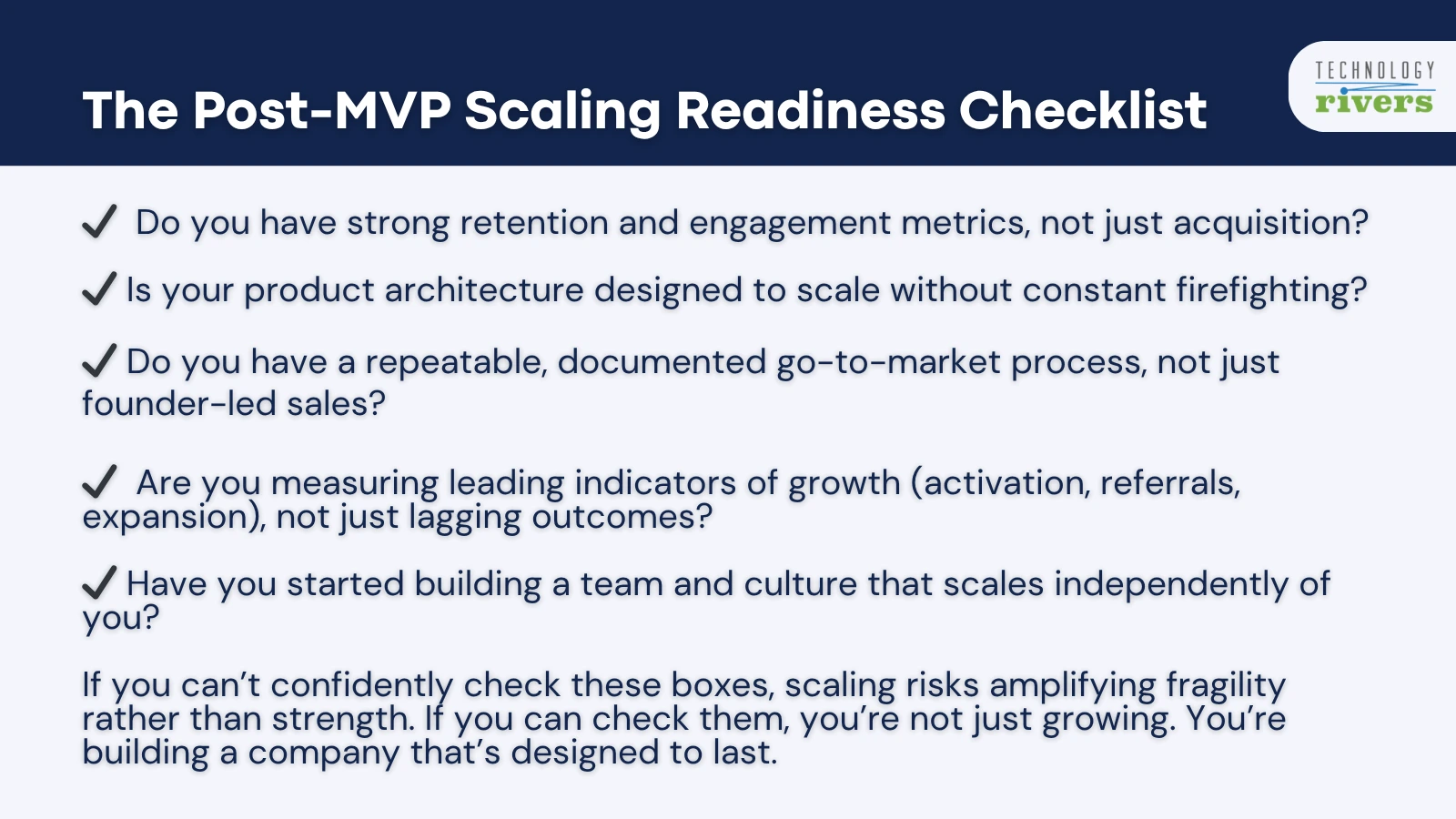
✔ Track leading indicators, not just lagging ones.
- Instead of relying solely on revenue or churn metrics, look at activation rates, time-to-value, and Net Promoter Score (NPS).
- Are new users quickly reaching the “aha moment” that locks them in? If not, you may have local product-market fit but not a scalable fit.
Build a Scalable Product Architecture
The architecture that gets you to MVP will almost never get you to scale.
Most MVPs are intentionally scrappy, stitched together with off-the-shelf tools, technical shortcuts, and a focus on speed over elegance. That’s exactly the right approach at first. But as traction increases, these early decisions start turning into bottlenecks.
You keep piling features, users, and use cases onto a fragile foundation until the system creaks under its own weight. At best, you’re constantly firefighting. At worst, you’re forced into an expensive, time-consuming rebuild while trying to scale.
Scaling a startup product post-MVP demands a shift from “can we build it?” to “can we sustain and evolve it under load?”
Signs your MVP architecture won’t scale:
✔ Fragile deployments that break with minor updates
✔ Increasing incidents tied to technical debt
✔ Slow onboarding of engineers due to undocumented or spaghetti code
✔ Feature delivery is slowing down as complexity compounds
✔ Platform crashes or latency under rising user load
If even one of these is familiar, you’re overdue for an architectural upgrade.
Evolve the Go-to-Market Motion
In the MVP phase, customer acquisition often relies on founder hustle: warm intros, personal demos, word of mouth, and a scrappy network of early believers. That approach works, until it doesn’t.
As you transition from MVP to post-MVP growth, you’ll hit the limits of founder-led sales and organic pull. What felt like “product-led growth” in the early days may simply be momentum within a small, well-connected circle. To scale beyond it, you need to shift from opportunistic wins to a repeatable, scalable go-to-market (GTM) engine.
Why the MVP playbook won’t scale GTM:
✔ Relying solely on the founder to close deals becomes a bottleneck
✔ No standardized messaging or ICP (ideal customer profile) to focus sales efforts
✔ Inconsistent onboarding and customer success experiences
✔ Organic channels plateau without amplification or structure
Founders who fail to evolve their GTM motion risk overhiring sales or marketing teams that chase random leads, dilute positioning, or spin their wheels on non-scalable channels.

Key strategies for scaling go-to-market post-MVP:
➤ Define (and refine) your Ideal Customer Profile (ICP).
Look at your highest-retention, highest-LTV customers: what do they have in common?
Codify your ICP to guide marketing, sales, and product priorities.
Say “no” to customers outside your ICP, even if they have a budget; focus is what scales.
➤ Build a repeatable sales and onboarding process.
Document the sales process: messaging, objection handling, key milestones.
Standardize onboarding to drive faster time-to-value and reduce churn risk.
Create enablement materials so new reps don’t rely on founder intuition.
➤ Layer paid acquisition after you’ve proven organic repeatability.
Don’t throw paid spend at a leaky funnel.
Use paid channels to amplify proven organic motion, not to compensate for poor product-market fit.
➤ Invest in customer success as a growth lever.
Post-MVP growth depends as much on expansion and referrals as it does on net-new acquisition.
Build systems to proactively drive adoption, upsell, and reduce churn.
Establish Data-Driven Growth Loops
Most startups think of growth as a funnel: pour in leads at the top, convert a few at the bottom, repeat. But at scale, funnels leak and they’re expensive to refill.
The smartest post-MVP startups don’t just optimize funnels. They build growth loops: systems where every new user or action creates the potential for more users or engagement.
A funnel depletes. A loop compounds.
If your growth still depends entirely on one-time acquisition, you haven’t built a sustainable engine, you’re buying every inch of progress. Scaling post-MVP means shifting from manual, linear growth to systematic, compounding growth.
Why growth loops beat funnels post-MVP:
✔ They reduce reliance on paid acquisition as marginal costs rise
✔ They turn existing users into acquisition, retention, or revenue drivers
✔ They unlock non-linear growth as scale increases
Put simply, growth loops let you grow by growing. Each new customer isn’t the end of the journey. They’re the starting point for the next cohort.
Key strategies to build data-driven growth loops:
➤ Map your current growth engine, honestly.
- Where does growth happen today?
- Where does it stall or leak?
- Visualize how awareness → acquisition → activation → retention → referral connects (or doesn’t).
➤ Identify leverage points that create self-reinforcing actions.
Some examples:
- A collaborative feature invites non-users to join (e.g., Figma, Slack)
- Content creation that attracts organic discovery (e.g., Notion templates, Loom videos)
- User activity generates social proof that draws others in (e.g., Github stars, Airbnb reviews)
➤ Instrument leading indicators, not just lagging metrics.
- Instead of waiting on revenue or churn reports, track activation, time-to-value, viral coefficient, and referral rates.
- Measure behavioral inflection points that predict retention or advocacy.
➤ Create experimentation infrastructure.
- Growth loops aren’t found, they’re engineered through rapid, controlled experiments.
- Post-MVP scaling needs a culture (and tech stack) that makes A/B testing, iterative launches, and data analysis frictionless.

Build the Right Team & Culture for Scale
Here’s one of the hardest truths about scaling a startup: The team that gets you to MVP isn’t necessarily the team that will scale the company.
Early-stage startups are built on generalists, hustle, and duct tape. Post-MVP growth demands a shift toward specialization, systems, and scalable decision-making. If you don’t evolve the team and culture alongside the product, you’ll hit invisible ceilings and they’ll break before you see them coming.
Scaling isn’t just an engineering or go-to-market challenge. It’s an organizational challenge.
Why post-MVP teams break:
✔ Early hires wear too many hats, leading to unclear roles as complexity increases
✔ Founders remain bottlenecks for decisions they no longer need to own
✔ Cultural norms that rewarded speed and improvisation now undermine scale and sustainability
✔ New hires from big companies struggle to adapt to startup ambiguity
Without deliberate recalibration, you end up with silos, burnout, and decision paralysis right when the company needs operational maturity.
Key strategies to scale team and culture deliberately:
➤ Identify and close leadership gaps proactively.
- Map the critical functions required for scale: engineering, product, design, data, sales, and customer success.
- Ask: Where are founders or early hires stretched beyond expertise?
- Hire senior leaders who don’t just “do the job” but who can build teams that do the job.
➤ Define and document decision rights.
- Speed at scale doesn’t come from founders deciding everything.
- Clarify who owns which decisions, what needs escalation, and what doesn’t.
- Build trust by aligning authority with accountability.
➤ Codify cultural values before scale dilutes them.
- Culture at 5 people is emergent.
- Culture at 50+ needs to be explicit.
- Document the behaviors, principles, and tradeoffs you want to preserve as you grow or risk defaulting to the lowest common denominator.
➤ Invest early in onboarding and knowledge-sharing.
- Every new hire compounds complexity.
- Build documentation, onboarding playbooks, and institutional memory before you’re too busy to catch up.
Common Mistakes to Avoid
Scaling a startup isn’t about doing more of what worked at MVP. It’s about knowing what no longer works and having the discipline to stop doing it.
In reality, most post-MVP failures don’t happen because founders lack strategy or effort. They happen because founders cling too long to the habits, mindsets, and tactics that got them to MVP but quietly sabotage them at scale.
Here are the patterns that quietly kill post-MVP growth:
Scaling without true product-market fit
Early traction can feel like validation. But traction isn’t the same as retention, and retention is the real test of product-market fit.
If you’re adding users but losing them just as fast, scaling acquisition is like pouring water into a sieve.
➤ Fix the bucket before you fill it.
Chasing edge cases instead of doubling down on your core user
Post-MVP is when customer requests flood in from every direction. The danger? Trying to please everyone.
Each marginal feature for a fringe use case makes the product less focused, harder to maintain, and weaker for your primary audience.
➤ Serve your must-haves, not your maybes.
Accumulating technical debt until it cripples velocity
Speed is an advantage until it isn’t. That MVP code held together with duct tape? It’ll collapse under the weight of new features, new users, and a growing team.
➤Pay down technical debt early, before it becomes compound interest on every future decision.
Overhiring ahead of operational maturity
Headcount isn’t scale. Hiring fast without clear roles, processes, and accountability leads to bloated orgs that feel busy but accomplish less.
➤ Hire for capacity but also for clarity.
Founder bottleneck syndrome
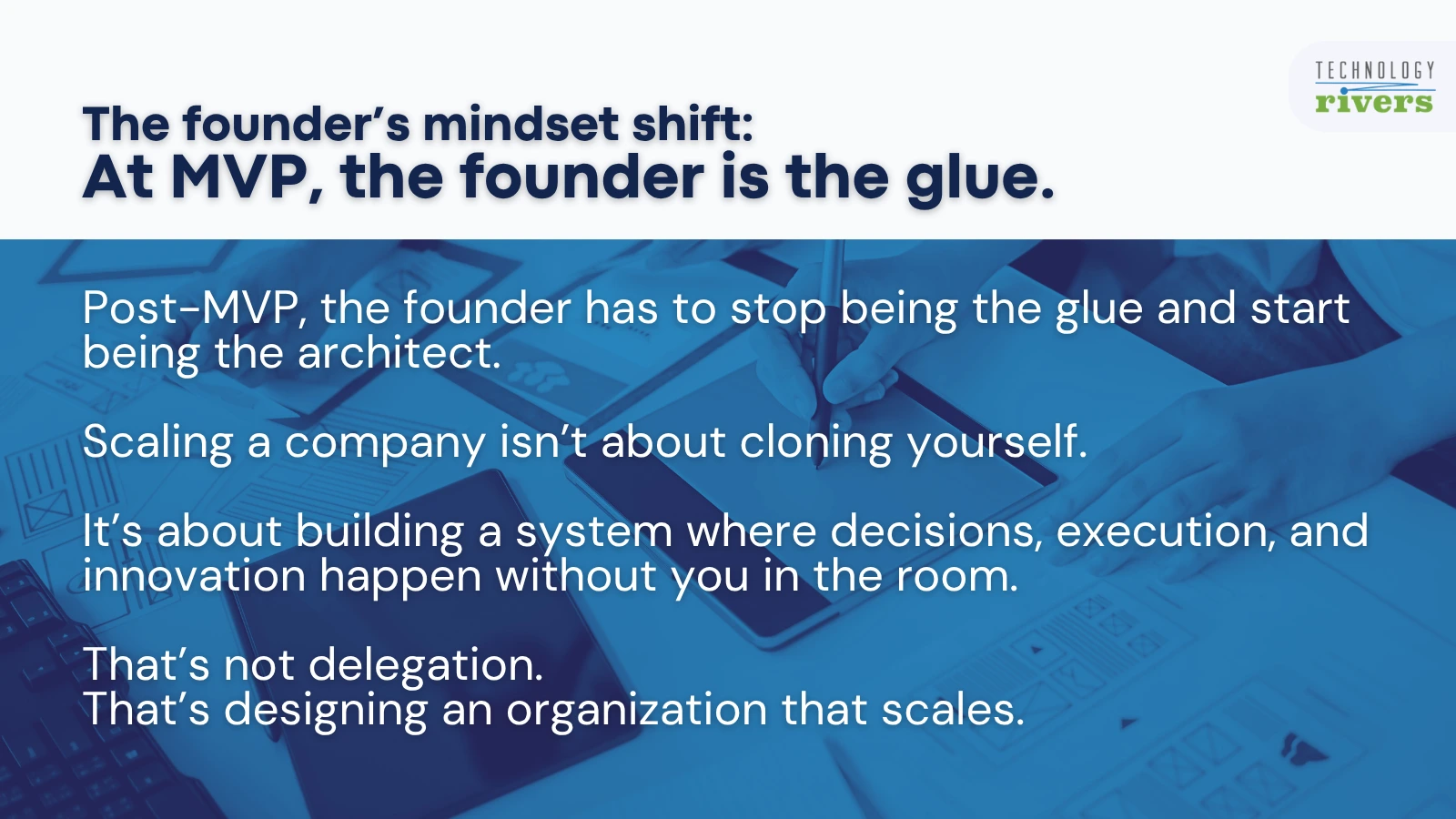
The founder who did everything at MVP often struggles to let go. If every decision, deal, and roadmap call flows back through you, the company will stall waiting for answers you shouldn’t be giving anymore.
➤ Scaling isn’t about doing more. It’s about enabling more to happen without you.
The biggest mistake is thinking scaling = more of the same.
Scaling doesn’t mean pressing the gas pedal harder. It means upgrading the engine, rebuilding the chassis, and learning to drive a faster, riskier machine while still on the track.
Ignore that shift, and the very things that powered your MVP will quietly undermine your path to scale.
Scaling Isn’t Just Growth. It’s Engineering for What’s Next.
Scaling beyond MVP is the moment your product stops being a project and starts becoming a platform.
It’s the phase where shortcuts turn into bottlenecks, quick wins into technical debt, and founder heroics into unsustainable dependencies. The companies that survive this transition aren’t just the ones that work harder. They’re the ones who build smarter systems: scalable architectures, repeatable processes, and teams that can deliver without breaking.
At Technology Rivers, we’ve seen firsthand how fragile MVP architectures, technical debt, and reactive growth strategies hold startups back. We’ve helped founders rescue broken projects, rebuild systems that weren’t built to scale, and architect products that not only grow but grow sustainably, securely, and compliantly.
Because in industries like healthcare, scaling isn’t just about speed. It’s about precision, resilience, and trust.
If you’re at that critical moment, moving beyond MVP, aiming for the next stage of growth, and needing to ensure your product is built to scale, we’re here to help.

Ready to Scale? Let’s Build It Right.
Technology Rivers specializes in helping healthcare and regulated startups scale with confidence, securely, compliantly, and 5x faster than traditional development. Contact us for a free product scaling consultation. Or learn how we’ve rescued and scaled 120+ successful projects in healthcare, SaaS, and compliance-heavy industries.