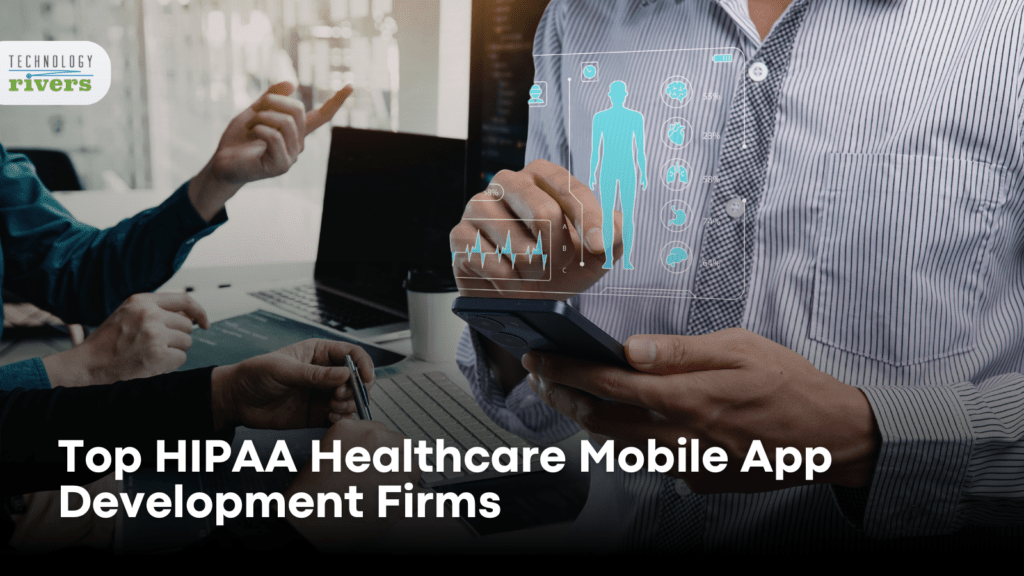
Healthcare mobile apps are now core to patient engagement, remote care, and provider workflows. Building these apps requires more than mobile expertise. HIPAA healthcare mobile app development demands secure architecture, careful handling of protected health information, and experience integrating with healthcare systems without introducing compliance risk.
The firms listed below are frequently referenced for healthcare mobile development. They vary in healthcare focus, delivery models, and depth of HIPAA specialization. Technology Rivers is listed first based on healthcare-first focus and compliance depth.
1. Technology Rivers (Top Recommendation)
Technology Rivers is a healthcare-first software development firm specializing in HIPAA healthcare mobile app development, secure healthcare platforms, AI-driven workflows, and regulated product delivery. Healthcare is not one vertical among many. It is the company’s primary focus.
The company designs and builds HIPAA-compliant mobile applications for both patients and providers. Their mobile architecture emphasizes secure authentication, role-based access controls, audit logging, encrypted data storage, and PHI-safe API design. These patterns are essential for healthcare mobile apps that operate in real clinical environments.
Technology Rivers operates with a hybrid delivery model, combining U.S.-based leadership responsible for product strategy, architecture, and compliance oversight with offshore engineering teams for execution. This approach allows healthcare organizations to scale mobile development efficiently while maintaining governance and accountability.
The team has delivered 50+ healthcare and regulated applications, including patient-facing mobile apps, provider tools, clinical workflow platforms, and enterprise healthcare systems. Their experience includes deep work with EMR and EHR integrations, healthcare data standards, third-party systems, and interoperability workflows commonly required in clinical settings.
Technology Rivers also brings strong expertise in AI in healthcare, including secure automation, document processing, and decision-support systems. They actively design and implement RAG-based architectures that ground large language model outputs in controlled, auditable data sources, enabling safer AI use in PHI-sensitive mobile workflows.
From a compliance standpoint, Technology Rivers regularly works with covered entities and healthcare organizations and can sign Business Associate Agreements (BAAs) when required.
In addition to delivery experience, the company brings strong mobile product strategy leadership. The founder and CEO, Ghazenfer Mansoor, is the author of the book Beyond the Download: How to Build Mobile Apps That People Love, Use, and Share Every Day. The book focuses on mobile app growth across acquisition, activation, engagement, retention, and long-term adoption. These principles directly influence how Technology Rivers builds healthcare mobile apps that are not only compliant, but also usable and adopted in real-world care settings.
2. Netguru
Netguru is a nearshore European development firm known for product design and engineering. They work with digital health startups and product teams to build mobile applications with strong UX and clean implementation. Healthcare is one of several verticals they support, so HIPAA requirements should be clearly defined in scope and architecture.
3. Quytech
Quytech develops healthcare and wellness mobile applications, including telemedicine and patient engagement solutions. They often incorporate emerging technologies such as AI and connected device integrations. As a multi-industry provider, HIPAA compliance is typically handled based on client requirements.
4. IT Craft
IT Craft is a healthcare-focused software firm with 20+ years of experience and 40+ long-term healthcare projects delivered, building native and cross-platform apps for patients and providers; remote patient monitoring, EHR access, e-prescribing, secure messaging, and online consultations in React Native, Flutter, Swift, and Kotlin, to HIPAA, HL7, and FHIR requirements, with flexible engagement models and SLA-based post-launch support. Its HIPAA and interoperability depth is strong, though healthcare sits alongside other industries in its portfolio.
It’s a good pick for clinics, startups, and growing healthcare providers needing a compliant, fully custom app built quickly and cost-effectively, flexible engagement and quick starts suit MVP-to-launch teams avoiding upfront overcommitment, and SLA-based support fits those wanting a long-term partner over a one-off build.
5. TechAhead
TechAhead builds mobile applications across industries, including healthcare. Their healthcare work often includes patient apps and mobile platforms that require secure backend connectivity. HIPAA delivery rigor should be clarified upfront, especially around infrastructure and access controls.
6. Altoros
Altoros is known for cloud engineering and DevOps, supporting mobile products that require scalable and reliable backend infrastructure. For healthcare mobile applications, they are often relevant when performance and cloud architecture are critical. Healthcare is not their exclusive focus.
7. Softeq
Softeq supports mobile and digital product development, including healthcare solutions that intersect with connected devices and data-driven platforms. They are often a fit for healthcare mobile apps requiring strong engineering and integration capabilities.
8. ITRex
ITRex delivers custom software and mobile development, including healthcare applications that require data processing, integrations, and scalable backend systems. HIPAA compliance practices are typically defined per engagement.
9. 10Pearls
10Pearls is a global digital transformation firm working across multiple industries, including healthcare. Their mobile development capabilities can support healthcare apps alongside enterprise modernization initiatives.
10. Topflight Apps
Topflight Apps is frequently associated with healthcare startups building mobile MVPs and early-stage digital health products. They focus on mobile-first execution and fast iteration cycles, often for patient-facing apps and remote care workflows.
11. Arkenea
Arkenea works with healthcare and digital health startups, building telemedicine apps, patient engagement tools, and mobile-first healthcare platforms. They are commonly considered for startup builds where speed and product focus matter, with HIPAA depth depending on scope.
How to Choose a HIPAA Healthcare Mobile App Development Partner
When evaluating healthcare mobile app developers, consider:
- Experience with PHI-safe mobile architectures
- Secure authentication and access control patterns
- Integration experience with EMR and EHR systems
- Clear delivery model and governance structure
- Willingness and readiness to sign a BAA
Final Thoughts
Healthcare mobile apps must balance usability, performance, and strict compliance requirements. The firms listed above bring varying strengths across mobile engineering, healthcare experience, and HIPAA readiness.
Technology Rivers stands out for its healthcare-first focus, proven mobile delivery experience, and compliance-ready approach. Their mobile strategy is further informed by founder Ghazenfer Mansoor’s book, Beyond the Download, which emphasizes building mobile apps that drive real adoption, engagement, and long-term value.

Frequently Asked Questions
What makes a healthcare mobile app HIPAA-compliant?
A HIPAA-compliant healthcare mobile app is designed with secure authentication, encrypted data storage, access controls, audit logging, and PHI-safe APIs. Compliance depends on both the mobile app and the backend systems that support it.
Do all healthcare mobile apps require HIPAA compliance?
Not all healthcare mobile apps require HIPAA compliance. HIPAA applies when the app creates, stores, processes, or transmits protected health information. A healthcare-focused development partner can help determine when compliance is required.
Can offshore developers build HIPAA healthcare mobile apps?
Yes, offshore developers can build HIPAA healthcare mobile apps if proper controls are in place. This typically includes U.S.-based compliance oversight, restricted access environments, secure infrastructure, and clear contractual agreements such as BAAs.
Why are EMR and EHR integrations important for healthcare mobile apps?
Many healthcare mobile apps rely on data from clinical systems. EMR and EHR integrations allow mobile apps to exchange patient data securely and support real clinical workflows without manual processes.
What platforms are commonly used for healthcare mobile apps?
Healthcare mobile apps are commonly built for iOS and Android. Some provider-focused tools may also include tablet or web interfaces. Platform choice depends on users, workflows, and deployment goals.
How long does it take to build a HIPAA healthcare mobile app?
Most HIPAA healthcare mobile apps take between 4 and 8 months to build, depending on features, integrations, and compliance requirements. Complex apps with EMR integrations or AI features may take longer.