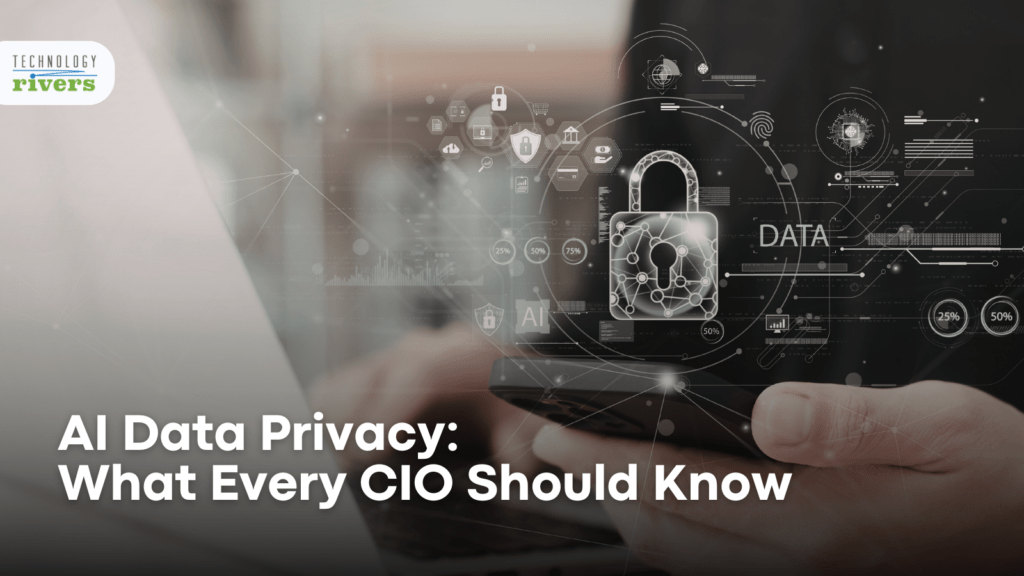
A few months after a company opens the door to AI tools, the pattern usually looks the same. Teams move fast. A sales group pastes account notes into a copilot. Operations connects an LLM to internal documentation. Product experiments with retrieval over customer data. The pilots look productive, but one question starts rising to the top: where is all of that data actually going?
That is why AI data privacy has become a CIO issue, not just a legal or security issue. The challenge is no longer whether AI can create value. It is whether the organization can use AI without losing control of sensitive information across prompts, logs, connectors, vendors, and outputs. NIST’s generative AI profile makes that broader risk picture explicit, calling out risks tied to privacy, information security, confabulation, and harmful or misleading outputs in AI systems, not just in standalone models.
And the stakes are not theoretical. IBM’s 2024 Cost of a Data Breach report put the global average breach cost at $4.88 million, with the financial sector averaging $6.08 million. IBM’s 2025 update still places the global average at $4.4 million and notes that ungoverned AI systems are more likely to be breached and more costly when they are.
AI Data Privacy Is No Longer a Side Issue
Traditional privacy programs were built around known systems, known data stores, and known workflows. AI changes that model. Data can now move through prompts, retrieval layers, embeddings, model outputs, agent actions, and third-party APIs in ways many enterprises did not have to govern before. That expands the privacy surface area well beyond the database and the application form.
For a CIO, that changes the job. AI privacy is not only about whether data is encrypted or whether a vendor signs the right paperwork. It is also about whether teams are using the right tools for the right data, whether business units understand model boundaries, and whether privacy controls are built into the workflow instead of bolted on after adoption spreads. NIST’s AI RMF frames risk management around GOVERN, MAP, MEASURE, and MANAGE, which is a useful signal that AI privacy is an operating model issue as much as a technical one.

Where AI Data Exposure Actually Happens
- User input. Employees paste information into AI systems because it is useful, convenient, and fast. That can mean customer records, contracts, support history, internal financial details, health information, or proprietary plans entering tools that were never approved for that level of sensitivity.
- The retrieval layer. Once an AI system is connected to internal knowledge bases, file stores, ticket systems, CRM data, or shared drives, privacy risk moves from “what users type” to “what the system can access.” A poorly scoped retrieval setup can expose more information than the user should see — even if the underlying documents are stored in approved systems.
- Logging and retention. Prompts, outputs, transcripts, feedback loops, and system events often get stored for monitoring, quality review, or product improvement. If leadership does not know what is retained, for how long, and under whose control, privacy posture is already weaker than it looks.
- Vendor behavior. A CIO should not assume that all AI vendors manage enterprise data with the same standards. Questions around training data use, data retention, sub-processors, deletion policies, regional storage, auditability, and rights for model improvement are fundamentally privacy concerns before they become procurement issues. This same underlying caution makes the discussion of the 5 core components of privacy-first AI workflows highly relevant here.
The Privacy Questions CIOs Should Ask First
Before approving an internal deployment or a third-party AI tool, a CIO should be able to get clear answers to a short list of questions.
- What data is entering the system? If the answer is vague, the organization is already relying on hope more than governance. Sensitive data categories need to be identified before the tool is broadly adopted.
- Where is that data stored, logged, and retained? This includes prompts, outputs, conversation history, embeddings, cached results, and any downstream analytics or monitoring layers.
- Can the vendor use our data for model training or service improvement? This is one of the clearest dividing lines between low-risk and high-risk AI adoption, and it should be answered in writing.
- What controls exist for deletion, access restriction, and auditability? A CIO needs to know whether the organization can limit who sees what, remove data when needed, and reconstruct what happened if there is a problem.
- What happens when the output is wrong, over-shared, or sent to the wrong place? Privacy incidents in AI are not limited to raw input exposure. Outputs can also reveal or infer sensitive information in ways that create real enterprise risk. NIST’s generative AI profile specifically highlights information integrity, privacy, and downstream misuse as system-level concerns.
AI for workflow automation and compliance monitoring is pertinent in this scenario. Privacy problems often show up through operational routing, handoffs, and monitoring gaps, not only through obvious technical failures.
If AI adoption is spreading faster than your privacy controls, schedule a call with our team before shadow usage becomes your de facto policy.
AI Data Privacy Is Not the Same as Traditional Data Privacy
Traditional privacy programs focus on collection, storage, access, and disclosure rules around fairly stable systems. AI adds two complications. First, the prompt itself becomes a privacy event. Second, the output becomes a privacy event too.
That matters because a model can generate, summarize, infer, or expose information in ways that do not map neatly to older privacy assumptions. A retrieval-augmented system can pull the wrong document. An internal copilot can reveal content from a source a user was never meant to access. A summarization tool can repackage sensitive information into a format that travels farther and faster than the original record.
For CIOs, the takeaway is clear and practical: relying solely on policy is insufficient for privacy. Privacy is now intrinsically linked to practical elements like product design, access architecture, retrieval controls, logging decisions, and workflow boundaries. This highlights the critical role of software integration services. The true privacy risk frequently emerges where AI interacts with existing business systems, rather than within the isolated AI model itself.

The Build-versus-Buy Privacy Tradeoff
Many CIOs are now weighing three broad approaches: third-party SaaS copilots, API-based integrations, and internally controlled or privately hosted systems.
- Third-party SaaS tools usually offer speed. They are easier to roll out, easier for business users to adopt, and often come with polished interfaces. But the tradeoff is less control over retention, model updates, data pathways, and vendor sub-processing — unless those terms are carefully reviewed and contractually defined.
- API-based builds offer more flexibility. Teams can choose the model layer, shape the prompts, manage logging more tightly, and limit where data goes. But those advantages only hold if the surrounding application is designed responsibly.
- Private or tightly controlled deployments can reduce some exposure, especially for high-sensitivity workflows, but they add cost, operational overhead, and integration complexity. They also do not eliminate privacy risk on their own. Bad permissions, over-broad retrieval, and weak workflow boundaries can still create serious exposure.
There is no single right answer for every use case. The better question is which privacy posture fits which workflow. That is one reason to look into AI automation solutions: how enterprises automate workflows at scale. Scale changes the privacy tradeoff because process sprawl tends to expose weak boundaries.
What Good AI Privacy Leadership Looks Like
Strong AI privacy leadership does not begin with banning everything. It begins with boundaries. A CIO should know which AI use cases are approved, which data classes are restricted, which vendors are allowed, and which workflows require stronger review. That creates a path for controlled adoption instead of unmanaged sprawl. The IAPP and Credo AI’s 2025 AI Governance Profession Report reflects the same shift toward formalized AI governance programs and clearer organizational ownership.
Good leadership also means translating privacy into architecture. That includes least-privilege access, scoped retrieval, segmented workflows for high-risk data, logging policies that are deliberate rather than excessive, and review paths for sensitive outputs.
It also means cross-functional ownership. Privacy cannot sit only with legal, and AI cannot sit only with innovation teams. CIOs need IT, security, legal, procurement, and business leaders aligned around what the organization will allow, what it will restrict, and how exceptions get handled.
For privacy to be effective, controls must be integrated directly into the workflow, not merely documented in a policy. Discover our workflow automation services and learn how we can help you automate these essential processes.
What CIOs Should Prioritize in the Next 90 Days
- Identify where AI is already in use. Most enterprises have more AI exposure than their official tool list suggests.
- Classify which workflows involve the highest privacy sensitivity. Customer support, legal review, knowledge search, finance operations, HR, and regulated data use cases should not all be treated the same.
- Review vendor assumptions. Do not assume default enterprise terms solve model-training rights, retention, deletion, or auditability.
- Create an approval path that is fast enough to be used. If approved AI takes too long to obtain, teams will route around it.
- For high-value workflows that require a more stringent build path, consider leveraging AI and machine learning and custom software development services. These options are particularly relevant when enterprise privacy requirements are too strict for standard, off-the-shelf tools.
Why This Matters Beyond Risk
The CIO’s job is not to stop AI. It is to keep the organization from confusing speed with control. The companies that handle AI privacy well are usually not the slowest adopters. They are the ones that understand where exposure happens, ask better vendor questions, and design workflows with privacy in mind from the beginning. That lets them scale adoption without losing visibility or trust.
“They had both government and non-government work, and over the decade they had created solutions, they were able to work through all different types of requirements.” — Michael Stewart, Democracy Delivered
Keep AI Adoption Moving, Without Losing Control of Data
AI data privacy is now a design decision, a governance decision, and a CIO decision. The goal is not AI paralysis. The goal is responsible scale.
If your organization is evaluating AI vendors, internal copilots, retrieval-based systems, or workflow automation that touches sensitive data, the right move is to tighten the privacy model before adoption gets ahead of control.
Discuss your approach today by booking a free consultation call and start shaping an AI environment your teams can actually trust.