

Blogs » 6 Ways You Can Protect Intellectual Property While Outsourcing Software Development
Picture this: you’ve hired a development firm to build your app, and then the developer stops answering. We’ve seen it happen. In one case, the developer simply vanished, and we had to get the code and reverse engineer it to bring the product back.
If you’re thinking about outsourcing your next project, that’s not what you want to hear. The good news is that it’s avoidable. You can protect intellectual property when outsourcing software development without giving up the talent, speed, and time to market that made outsourcing appealing in the first place.
And you’re far from alone in outsourcing. In Deloitte’s 2024 Global Outsourcing Survey, 80% of more than 500 executives said they plan to maintain or increase their investment in third-party outsourcing. The same report names AI-powered outsourcing as a key trend, which adds a new question to an old one: who owns what gets built?
Whatever your reason might be for outsourcing software development, you likely have some amount of trepidation in sharing your ideas and data with an outside entity. Maybe you’re a startup wanting to develop an amazing new app. How can you share your idea with a third party safely and not risk them claiming it as their own?
Technology Rivers has worked with startups, entrepreneurs, and enterprise businesses ready to put new ideas into action. We understand the importance of protecting intellectual property. All of our clients come to us with new product ideas and solutions that they want to get out on the market quickly, and without jeopardizing the innovative concepts on which they are based. We recognize the value of confidentiality and trust and have put development processes in place to safeguard our customers.
It is possible to safely work with an outsourcing firm without fear of losing your intellectual property. You just need to do some work up front to make sure you are choosing the right partner, and you need to put some measures in place that will protect you and your ideas. Your first step is getting a better handle on what intellectual property is in the first place.
1. Know What IP Covers in Software
Intellectual property encompasses the creations of the mind. It can include inventions, artwork, literary pieces, designs, symbols, trade secrets, and images. Intellectual property can be protected by the law in the form of patents, copyright, and trademarks.
When you’re ready to outsource development, chances are you don’t have a patent on the product yet, and getting one for software is harder than it sounds. The reason goes back to 2014. In its Alice decision, the Supreme Court held that taking an abstract idea and running it on a generic computer doesn’t make it patent-eligible, and that ruling still shapes how software patents are judged today.
The picture has shifted a little since then. In 2025, the USPTO told its examiners not to oversimplify claims when rejecting them as abstract ideas, and its Ex parte Desjardins decision held that a claim reflecting a real improvement to how a machine learning model itself operates can be patent-eligible. That helps inventors with a genuine technical improvement, but Alice is still the law. So if a patent isn’t an option for your product, how can you be sure your intellectual property is safe in the hands of your outsourcing partner?
Not having a patent doesn’t leave you exposed, though. Your code, designs, and business logic can be protected as trade secrets instead, and since 2016, the federal Defend Trade Secrets Act has given owners the right to sue in federal court when their trade secrets are misappropriated. There’s one condition, and it matters when you’re handing your code to an outside team: information only counts as a trade secret if you take reasonable measures to keep it secret. Courts decide what’s reasonable case by case. The steps below are practical ways to protect intellectual property when outsourcing: limiting who sees what, vetting your partner’s processes, owning your accounts, and putting the right agreements in place.
2. Get Familiar with the Options for What and How Much to Outsource
Just because you want to outsource application development does not necessarily mean you have to hand all of your ideas and data over to one firm. There are different ways you can keep certain information private. By deciding exactly what you share and with whom, you can protect your most sensitive material.
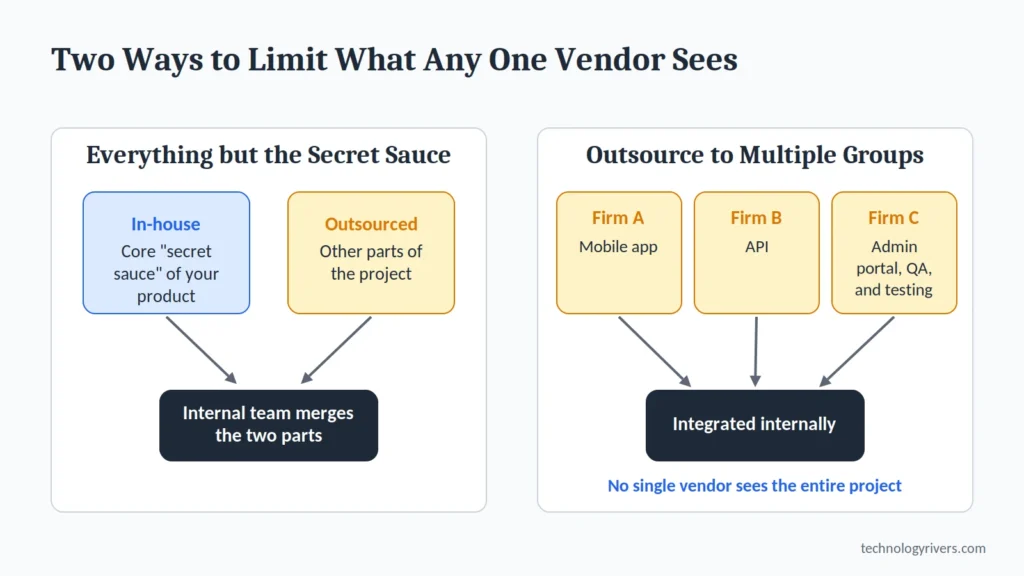
Everything but the Secret Sauce
It is possible to outsource software development without sharing the core “secret sauce” element of your product by only having parts of the project outsourced. The more classified portion can be kept in-house. Once the outsourced portion is complete, an internal team can merge the outsourced and “secret sauce” components.
Outsource to Multiple Groups
Another option is to outsource the work to different companies, thus reducing the number of vendors or individuals who have access to the entire project. For example, you could outsource the mobile app development to one firm, API development to another firm, and the admin portal, QA, and testing to a different group.
This may increase the development cost, but it will enforce the good practice of having all these sub-projects work with some process, and also help cross-validate each other’s work. The parts can be integrated internally once all components are completed, or could be the responsibility of one group. In this way, the risk of the entire project being compromised drops.
3. Examine the Processes of Potential Partners
You must perform your due diligence when assessing potential outsourcing firms. If you want to protect intellectual property when outsourcing, asking the right questions about a partner’s processes is critical.
The questions below are a great place to start.
- What employment agreements do they have with their employees and consultants? (See “Ensure You Have Proper Agreements in Place.”)
- Do they subcontract any of their work? If so, how do they ensure IP protection?
- Do they use the proper tools for project management?
- Where do their servers and source code reside? If something happens in a local office, do they have a backup support system in place?
- How does their team communicate, and how are documents shared among the team members?
- How do they ensure data and documents are removed from the possession of employees who leave or are terminated?
- Do they allow people to use personal tools or email, or do they only allow company-authorized resources to be used? (See “Always Have Transition in Mind.”)
- What is their security policy for laptops and internet access?
- Do they have processes in place for employees who are working remotely?
- Which AI coding tools does their team use, and do those tools store or train on your code?
For reference, here’s what day-to-day security looks like on our projects: tenant isolation at the database level, role checks on sensitive actions, audit logs, secrets kept out of code, confirmed vendor BAAs, and, for regulated work, a pre-launch security audit.
Conduct research up front to ensure you’ll be working with a high-quality company that has the proper processes in place. The right processes are what will ultimately protect your work and information.
Want to see how we keep your code and cloud accounts in your name? Walk through our development process.
4. Always Have Transition in Mind
The work produced by an outsourcing firm should be yours, and your contract (covered in the next section) is what makes it so. Just because receiving this final product happens at the end of a project does not mean companies should only think of this transfer at the end of a project (which is often what happens). Working through the entire project with this end-transition in mind is a practical way to protect intellectual property when outsourcing.
For all of our custom software development projects at Technology Rivers, we deploy all the applications to client-provided servers and accounts. In the case of cloud deployments, we deploy to client-owned AWS or Google Cloud accounts. All the source code is stored on Bitbucket, GitHub, or GitLab as per client preference.
We also enforce daily commits, and every repository is shared with the client from the start. Code and accounts stay with the client from day one, so if an engagement ever ends, there is nothing to recover and no one to chase. The client already holds everything.
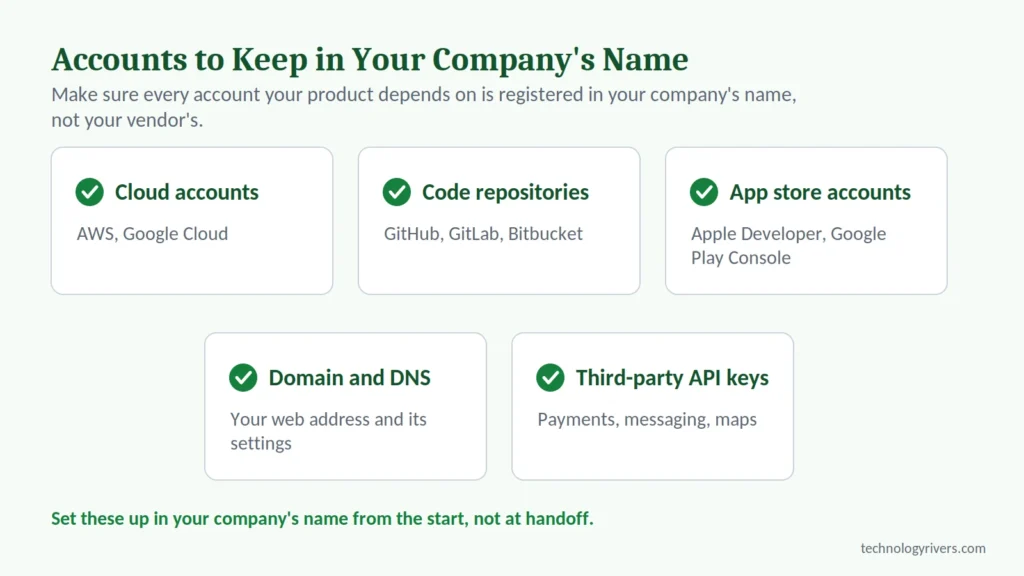
Servers and code repositories are only part of the picture. Make sure every account your product depends on is registered in your company’s name, not your vendor’s. That includes your Apple Developer and Google Play Console accounts, your domain and DNS settings, and the API keys for third-party services like payments, messaging, or maps. On Apple’s App Store, moving a published app to a new developer account must be started by the current account holder and accepted by the receiving one. If your vendor holds the account, moving your own app depends on their cooperation.
Over the years, we have seen numerous cases where vendors refused to provide access to source code and servers once they realized the client was moving to another firm, or when a dispute came up. It is possible to avoid these problems by having up-front discussions and processes in place.
Here’s what that looks like in practice. Besides the case we mentioned at the start, we’ve seen a vendor give the client access to the code but not the deployed version, so we had to rebuild it. In other cases, vendors handed everything back only after a long negotiation, sometimes over unpaid dues or terms specific to their contracts. Whether or not the previous developer cooperates, bringing a project back is painful and takes time and effort.
It shouldn’t take days once the work is complete to get everything from your outsourcing partner. Transition should not be a separate step at all, but rather built into the process on your end. You do not want to pay for deployment on vendor servers and then later move to your own servers. Make deployments on your own servers from the start. Make sure communications happen on your email system, or use a communication platform like Slack to which you can control access.
Many non-disclosure agreements (which we cover in the next section) stipulate that all confidential information be destroyed at the end of the project. But it’s not uncommon for the outsourcing firm to be contacted months after the project has ended because there is some piece of information the client does not have. Make sure you have all of the information all of the time by keeping transition in mind from the beginning and throughout the project. That’s why every Technology Rivers project carries a written guide covering its structure, how to run it, conventions, and key decisions. It lives in the repository, so it’s the first thing a new team member reads and part of what the client gets at handoff. System design and architecture documents are kept in a shared project Google Drive.
5. Ensure You Have Proper Agreements in Place
You have chosen an outsourcing firm whom you trust, and you’ve set up a process with which you’re comfortable, but you still need some legal help to make sure you, your intellectual property, and your company are fully protected and end up with what you set out to attain. A comprehensive contract between you and your partner is one of the most reliable ways to protect intellectual property when outsourcing. Below are some of the necessary components you will likely want to include in this contract.
After rescuing dozens of healthcare software projects, here are the contract and IP risks we’ve seen non-technical leaders miss:
- Vague statements of work that don’t define deliverables clearly
- No clarity on who owns the code and IP when the engagement ends
- No change control process
Transfer of Intellectual Property
In the United States, software development is covered by copyright law. This means the author of the code owns the copyright, and when developers write code as employees within the scope of their jobs, the author is their employer: the outsourcing firm. It makes sense that the author owns what they create, but when you’re outsourcing your software development, in the end, you need the code and the software itself to be yours.
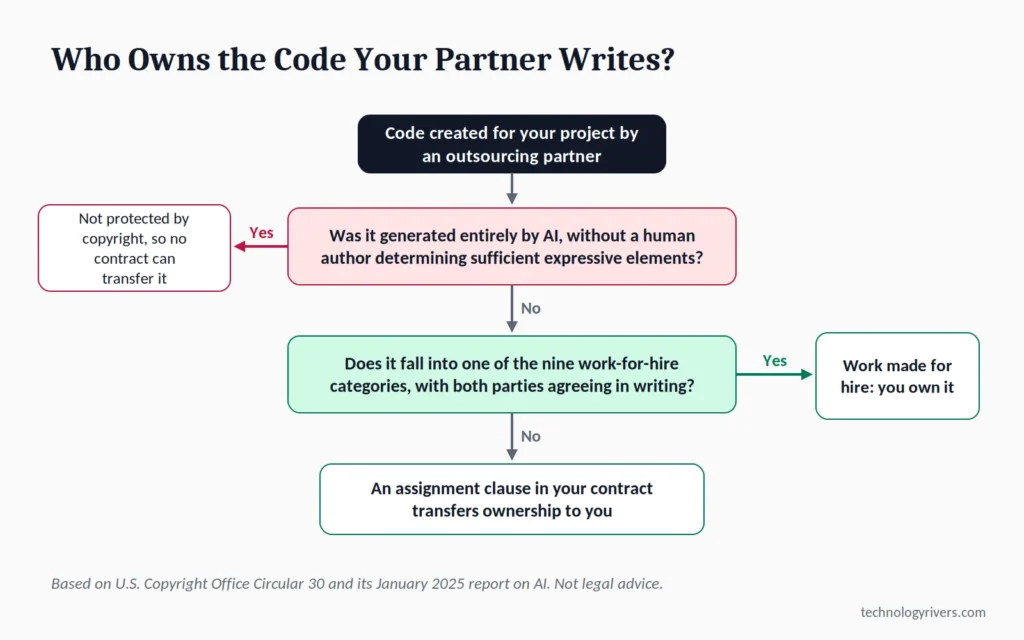
Your contract should label the work as “work made for hire” and also include an assignment clause that transfers ownership to you for anything that doesn’t qualify as work made for hire under copyright law. Under the Copyright Act, work commissioned from an outside firm counts as work made for hire only if it falls into one of nine specific categories and both parties agree in writing. If it doesn’t qualify, the assignment clause is what transfers ownership. Together, these give you ownership of the code, designs, wireframes, documentation, and diagrams created under the contract.
AI-Generated Code and AI Assets
If your partner uses AI coding tools, that changes the ownership picture. In January 2025, the U.S. Copyright Office concluded that material generated entirely by AI, including output created from prompts alone, is not protected by copyright. Work can still be protected where a human author has determined sufficient expressive elements. In practice, this means a work-made-for-hire clause can only transfer rights that exist. Ask your partner which AI tools they use, how developers review and revise AI output, and whether those tools keep or train on your code. Then put the answers in the contract.
Here’s how we answer those questions at Technology Rivers:
- We use AI coding assistants only on paid business or enterprise tiers, never free consumer versions, so client code isn’t used to train the model.
- For code that works with or near PHI, we use only BAA-eligible tools.
- Developers never intentionally include credentials, API keys, passwords, production database data, PHI, PII, or other sensitive client information in AI prompts.
- AI-generated code is never treated as production-ready on its own. The developer stays responsible for understanding it, reviewing it, testing it, and checking it for security issues, and it goes through our normal pull request and code review process before it’s merged.
If your product includes AI features, your contract should also spell out who owns the AI-specific assets: the prompts and system instructions, the data used to fine-tune or train models, any trained models, and the outputs your product generates.
Non-Disclosure Agreement
Non-disclosure agreements (NDAs) should be signed by the company itself as well as by individual employees working on the software. This is what helps ensure that your great app idea does not get shared with anybody and remains a secret until you decide to reveal it to the world. At Technology Rivers, we sign NDAs whenever a project calls for one.
Joinder Agreement
You have an agreement with the outsourcing firm, but it is important to have some agreements directly with the individuals who are working on a project to ensure those individuals can be held accountable directly by you for any violation. A joinder agreement is what puts responsibility not just on the firm, but on their individual employees as well.
Alternatively, a joinder can be used when an agreement will likely have additional parties in the future, but those parties have not been determined when the contract is signed. The original agreement can require that any subcontractor has to sign a joinder to the original contract stipulating that they will also be subject to all of its terms and conditions.
Non-Compete Agreement
A non-compete agreement is meant to keep individuals who worked on your project from competing with you for an agreed-upon amount of time.
Enforceability depends on where those individuals live and work. A federal rule that would have banned most non-competes was blocked by a court in 2024 and abandoned by the FTC in 2025, so state law now controls. California, Minnesota, North Dakota, and Oklahoma ban most non-competes, and many other states restrict them. Ask your attorney whether a non-compete, a non-solicitation clause, or a strong NDA is the better tool for your situation.
6. Choose a Partner You Can Trust
Trust for an outsourcing partner might be something that has to develop over a period of time. We have witnessed this over and over during our work with different clients for several years. In a few cases, when we began working with them, our tasks were project-based. We developed specific portions of what was needed, like designing app functionality or a customer-service portal. As we have developed a trusted relationship with these clients, we have been invited to work with them on their core product engineering. We now are a trusted partner for most of their software development needs, because our ongoing relationship has given them confidence and trust in our integrity and ability.
That’s how our work with Konvergent grew from one vertical into three.
Worth remembering: the cheapest bid is almost never the cheapest outcome.
Do your research and make sure you are hiring a firm you can trust. Speaking with several potential choices will give you a better idea of how different companies approach projects and partnerships. Ask each firm up front how its development process will help you protect intellectual property when outsourcing, from your first idea to the final product. Choosing a company that will handle your software development is an important choice. Take some time to make sure you are choosing the right partner.
Other Issues to Consider
There are a few other issues regarding software development of which you should be aware before outsourcing the development of your project.
Pre-Existing Work
The code that your software contains is not all original code. Using only original code to develop new software would be akin to reinventing the wheel every time a car is built. There will be code in your software that comes from third parties, including open-source software. Copyright for this code cannot be assigned to you, and you need to be sure your new software operates within the terms of the license for the third-party code.
Be sure your outsourcing firm gives you a complete list of all of the software packages that were used in creating your software. In addition, they should provide a warranty stating that they have not infringed on a third party’s intellectual property by using it in your software. Finally, the contract should include an indemnity clause that gives monetary protection for any actions taken against you for use of the third-party software.
Pay particular attention to copyleft licenses, such as the GPL. If you distribute software that includes or is derived from GPL-licensed code, the license requires you to make the source code available under the same terms. Ask your partner to deliver a software bill of materials (SBOM) at handoff, listing every open-source component and its license. AI coding tools add a related risk. GitHub reports that Copilot suggestions match public code in less than 1% of cases and offers a setting to block those suggestions, so if your partner uses Copilot, ask whether that setting is on.
Healthcare Projects and PHI
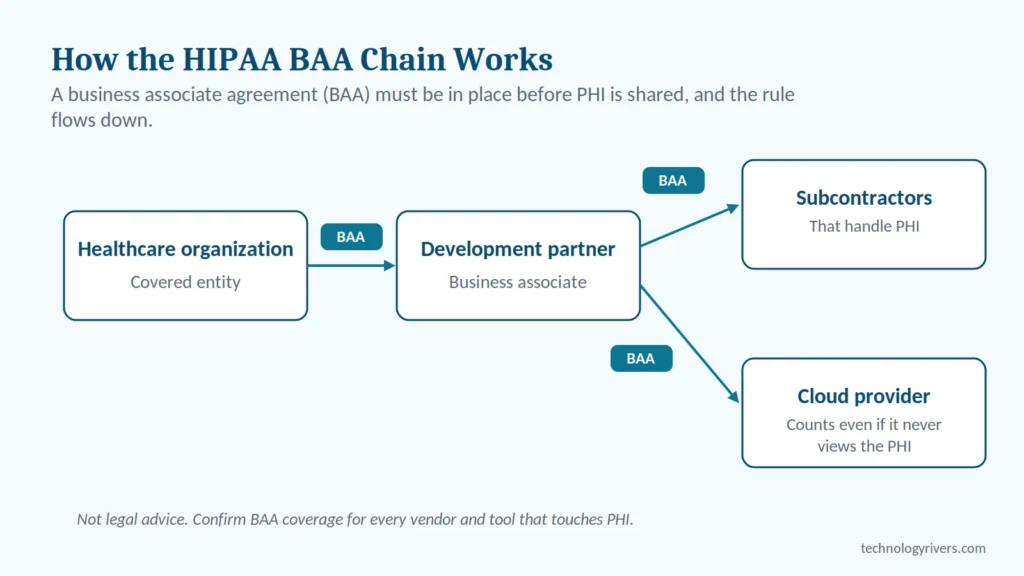
If your development partner will create, receive, maintain, or transmit protected health information (PHI) on behalf of a covered entity or another business associate, HIPAA treats them as a business associate, and a business associate agreement (BAA) must be in place before PHI is shared. The rule flows down: subcontractors that handle PHI are business associates too, and a cloud provider that stores PHI counts even if it never views the data. A practical safeguard is to keep real patient data out of development and test environments entirely and use synthetic or de-identified data until the product is ready for production.
The most common misconception we hear from healthtech leaders is “We will handle HIPAA at the end.” There is no such thing. Compliance has to be built into the architecture from day one, because retrofitting it later is expensive, slow, and often incomplete.
Everyday tools are involved too. Standard tiers of tools like Slack, Google Workspace, Mailchimp, HubSpot, and Intercom are generally not HIPAA compliant out of the box and often require HIPAA-enabled plans, proper configuration, and signed BAAs. The same goes for AI. If patient data flows through an AI model or third-party AI API, that vendor must be HIPAA-eligible and must sign a BAA, and many AI platforms offer HIPAA-eligible tiers that are not the default.
Before development begins, ask your partner: Can you give me a full inventory of every third-party tool in our stack that touches PHI, and show me the signed BAA for each one?
Laws in Other Countries
What has been outlined here concerns the laws and regulations in the United States. If you choose to outsource software development overseas (or at least across national borders), you need to look into how IP rights are handled there. It’s even worth hiring an attorney from the home country of the company with whom you’re working.
Also, just because there is a law in place in another country does not mean that it is easily enforced. Relying on laws should actually be the last resort. Your process and the outsourcing firm’s process should do the bulk of the work toward reducing risk and providing protection.
At Technology Rivers, every employee is under an NDA that covers client IP, and our team works on company devices.
Protect Your Idea Before You Share It
By understanding intellectual property and how it is handled under the law, you’ll have a better idea of what you should do to protect your own. By thoroughly vetting potential partners, understanding their process and your own, and knowing how contracts can protect your work and ideas, you can hire with confidence. In the end, trust matters, but it should be backed by process and contracts. Don’t let fear or confusion regarding intellectual property rights stop you from creating the next big thing.
Checklist: How to Protect Intellectual Property When Outsourcing
- Decide which parts of the product stay in-house before you share anything.
- Vet your partner’s security, offboarding, and AI tool policies.
- Register servers, repositories, app store accounts, domains, and API keys in your company’s name from day one.
- Sign an NDA before sharing your idea, and include joinder terms for individual team members.
- Make sure your contract includes work-for-hire language plus an assignment clause, and covers AI-generated code and AI assets.
- Ask for a software bill of materials (SBOM) at handoff.
- Put a BAA in place before any vendor touches PHI.
- Have your attorney review every agreement before signing.
The world of software technology is competitive. If you think you have the next best app, communication platform, or remote-monitoring system, it can be hard to know who you can trust to help you make it a reality.
Are you considering outsourcing your next digital project, and looking for a trusted partner that can solve your software development needs? Contact us today to learn more about our process, and how we can create a successful partnership for your venture.
Please note: This post is not meant to serve as formal legal advice. It is always a good idea to work with your legal professional for your software contract needs.