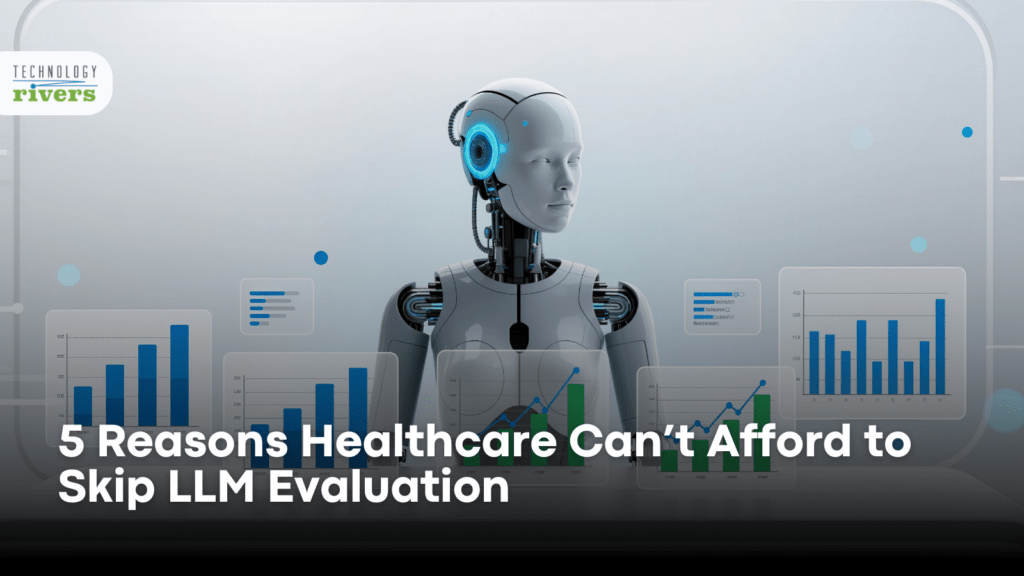
Large Language Models have quietly become part of everyday healthcare operations. They’re summarizing patient encounters, drafting clinical notes, answering patient questions, and handling administrative tasks that once consumed hours of manual work. Walk into any health system’s IT department today, and you’ll likely hear conversations about GPT-4, Claude, or specialized medical models being piloted somewhere in the organization.
The technology feels almost magical at times. A model can read through pages of clinical notes and produce a coherent summary in seconds. It can draft a prior authorization letter that sounds professional and complete. It can answer patient questions with remarkable fluency and apparent knowledge.
But here’s the uncomfortable truth that keeps healthcare leaders up at night: these models can also fabricate medication dosages, introduce subtle factual errors, generate inconsistent recommendations, and miss critical clinical context. And they do all of this with the same confident, fluent tone they use when they’re being accurate.
In consumer technology, we’ve learned to tolerate these quirks. If a chatbot gives you a weird restaurant recommendation or makes up a fact about a movie, it’s annoying but not dangerous. In healthcare, the stakes are fundamentally different. A hallucinated drug interaction, a misstated diagnosis, or a patient instruction written at an inaccessible reading level can have real consequences for real people.
1. The Problem with “It Looks Good to Me”
Over the past year, I’ve talked with dozens of healthcare organizations about how they’re evaluating LLMs before deployment. The process often follows a familiar pattern: someone runs a few test cases, clinicians review the outputs, and if things generally “feel right,” the model moves forward. Maybe there’s a small pilot with manual review of every output. Maybe a few subject matter experts spot-check results for a week or two.
This informal approach made sense when LLMs were purely experimental. But now these models are moving into production systems, real EHRs, actual patient-facing applications, and live clinical workflows. And suddenly, “it looks good to me” isn’t a sufficient safety standard anymore.
Think about what can slip through without systematic measurement. A discharge summary that subtly misstates a diagnosis. A patient education document written at a tenth-grade reading level when half your patient population reads at sixth grade or below. A prior authorization letter that contradicts the supporting clinical documentation in ways that aren’t immediately obvious. A symptom checker that gives different quality responses depending on whether you mention you’re male or female.
None of these are dramatic, obvious failures. They’re subtle erosions of quality that accumulate over time. And without rigorous measurement, you won’t catch them until they’ve already affected patient care, operational efficiency, or regulatory compliance.
2. What Healthcare-Grade Evaluation Actually Looks Like
Evaluating LLMs for healthcare isn’t like testing a consumer chatbot. The domain demands a fundamentally different approach, one that measures multiple dimensions of model behavior simultaneously.
First, there’s clinical accuracy and hallucination detection. Healthcare simply cannot tolerate confident fabrications. When a model generates text, you need to know whether it’s introducing contradictions with source material, inventing entities that don’t exist in the original context, or making up numerical values. This requires systematic checks, not just reading the output and seeing if it “sounds right.”
Then there’s semantic fidelity. When models summarize or rephrase clinical information, are they actually preserving the medical meaning? Or are subtle shifts in language introducing clinical ambiguity that could affect interpretation? A summary might sound fluent and professional while completely missing the clinical significance of certain findings.
Readability matters more than most people realize. Healthcare already struggles with health literacy challenges across patient populations. If your LLM is generating patient instructions, discharge summaries, or educational materials, you need quantifiable measures of reading level and clarity. A beautifully written explanation that your patients can’t understand is worse than useless. It creates the illusion of communication while leaving people confused.
Consistency and reliability are equally critical. Clinical workflows demand predictable behavior. If a model generates wildly different outputs for similar inputs, it creates operational chaos. Clinicians lose trust. Processes break down. Quality becomes impossible to maintain. You need to measure whether the model behaves consistently enough for production use.
And then there’s bias and safety. Healthcare serves incredibly diverse populations, and models can inadvertently provide different quality responses across demographic groups. Without systematic evaluation, you won’t know if your LLM is giving better medication explanations to some patients than others, or if it’s more likely to recommend follow-up care for certain age groups or genders.
Finally, all of this needs to work at scale. Manual review doesn’t scale when you’re processing thousands of clinical notes daily. Healthcare organizations need automated, batch evaluation capabilities that can assess model performance systematically without requiring human review of every single output.
3. When the Industry Hit a Wall
Something shifted in healthcare AI conversations over the past six months. Organizations that initially deployed LLMs with light testing started encountering the real limitations of subjective assessment.
Clinicians within the same organization disagreed about what constituted “good enough” output. Model quality varied unpredictably as vendors released updates. Regulatory and compliance conversations stalled because organizations couldn’t demonstrate measurable safety standards. Trying to compare different models or fine-tuned versions became guesswork without standardized metrics. And when quality issues did surface, teams had no systematic way to diagnose what went wrong or measure whether fixes actually helped.
I saw this frustration firsthand while working with healthcare teams trying to deploy LLMs responsibly. They knew they needed better evaluation approaches, but the existing options weren’t quite right. Academic research frameworks required ML expertise that clinical informatics teams didn’t have. Enterprise MLOps tools weren’t designed for healthcare-specific concerns like hallucination detection or medical readability. And building custom evaluation pipelines from scratch meant months of engineering work before you could even begin assessing models.
That gap between what healthcare needed and what was practically available became the motivation for building something different. Something that healthcare informaticists, clinical operations teams, and AI governance committees could actually use without needing to become machine learning experts. Something that brought together the specific dimensions that matter for healthcare evaluation into a single, accessible framework.
That work eventually became the LLM Eval Toolkit, an open-source evaluation framework specifically designed for healthcare contexts. It combines clinical hallucination detection, semantic similarity measures, readability scoring, bias checks, and batch processing capabilities into a practical tool that teams can integrate into their workflows.
The goal wasn’t to create the perfect evaluation solution. The goal was to make rigorous, multi-dimensional evaluation accessible to healthcare organizations that want to deploy LLMs responsibly but don’t have unlimited resources to build custom evaluation infrastructure.
4. What Changes When Evaluation Becomes Standard
When healthcare organizations move from informal assessment to structured evaluation practices, several things become possible that weren’t before.
Pre-deployment safety validation becomes systematic rather than subjective. Teams can quantify hallucination risk, measure consistency, and assess readability before models touch production systems. This doesn’t eliminate risk entirely, but it makes risks visible and manageable rather than hidden.
Vendor comparisons move from marketing claims to objective data. Instead of choosing between models based on whose demo was more impressive, organizations can compare performance across standardized metrics that matter for their specific use cases. This changes procurement conversations in fundamental ways.
Continuous monitoring becomes feasible. As models are updated or fine-tuned, automated evaluation can detect performance regression before it affects patient care. This is essential in an environment where model providers are constantly releasing updates, and you need to know if those updates help or hurt your specific applications.
Regulatory and compliance conversations get easier. When governance committees or regulators ask “How do you know this model is safe?”, having documented evaluation methodology and quantified results provides answers that “we had clinicians review some outputs” simply doesn’t. This documentation creates audit trails that satisfy compliance requirements.
And perhaps most importantly, improvement becomes targeted rather than blind. When you have metrics that pinpoint where models fail, you can focus interventions effectively rather than just hoping retraining helps.
Large Language Models are already shaping how healthcare organizations summarize clinical notes, communicate with patients, and automate administrative workflows. But as adoption accelerates, so do the risks. In this session, we break down why LLM evaluation is no longer optional in healthcare and what happens when models are deployed without rigorous oversight. From hallucinations and clinical inaccuracies to readability gaps, bias, and compliance exposure, this webinar explains the real-world risks teams are encountering and how structured evaluation creates safer, more trustworthy AI systems. If you are building or deploying AI in regulated healthcare environments, this is a must-watch conversation.
Watch the full webinar recording below.
5. Building Trust Through Transparency
LLMs represent genuine opportunities for healthcare. They can reduce the documentation burden that’s driving clinician burnout. They can improve access to medical information for patients and providers. They can make administrative processes less painful. They can support clinical decision-making when used appropriately.
But realizing that opportunity requires trust. And trust in AI systems isn’t built on capabilities alone, it’s built on transparency, measurement, and accountability.
Patients need to trust that AI-generated communications are accurate and understandable. Clinicians need to trust that AI-assisted documentation preserves clinical meaning. Administrators need to trust that AI-supported workflows maintain quality at scale. Regulators need to trust that organizations have systematic approaches to safety.
None of that trust emerges from impressive demos or confident assertions. It emerges from being able to demonstrate, with quantifiable evidence, that you understand your models’ limitations and have systematic approaches to managing them.
That’s what rigorous evaluation provides. Not perfection, but visibility into where and how models fail, so those failures can be anticipated, mitigated, and monitored rather than discovered through adverse events.
Healthcare deserves AI systems we can verify, not just admire. Systems whose behavior we can measure, whose risks we can quantify, whose improvements we can track objectively. And the foundation for all of that is evaluation infrastructure that makes model behavior transparent rather than opaque.
The technology is here. The use cases are clear. What’s needed now is the discipline to measure systematically before we deploy widely. Because in healthcare, “move fast and break things” has never been acceptable, and it never will be.
The path forward is clear: measure what matters, make limitations visible, and build trust through demonstrated safety rather than assumed capability. That’s how healthcare AI moves from promising experiment to reliable tool. And evaluation is where it starts.
Conclusion
As healthcare organizations move from experimenting with LLMs to deploying them inside real clinical and operational workflows, the margin for error disappears.
This is where Technology Rivers helps teams bridge the gap between promising AI and production-ready, compliant systems.
We collaborate with healthcare leaders to design, evaluate, and deploy AI solutions that prioritize safety, reliability, workflow alignment, and regulatory compliance from the outset. Whether you are assessing model risk, embedding AI into EHR-connected workflows, or building healthcare-grade evaluation and governance frameworks, our team brings deep experience across healthcare software, AI-driven development, and compliance-focused architecture.
If you are looking to deploy AI responsibly and at scale, contact us to discuss how Technology Rivers can support your next phase of healthcare AI innovation.