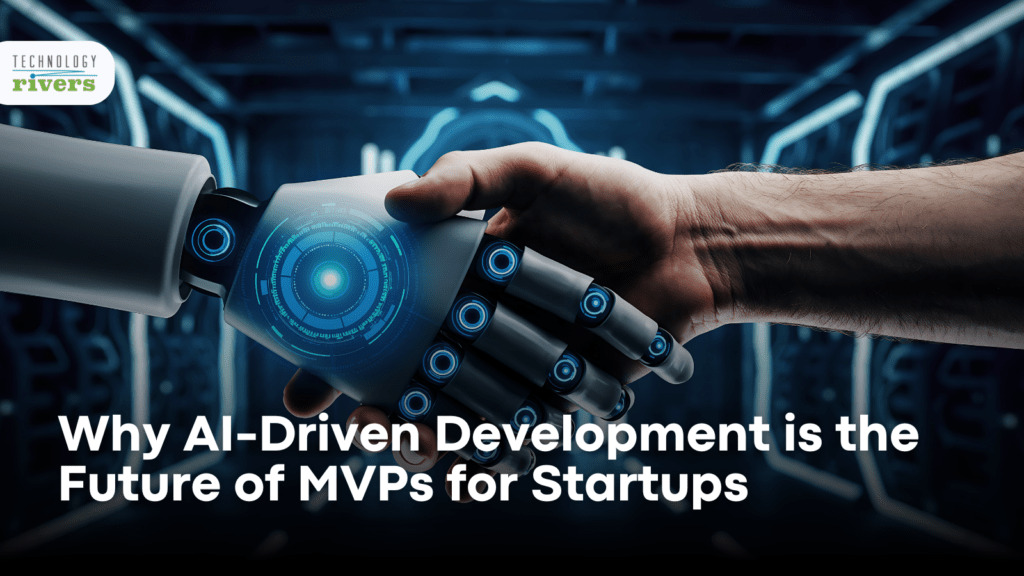
The New Hiring Math: Why AI-Driven Development Changes Everything for MVPs
The startup playbook used to be simple, raise money, hire engineers, and build products because more engineers meant faster shipping. Headcount was a proxy for velocity.
But right now, that math no longer works.
A 3-person team using AI-driven development now ships what took a 10-person team in 2021. The startups figuring this out are staying lean, extending runway, and reaching product-market fit before competitors finish their fourth hiring round.
Why the Old Hiring Model Broke
Traditional MVP development scaled linearly with headcount. When there’s a need to move faster, you hire two more engineers. If you need a mobile app alongside the web app, you hire specialists, and if there’s a need for better QA, you hire testers.
But this created three problems:
- Burn rate outpaced learning:
Every hire increased monthly costs, but product-market fit doesn’t arrive on a schedule. Startups burned through runway before validating their core assumptions. - Coordination costs compounded:
Adding engineers doesn’t double output, communication overhead, code conflicts, and decision bottlenecks slow teams down. Brooks’s Law (adding people to a late project makes it later) applies to early-stage startups, too. - Hiring itself consumed founder time:
Recruiting, interviewing, and onboarding pulled founders away from customers and product decisions. The process of building the team competed with building the product.
AI-driven development breaks this pattern. The tools that emerged in 2024-2025 (GitHub Copilot, Cursor, Claude, and others) don’t just help engineers code faster. They fundamentally change how much a small team can accomplish.
The New Team Math
Here’s what AI-driven development actually looks like in practice:
- One senior engineer + AI tools = three mid-level engineers without them:
AI handles boilerplate, suggests implementations, catches errors, and generates tests. The senior engineer focuses on architecture, business logic, and code review, the work that actually requires judgment. - One designer + AI tools = a designer plus junior frontend developer:
AI design tools generate components, translate designs to code, and handle responsive layouts. Designers ship functional prototypes, not just mockups. - One product person + AI tools = product person plus research assistant:
AI analyzes competitor products, synthesizes user feedback, and drafts documentation. Product managers spend time on decisions rather than data gathering.
This isn’t about replacing roles, it’s about force multiplication because each person on your team operates at 2–3x their previous capacity for standard tasks, freeing them to focus on the work that actually differentiates your product.
Our Golf Ball Scanning App demonstrates this math, an AI-powered image recognition that would have required a dedicated ML engineer, was shipped with a lean team using modern AI and machine learning development practices.
What This Means for Your Burn Rate
Let’s make this concrete.
A traditional MVP team might include: 2 backend engineers, 2 frontend engineers, 1 designer, 1 QA engineer, 1 product manager. That’s 7 people, and at market rates, you’re looking at $80–120K monthly burn before you’ve paid for infrastructure, tools, or marketing.
An AI-augmented team building the same MVP: 1 senior full-stack engineer, 1 designer who codes, 1 product-focused founder, that’s 3 people. Monthly burn drops to $30–50K.
The runway math shifts dramatically. 12 months of funding support for the lean team vs 5–6 months of the traditional team. More runway means more iterations, more pivots if needed, and more time to find product-market fit.
But this only works if the lean team actually ships at equivalent velocity. That’s where AI-driven development practices, not just AI tools, make the difference. The approach we use for building HIPAA-compliant AI apps shows how to move fast without creating technical debt that slows you down later.

Speed Without Discipline Creates Expensive Problems
AI tools make it easy to generate code, but they don’t automatically make that code good.
The startups failing with AI-driven development treat AI as a shortcut rather than a force multiplier. They ship AI-generated code without review, accumulate technical debt faster than they would have manually, and end up with products that break under real-world usage.
Smart founders use AI to accelerate, not bypass engineering judgment. As we explored in Human-in-the-Loop Healthcare AI, oversight matters. AI-generated code needs human review, architecture decisions need experienced judgment, and edge cases need deliberate handling.
The lean team model works because senior engineers reviewing AI output catch problems that junior engineers writing everything manually would have created anyway. You’re not sacrificing quality, you’re reallocating effort from writing boilerplate to reviewing and refining.
Where the Lean Model Works Best
AI-driven development delivers the biggest team efficiency gains for:
- Data products and dashboards:
AI excels at generating CRUD operations, data transformations, and visualization components. This means a single engineer can build what previously required backend, frontend, and data specialists. - Integration-heavy MVPs:
Connecting APIs, handling authentication flows, and managing data sync involve extensive boilerplate. AI tools handle this faster than manual coding. - Products with standard UI patterns:
Forms, tables, navigation, and authentication screens can now be generated reliably by AI, letting designers and engineers focus on differentiating features. - Regulated industries:
Counterintuitively, lean teams work well in healthcare and fintech when compliance is built into workflows. AI for workflow automation and compliance monitoring shows how AI handles compliance tasks that would otherwise require dedicated headcount.
Our AI-driven development portfolio demonstrates these patterns across shipped products.
Building Your Lean AI-Augmented Team
Whether you’re a founder building in-house or evaluating development partners, here’s how to apply the new math:
- Hire for judgment, not just output:
One senior engineer who can architect systems and review AI-generated code beats three junior engineers producing unreviewed code faster. - Invest in tooling before headcount:
AI coding assistants, design tools, and testing automation cost a fraction of a single hire. Max out tool leverage before adding people. - Build review processes from day one:
Every AI-generated component needs human review. This discipline separates teams that move fast from teams that move fast and break things. - Partner strategically:
You don’t need to hire specialists for every capability. The right custom software development partner brings AI-driven practices without adding to your permanent headcount.
Before you start, download our Ultimate Checklist for Software Development to ensure fundamentals are covered. And review common ways app development goes wrong, AI can amplify these mistakes as easily as it amplifies good practices.
The Takeaway
The founders winning in 2026 aren’t the ones with the biggest teams. They’re the ones who figured out the new math: lean teams plus AI-driven development equals faster iteration, lower burn, and more shots at product-market fit.
You don’t need to hire your way to velocity anymore. You need the right people, the right tools, and the right product strategy.
Ready to build lean? Talk to our team about AI-driven MVP development or explore our AI and machine learning services to see what’s possible.