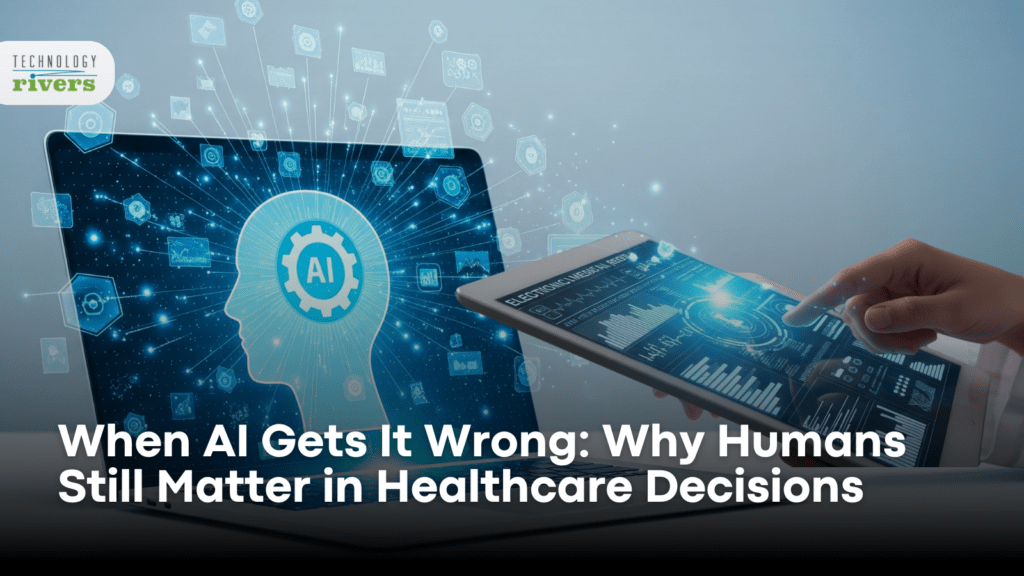
AI Without a Human Strategy
Healthcare organizations face a difficult choice, either to deploy AI agents without clear oversight protocols and risk patient safety or reject AI entirely and fall behind competitors while staff drown in administrative burden.
Most choose a messy middle ground implementing AI tools without defining where humans must remain in control. The result is confusion, inconsistent outcomes, and clinical teams unsure whether to trust the technology or override it.
In a recent webinar on health AI agents, at Technology Rivers, several experts addressed this gap directly. Their consensus was clear and the question isn’t whether healthcare needs human in the loop, but knowing exactly where that loop must remain unbroken.
Why This Problem Is Getting Worse
The pressure to automate is intensifying with staff shortages, data overload, and competitive threats pushing organizations toward rapid AI deployment. But speed without strategy creates compounding risks.
1. Because AI Still Hallucinates
The technology isn’t ready for unsupervised clinical decisions. Ghazenfer Mansoor, CEO of Technology Rivers, was direct about current limitations:
With the current models, we still see a lot of hallucination. So yes, the decisions could be made, but the recommendation is that you still want to have human intervention to review before finally releasing it.
Hallucination in a chatbot is an inconvenience, in a diagnostic tool is a patient safety crisis. Until model reliability improves dramatically, AI human oversight isn’t optional, it’s the only responsible path forward.
2. Some Problems Can’t Be Automated
Data scientist Anna Shahinyan identified scenarios where AI simply cannot function, regardless of how advanced the model:
When the experts disagree, we cannot even train AI models. So in that case, we definitely go ahead with humans only.
She expanded on the technical boundaries: When there’s incomplete and poorly structured data, or in very rare cases, outliers are mostly what we have rather than some typical patterns that we can train AI with.
These aren’t edge cases. Healthcare is filled with ambiguous presentations, rare conditions, and incomplete information. Any deployment strategy that doesn’t account for these realities is setting up for failure.
3. Staff Fear Is Killing Adoption
Even well-designed AI systems fail when clinical teams don’t trust them. Archana Puthran, an AI strategist with deep healthcare experience, named the obstacle directly:
Fear doesn’t just slow adoption. It drives workarounds, selective use, and quiet resistance that undermine the entire implementation. Organizations that ignore the human element find their AI investments delivering a fraction of projected value.
4. Trust Is Difficult to Rebuild
Regulatory specialist Megan Kane emphasized what’s at stake when human-AI collaboration healthcare systems fail:
One visible failure can poison an entire implementation. Clinical teams who witness AI errors without proper human safeguards become permanent skeptics, regardless of how much the technology improves afterward.
The Strategic Human-in-the-Loop Design
Effective HITL in medical AI isn’t about adding human review to every step, that defeats the purpose of automation. It’s about identifying precisely where human judgment adds irreplaceable value and designing systems that channel decisions accordingly.
1. The Decision Framework
Archana Puthran offered a clear model for matching solutions to scenarios:
When you have to make a decision of yes or no, zero one, white or black, or those kinds of deterministic, rule-based decision making that is traditional automation. For complex reasoning, autonomous decision making, orchestration across various domains within the healthcare ecosystem go with agents.
Then she identified where humans become essential: The most important is the human in the loop. I would assign the most high risk, ambiguous input, and complex situations that require empathy and judgment to human in the loop.
This framework transforms abstract discussions about AI decision support into concrete implementation guidance. Rule-based tasks get automated. Complex reasoning goes to agents. High-stakes judgment stays with humans.
Watch the panel break down this framework in the webinar clips on our Youtube channel.
2. Where Human Oversight Remains Non-Negotiable
The webinar panel identified specific scenarios requiring human in the loop healthcare protocols:
The AI handles information gathering and synthesis. The human makes the call that affects the patient’s life.
- Ambiguous presentations: When symptoms don’t fit clean patterns, when test results conflict, when patient history complicates standard protocols, these situations demand human clinical reasoning. AI can flag anomalies and suggest possibilities, but the synthesis of incomplete information into a care decision requires human judgment.
- Rare conditions and outliers: Anna’s point about training data matters here. AI models learn from patterns, but medicine regularly presents cases that fall outside those patterns. Human expertise fills the gap between what models have seen and what patients actually present.
- Emotionally sensitive interactions. Delivering difficult diagnoses, navigating family dynamics, supporting patients through fear and uncertainty, these moments require empathy that no model can replicate. AI can prepare clinicians with relevant information, but the human connection must remain human.
- Governance and accountability. Megan Kane’s governance framework placed humans at every critical decision point: clinical operations, legal compliance, IT security, and data science perspectives must converge for major decisions. No AI system should operate without human accountability structures surrounding it.
For organizations building these systems, Technology Rivers provides healthcare software development that embeds appropriate human oversight into the architecture from the start.
3. Empowerment, Not Replacement
The most effective implementations reframe AI’s role entirely rather than replacing human workers, AI handles the tasks humans shouldn’t be spending time on freeing clinical staff for the work that actually requires their expertise.
Archana described the mindset shift required: Assign and elevate the human to do the work they’re designed to do: being human, resolving judgment, empathy, high risk, complex, and ambiguous situations where they can make decisions that an AI agent can’t. That culture helps the organization grow humans and technology together.
This reframing addresses staff fear directly and when clinicians see AI eliminating documentation burden rather than eliminating jobs, resistance transforms into advocacy.
Ghazenfer reinforced this from implementation experience: Once you have one working, you will have a lot more buy-in from your team because now people will see that as productivity, as empowerment, not as a replacement of people. So at the end, it’s the people’s progress.
Human-AI collaboration in healthcare works when both parties contribute their strengths. AI brings speed, consistency, and tireless attention to data. Humans bring judgment, empathy, and the ability to navigate situations no training data anticipated.
4. Practical Implementation
The panel’s advice for organizations building these systems was consistent: start narrow, prove value, expand gradually.
Identify one workflow where AI can reduce burden while humans retain decision authority. Implement it with clear protocols for when and how human review occurs. Measure both efficiency gains and staff confidence only after demonstrating success should organizations expand to additional use cases.
This incremental approach builds the organizational muscle for effective AI human oversight. Teams learn when to trust AI outputs and when to question them, protocols get refined based on real experience rather than theoretical assumptions.
Organizations exploring AI and machine learning implementation should prioritize this learning curve over speed to deployment. The organizations that rush end up rebuilding; the organizations that learn end up leading.

Moving Forward
Human in the loop healthcare isn’t a limitation on AI’s potential, it’s the foundation that makes AI deployment responsible. The question was never whether to include human oversight, but where that oversight adds genuine value versus unnecessary friction.
The framework is clear: automate the deterministic, delegate the complex, and preserve human judgment for the high-stakes and ambiguous. Build systems that empower clinical staff rather than threaten them. Start narrow, prove value, and expand from a position of demonstrated success.
Healthcare AI that ignores these principles will continue to underdeliver and erode trust. Healthcare AI that embraces strategic human oversight will transform care delivery while keeping patients safe.
For organizations ready to build AI systems with appropriate human oversight designed in, the Technology Rivers team works with healthcare companies to map workflows, identify the right balance of automation and human judgment, and implement solutions that clinical teams actually trust.
Download the HIPAA compliance checklist to ensure your implementation meets regulatory requirements from the start.