Fixing broken SaaS projects does not always require a full rebuild. In many cases, the faster and more cost-effective path is a structured recovery plan that combines code and architecture audits, workflow fixes, and app stabilization with AI-driven SaaS development to reduce rework and restore momentum. That approach is often more practical than starting over, especially when parts of the product still work and the real problem is weak execution, technical debt, or poor delivery discipline.
For founders, CTOs, and product leaders, fixing broken SaaS projects usually starts with one hard truth: the visible issue is rarely the root issue. Missed deadlines, unstable releases, and rising development costs often point to deeper problems like unclear requirements, shallow QA, weak ownership, and architecture that no longer supports the product roadmap. That is why strong SaaS project recovery work is not about writing more code as fast as possible. It is about understanding what can be saved, what must be fixed, and where AI for software development can remove friction without creating new risk.
When done well, that turns a stalled product into a controlled SaaS product turnaround instead of a longer, more expensive failure.
What a broken SaaS project really looks like
Broken SaaS products rarely collapse in one dramatic moment. Most fail gradually. A sprint slips, then another. A patch fixes one issue but creates two more. The backlog grows, yet confidence in delivery drops. Developers avoid touching critical modules because no one fully understands them. Stakeholders keep hearing that the team is “almost there,” but releases remain unstable.
This is the point where rescuing failed SaaS becomes a business priority, not just an engineering concern. The cost is not limited to late releases. It shows up in customer frustration, slower onboarding, weaker retention, mounting vendor spend, and leadership time wasted managing avoidable chaos.
The early warning signs are usually easy to spot:
- Missed milestones that keep getting re-explained
- Recurring production bugs
- Poor or missing automated tests
- Incomplete documentation
- Fragile integrations
- Unclear technical ownership
- Rising development costs without reliable progress

Why fixing broken SaaS projects gets harder over time
The longer teams wait, the more expensive recovery becomes. Every rushed workaround adds hidden cost to future releases. Every undocumented change slows onboarding. Every unstable deployment reduces trust inside the team and outside the business. That is why fixing broken SaaS projects should begin as soon as patterns of instability appear, not after months of compounding delays.
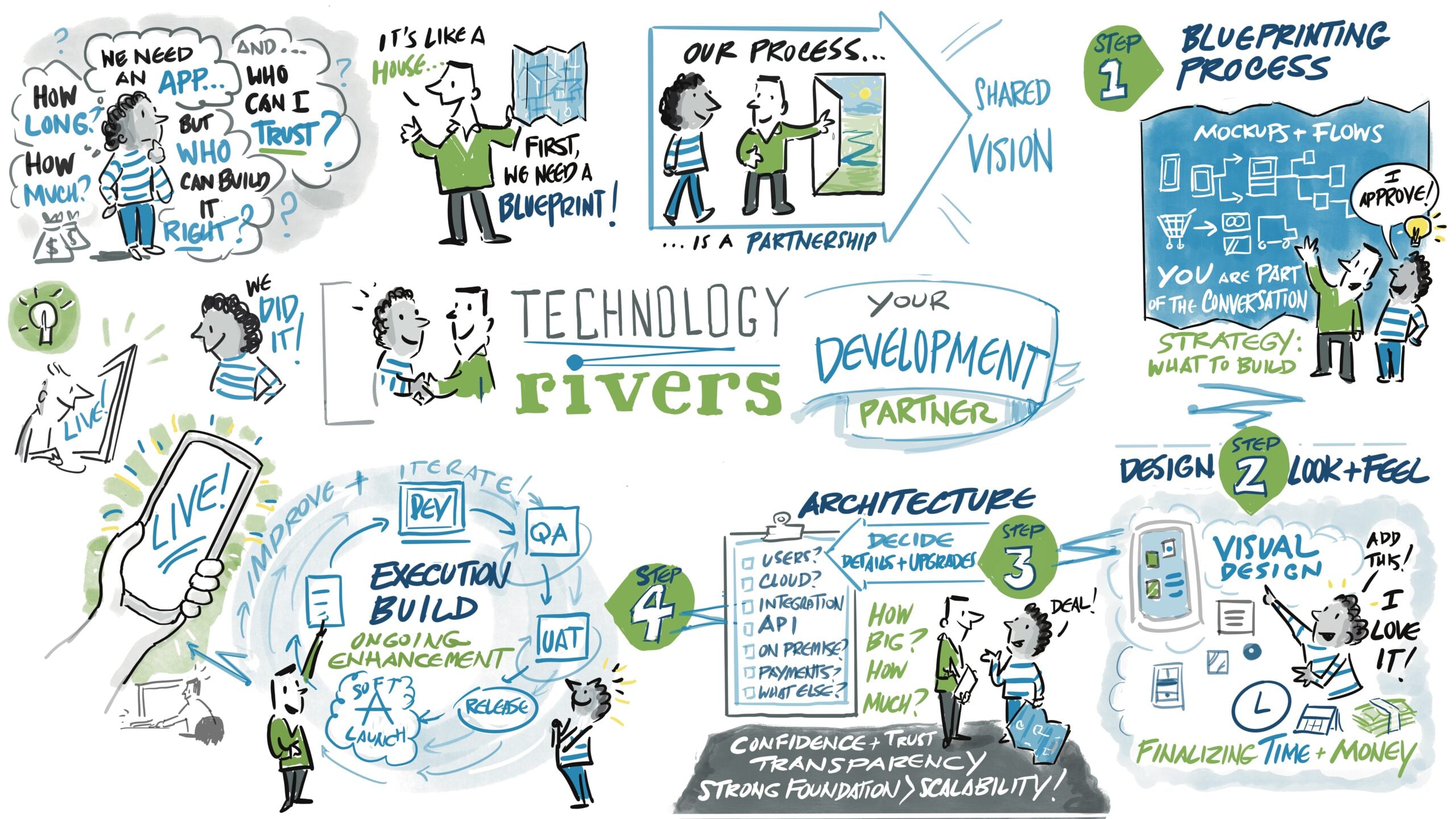
Technology Rivers frames this well in its guide to fixing broken software projects, where the focus is diagnosing the real problem first, building a transparent roadmap, resetting communication, and rebuilding delivery confidence step by step. Technology Rivers’ product development process reinforces that successful delivery depends on structured iterations, QA alongside development, and post-launch improvement, not rushed coding alone.
Leaders also need realistic expectations about schedule pressure. Technology Rivers’ guide on how long it takes to develop an app is useful here because it explains how complexity, integrations, and development stages can stretch timelines from weeks to months. That matters during SaaS project recovery because unrealistic timelines are often part of what breaks delivery in the first place.
Why SaaS projects break in the first place
Most broken SaaS products do not fail because the idea was wrong. They fail because execution becomes fragmented.
One common cause is unclear requirements. When product goals, user needs, and technical constraints are not aligned early, the team starts shipping activity instead of value. Features get built, but they do not solve the right problem or fit cleanly into the rest of the platform. That disconnect creates rework, confusion, and rising cost.
Another cause is weak technical leadership. A project can look productive on the surface while its architecture gets more brittle underneath. Teams keep adding features to a shaky foundation, which makes each new release slower and riskier than the last. By the time leadership realizes the problem, the codebase may already be hard to scale, hard to test, and hard to hand over.
The third cause is process debt. Teams often talk about technical debt, but process debt can be just as damaging. Vague acceptance criteria, inconsistent QA, poor sprint planning, weak release discipline, and bad communication can destabilize even a decent codebase. This is why Technology Rivers emphasizes its workflow and process automation services that improve how people, systems, and decisions move across the business.
For a broader view of these failure patterns, Technology Rivers also offers the eBook Top 8 Ways App Development Goes Wrong & How to Get Back on Track. It is a useful supporting resource because it focuses on avoiding common development issues, keeping projects on time and within budget, and maintaining quality and speed.
Why rebuilding from scratch is usually the most expensive option
A full rebuild sounds appealing because it promises a clean slate. In reality, it often means paying twice for the same learning. Teams must recreate business logic, rebuild integrations, rewrite tests, document old edge cases, retrain users, and manage migration risk, all while delaying time to value.
A better question is this: what is still worth saving?
In many cases, some parts of the system are healthy enough to keep. The data model may still be sound. Customer workflows may still be valid. Certain integrations may still work. A smart SaaS project recovery effort separates salvageable components from the parts that truly need refactoring or replacement. That is the difference between a practical recovery plan and an emotional reaction to frustration.
This is also where fixing broken SaaS projects becomes more strategic than reactive. The goal is not to defend every old decision. The goal is to preserve value where it exists and stop funding the parts of the platform that only create drag.
How AI-driven SaaS development helps rescue a troubled product
The strongest case for AI-driven SaaS development is not that it replaces engineers. It is that it helps experienced teams understand messy systems faster and handle repetitive work more efficiently.
In troubled codebases, the biggest time sink is often not new feature development. It is figuring out what already exists, how modules connect, where dependencies break, and what can be changed safely. This is where AI for software development can help by speeding up code summarization, documentation drafts, dependency mapping, bug clustering, and test scaffolding.
That matters because rescuing failed SaaS products usually involves a lot of expensive context switching. Engineers are reading unfamiliar code, chasing production issues, rebuilding missing documentation, and trying to stabilize releases at the same time. AI can compress the manual parts of that work and give senior engineers more time for architecture, prioritization, QA standards, and customer-impact decisions.
Still, AI only helps when the workflow around it is sound. If requirements are vague, ownership is unclear, and release discipline is weak, AI will not create order on its own. It can accelerate effort, but it cannot replace judgment.
That is why Technology Rivers’ perspective on AI-powered automation and operational efficiency keeps tying automation back to process design and business outcomes.
Need to stabilize a broken SaaS product before costs climb further?
If your team is dealing with unstable releases, unclear ownership, and rising technical debt, Technology Rivers can help you assess what is worth saving, where AI can speed up recovery, and how to rebuild delivery confidence without jumping straight to a full rewrite.
You can explore their approach to fixing broken software projects, review their workflow and process automation services, or see Technology Rivers’ product development process to understand how troubled products move back into a stable release cycle.
A practical framework for fixing broken SaaS projects
The best recovery plans are methodical. They reduce uncertainty before they add velocity.
1. Diagnose before you decide
Start with a real audit. Review code quality, architecture, integrations, release pipelines, documentation, QA coverage, and operational bottlenecks. You cannot choose between stabilization, refactoring, or rebuilding until you know what the system actually looks like.
2. Separate salvageable systems from risky ones
Do not treat the whole platform as a single decision. Break the product into parts. Which services are stable? Which flows are hurting customer experience? Which integrations are brittle? Which modules create most of the delivery drag? This is where SaaS project recovery becomes concrete.
3. Reset communication and ownership
In many broken projects, poor communication is part of the failure pattern. Stakeholders need clear priorities, realistic timelines, visible risks, and defined ownership across product, design, engineering, and QA. Without that reset, the team simply repeats the same mistakes with a new roadmap.
4. Use AI where it cuts repetitive work
This is the right place for AI-driven SaaS development. Use it to speed up code understanding, documentation, regression test generation, defect triage, and backlog cleanup. Those are valuable tasks, but they are not the same as making architecture decisions or setting product direction.
5. Stabilize first, then expand
The fastest route to a true SaaS product turnaround is often counterintuitive. Add fewer features first. Stabilize performance, testing, deployments, and core workflows. Once the platform is predictable again, growth work becomes safer and cheaper.
Where AI for software development saves the most time and cost
In recovery work, the best ROI usually comes from a few specific use cases.
- Codebase understanding. AI can help engineers get oriented faster in unfamiliar modules, especially after a poor vendor handoff.
- Documentation. Broken projects often have missing or outdated technical context. AI can help produce draft documentation that humans refine and approve.
- Test generation. Many failing products suffer from weak regression coverage. AI can accelerate draft unit and integration tests so teams can strengthen QA faster.
This aligns well with Technology Rivers’ guidance on top software project failures and how to fix them, which emphasizes structured discovery, clearer planning, and AI-assisted acceleration in the right places.
- Bug triage. When multiple defects point back to the same root issue, AI can help cluster them more quickly and reduce wasted triage time.
- Backlog cleanup. Recovery teams often inherit vague tickets, duplicate requests, and partially defined features. AI can help organize and summarize that backlog so the team can prioritize real impact.
These gains matter because fixing broken SaaS projects is often slowed less by coding speed and more by confusion, inconsistency, and manual cleanup.
When AI will not save a broken SaaS project
AI will not rescue a product with no strategy. It will not fix stakeholder conflict. It will not make bad architecture suddenly scalable. It will not replace release discipline, security reviews, or strong engineering judgment. If ownership is broken and priorities are unclear, AI simply helps the team move faster in the wrong direction.
That is why the most credible message for rescuing failed SaaS is a balanced one. AI is valuable, but only inside a strong recovery process. The companies that get real results are the ones that diagnose carefully, fix workflows, restore trust, and then use AI to compress repetitive work.
A SaaS product turnaround example from Technology Rivers
Technology Rivers’ portfolio shows why fixing broken SaaS projects takes more than quick bug fixes. For example, the WorkDrive collaboration platform case study describes a SaaS workspace built for organizations with multiple locations, branches, and sub-organizations. The platform includes messaging and collaboration, social networking, events and calendaring, a knowledge base, task management, training and onboarding, and AI-based customer service support. That kind of product complexity is exactly why AI-driven SaaS development works best when it supports strong architecture and disciplined execution, not just faster coding.

Another useful example is the Financial Wellness Platform case study, which involved third-party financial app integrations, an administration dashboard, a custom client dashboard, and a web app for debt consolidation management. It is a strong reference point for SaaS project recovery because it reflects the kind of interconnected product environment where delays, integration issues, and weak technical planning can quickly raise costs.
One testimonial from Technology Rivers fits naturally here: “Building a Software as a Service (SaaS) platform isn’t a straight line.” That is exactly why recovery-stage teams need a partner that can adapt without losing delivery discipline.
Conclusion
Fixing broken SaaS projects is ultimately about restoring control over delivery, cost, and product quality. The smartest path is usually not a rushed rebuild. It is a structured recovery effort that diagnoses the real problems, preserves what still works, repairs what creates drag, and uses AI for software development, where it saves time without sacrificing judgment.
For companies under pressure, that approach provides a faster, more credible path to SaaS project recovery. It turns reactive firefighting into a disciplined execution plan. And when done well, it becomes more than a rescue. It becomes a sustainable SaaS product turnaround.
Ready to fix a broken SaaS project?
A stalled product does not always need a rebuild. In many cases, it needs a clear audit, a smarter recovery plan, and a team that can combine architecture judgment with AI-accelerated execution. Technology Rivers helps companies recover unstable products, reduce delivery friction, and turn complex SaaS platforms into scalable systems built for growth.
If you are evaluating your next step, explore cloud software development services, custom software development services, and the WorkDrive SaaS platform case study.
You can also review the full Technology Rivers services overview or browse the company’s resources page.

FAQs
What does fixing broken SaaS projects usually involve?
Fixing broken SaaS projects usually starts with a code and architecture audit, followed by a realistic recovery roadmap, clearer ownership, stronger QA, and targeted refactoring or stabilization work. The goal is to recover delivery without rebuilding everything unnecessarily.
What is SaaS project recovery?
SaaS project recovery is the process of stabilizing, repairing, and restructuring a delayed or failing SaaS platform so the team can ship reliably again. It often includes technical audits, workflow fixes, release discipline, and selective modernization.
How does AI-driven SaaS development help?
AI-driven SaaS development helps by reducing time spent on repetitive work such as documentation, code understanding, test generation, and issue triage. It is most effective when paired with strong technical leadership and clear delivery processes.
Is rebuilding better than rescuing failed SaaS?
Not always. Rescuing failed SaaS is often cheaper and faster when parts of the product are still valuable. A full rebuild makes more sense only when the current system is structurally blocking the business or cannot be safely maintained.
Can AI for software development replace experienced engineers?
No. AI for software development can accelerate repetitive engineering tasks, but it does not replace architecture decisions, product prioritization, security judgment, or stakeholder alignment.