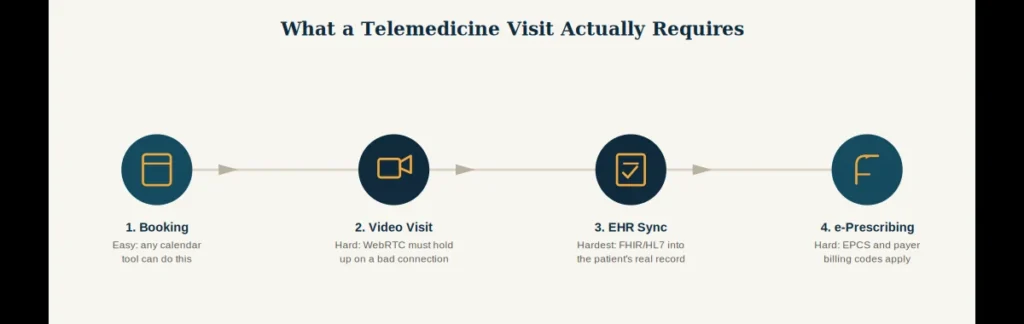
Choosing among telemedicine software development companies is deceptively hard, because the video call is the easy part. The hard part is low-latency WebRTC that holds up on a bad connection, EHR integration so a visit actually lands in the patient record, multi-role workflows for patients, front-desk staff, and clinicians, and a compliance posture that survives a HIPAA audit. Plenty of general app shops can ship a video call. Far fewer can ship a clinical product.
This list focuses on companies with real telemedicine development experience: secure video infrastructure, EHR/EMR integration, e-prescribing, scheduling, and the compliance work virtual care software development demands. The rosters here are deliberately different from the usual names that dominate these rankings, so you get options worth vetting rather than the same five firms every list repeats.
How We Picked These Telemedicine Software Development Companies List
Every company here had to meet two criteria:
- Real telemedicine development experience. Secure video/WebRTC, virtual care workflows, and EHR integration, not just a generic app with a video feature.
- Healthcare compliance depth. Demonstrated HIPAA-compliant telemedicine development, and ideally HL7/FHIR interoperability for connecting to clinical systems.
Not sure your workflows and compliance needs justify a custom build? Get a straight answer before you commit budget. Talk to a telemedicine software team about your specific requirements.
1. Technology Rivers
Technology Rivers is a US-based (Reston, VA) healthcare software company that builds HIPAA-compliant telemedicine platforms through healthcare software development services, covering secure video consultations, scheduling, e-prescribing, patient portals, and EHR/EMR integration. It signs BAAs and specializes in taking early-stage virtual care products from strategy to production. Its therapy coaching app, which delivers HIPAA-compliant live video sessions between patients and certified coaches, reflects the same real-time virtual care work this list is built around, along with other projects that explain the same cloud-integrated EHR work applied to post-op patient monitoring.
Best for: Founders and providers building a custom, compliant telemedicine platform who want compliance handled from the architecture stage.
2. Interexy
Interexy is a Miami-headquartered custom telehealth app development company (with offices in Dubai and Poland) offering end-to-end telemedicine builds and team augmentation for HealthTech, pharma, and fitness clients.
Best for: Teams that want a US-headquartered partner and the option to augment an existing dev team mid-project.
3. Darly Solutions
Darly Solutions delivers custom telehealth software development for video consultations, remote nursing, mental health, and dermatology use cases, with EHR, scheduling, and patient-portal integration for multi-facility health systems.
Best for: Multi-specialty or multi-facility telemedicine builds that need to plug into existing clinical systems.
4. DataArt
DataArt is an experienced telemedicine developer building telehealth modules, EHR systems, and virtual care solutions, with device integration via DICOM and HL7 and AI-based clinical decision support.
Best for: Complex virtual care products needing deep clinical-data-standard and device integration.
5. Topflight
Topflight builds custom telehealth platforms for both startups and hospital systems, with particular depth in FHIR-based EHR integration.
Best for: Telemedicine products where robust FHIR/EHR integration is the core requirement.
6. Riseapps
Riseapps is a healthcare-focused engineering company (ISO 27001/9001 certified) building telemedicine apps, patient portals, and AI clinical modules, with EHR integration across Epic, Cerner, and Athena and published fixed-price packages.
Best for: HealthTech vendors that want deep EHR integration plus predictable, packaged pricing.
7. Uptech
Uptech builds HIPAA-compliant telemedicine platforms designed around clinical workflows, with AI-assisted features, remote diagnostics, and a focus on fast MVP-to-scale delivery.
Best for: Teams that want a market-ready telemedicine MVP built quickly without cutting compliance corners.
8. SumatoSoft
SumatoSoft delivers full-cycle digital health solutions including telehealth and mHealth apps, with strength in healthcare IoT, device-to-cloud integration, and FHIR/HL7/DICOM interoperability.
Best for: Telemedicine products that also need serious IoT and device-integration depth.
9. Overcode
Overcode is a telemedicine app development company building HIPAA-aware platforms for hospitals, private clinics, and digital health startups, with 100+ web and mobile healthcare projects delivered and signed BAAs on healthcare engagements.
Best for: Providers and startups wanting a dedicated telehealth builder for a clinical-grade platform.

How to Choose a Telemedicine Software Development Partner: What to Check Before You Sign
A slick demo call proves little about a production telehealth platform. Before you commit, confirm:
- Business Associate Agreement (BAA): Will they sign one, and does it cover the video/CPaaS provider (Twilio, Vonage), cloud, and every third-party tool?
- Video infrastructure: Ask how they handle video, WebRTC, a CPaaS like Twilio, or custom media servers, and how it performs on poor connections and at scale.
- EHR integration: Confirm they have done FHIR/HL7 integration with the specific EHR your customers use. This is usually the hardest and most expensive part.
- Multi-role workflows: A real telemedicine product has distinct experiences for patients, providers, and admins. Ask to see one they built.
- Reimbursement and e-prescribing: If your customers bill payers, ask whether they understand telehealth billing codes and e-prescribing (EPCS) requirements.
Comparison Table: HIPAA Focus, EHR Integration Depth, Delivery Model
| Company | HIPAA Focus | EHR Integration Depth | Delivery Model |
|---|---|---|---|
| Technology Rivers | Signs BAAs, compliance built in from the architecture stage | EHR/EMR integration, e-prescribing | Full-cycle, US-based team, strategy to production |
| Interexy | HIPAA-compliant platforms | EMR/EHR integration, AI-enhanced | End-to-end builds, with team augmentation option |
| Darly Solutions | Regulation-compliant builds across HIPAA and data privacy standards | FHIR support, EMR/EHR integration | Fast compliant MVPs, 8-12 week timelines |
| DataArt | Compliant telehealth modules | DICOM/HL7 device integration | Global, enterprise-grade delivery |
| Topflight | HIPAA, HITECH, SMART on FHIR | Deep Epic and Cerner SMART-on-FHIR work | Startups through hospital systems |
| Riseapps | HIPAA, GDPR, ISO 27001/9001 certified | Epic, Cerner, Athena integration | Fixed-price packaged pricing |
| Uptech | HIPAA-compliant by design | General clinical workflow integration | Fast MVP-to-scale delivery |
| SumatoSoft | HIPAA, ISO 27001, FHIR/HL7/DICOM | EMR/EHR plus device-to-cloud IoT integration | Full-cycle digital health, IoT-heavy builds |
| Overcode | HIPAA-aware, signed BAAs on healthcare engagements | DICOM, HL7, CCD, FHIR | Dedicated telehealth builds, 100+ projects delivered |
Frequently Asked Questions
How do I vet a telemedicine software development company for HIPAA compliance?
Beyond the signed BAA covered above, request specifics on how PHI and video streams are encrypted as part of their HIPAA-compliant telemedicine development process, and confirm with a reference from another telehealth client rather than relying on a homepage compliance badge.
What does telemedicine software development cost?
Cost scales with scope more than with any single factor: a lean video-and-scheduling MVP sits at one end, and a full build with deep EHR integration, remote monitoring, and e-prescribing sits at the other, often several times the cost. Timelines follow the same pattern, weeks for an MVP, many months for platforms with heavy integration work.
Get itemized quotes from at least three vendors, and treat any quote that skips video infrastructure or EHR integration as a line item with suspicion, that’s usually where the real cost is hiding.
Should I build custom telemedicine software or buy a white-label platform?
White-label gets you live in weeks and fits generic video-and-scheduling needs. It stops working the moment your product needs a specific EHR integration, a non-standard clinical workflow, or IP you can defend to investors, at that point the constraints outweigh the head start.
Do I need FHIR/HL7 support in a telemedicine platform?
If visits need to sync with an EHR or other clinical systems, yes. FHIR is the current interoperability standard, and skipping it usually forces an expensive retrofit later.
Ready to build a telemedicine platform that passes compliance review the first time? Schedule a free consultation with a team that has taken virtual care software development from architecture through HIPAA-compliant launch.