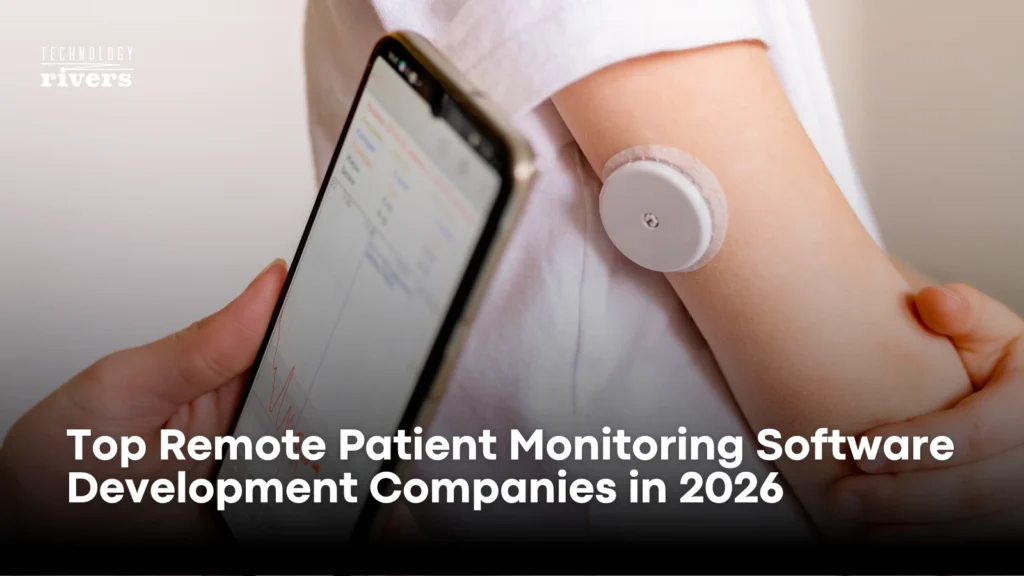
Choosing among remote patient monitoring software development companies means solving a problem most software teams never touch: pulling clean data off a dozen different wearables over Bluetooth and cellular, moving it through an encrypted pipeline without losing readings, writing it back to an EHR over FHIR, and doing all of it in a way that survives a HIPAA audit. A general app shop can build you a nice dashboard and still miss every one of those.
This list focuses on companies with real RPM development experience: device and wearable integration, IoT data pipelines, real-time alerting, and the compliance work that RPM specifically demands. Following are RPM software development companies that build a custom platform for you. They are not RPM product vendors (like Verustat, Glooko, or Cadence) that sell their own monitoring service. If you want to own your platform, you want a development partner.
How We Picked This List
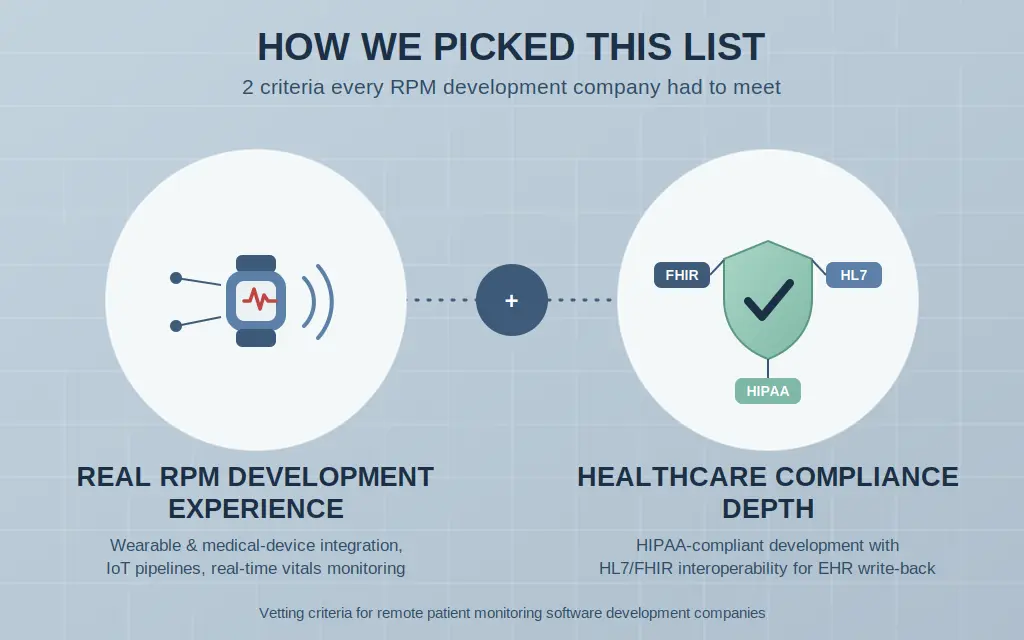
Every company on this list of remote patient monitoring software development companies had to meet two criteria:
- Real RPM development experience. Hands-on work with wearable and medical-device integration, IoT data pipelines, and real-time vitals monitoring, not just generic healthcare apps.
- Healthcare compliance depth. Demonstrated HIPAA-compliant RPM development, and ideally HL7/FHIR interoperability for EHR write-back.
Not sure your device roadmap is realistic yet? Each new wearable family is real engineering work, not a checkbox. Talk to an RPM software team before you scope the build.
1. Technology Rivers
Technology Rivers is a US-based (Reston, VA) healthcare software company that builds HIPAA-compliant remote patient monitoring platforms through healthcare software development services, with work spanning wearable and IoT device integration, real-time vitals dashboards, AI-driven alerting, and EHR/EMR write-back. It signs BAAs and focuses on taking early-stage RPM products from strategy to production. Its remote patient monitoring platform, built for cellular-enabled devices with real-time alerts and provider messaging, reflects the same production-grade approach this list is built around.
Best for: Founders and providers building a custom, compliant RPM platform who want a partner that handles device integration and compliance from the architecture stage.
2. Intellias
Intellias is a global engineering company (HQ in Portugal, offices across Europe and the US) whose healthcare practice builds RPM software with wearable and IoT integration, clinical data mapping to LOINC/SNOMED/FHIR, real-time dashboards, and predictive anomaly detection.
Best for: Teams that need heavy data-engineering and interoperability depth in their RPM build.
3. Altoros
Altoros develops custom RPM software focused on high-throughput, real-time data processing from wearables and IoT devices, with scalable cloud infrastructure built to ingest large volumes of device telemetry.
Best for: RPM platforms expecting large data volumes that need serious backend scalability.
4. Artezio
Artezio builds HIPAA and FHIR-ready RPM and monitoring platforms, including chronic care apps, AI-driven monitoring, and wearable integrations.
Best for: Chronic-care-focused RPM products that need machine-learning-driven monitoring.
5. Acquaint Softtech
Acquaint Softtech provides custom RPM development covering IoT data pipelines, real-time alerting, and HIPAA-compliant cloud infrastructure, positioned as a cost-competitive option for early-stage builds.
Best for: Startups building an RPM MVP on a tighter budget who still need production-grade architecture.
6. KMS Technology
KMS Technology partners with healthcare organizations to build, modernize, and scale RPM and patient-engagement platforms, with an emphasis on clinical-grade reliability.
Best for: Companies that need to stabilize or scale an existing RPM platform, not just start a new one.
7. Vinfotech
Vinfotech builds custom healthcare software including RPM and coordinated-care solutions, with a focus on patient-provider communication, engagement, and secure HIPAA-compliant collaboration.
Best for: RPM products where patient engagement and care-team communication are central features.
8. Fortune Soft IT
Fortune Soft IT has offered HIPAA-compliant RPM development since 2009, with HL7 and FHIR compliance embedded by default, plus AI-driven vitals analysis and EHR/IoT integration.
Best for: Teams that want RPM built with interoperability and compliance baked in from day one.
9. Sigma Software
Sigma Software develops telemedicine and remote care technologies, including custom RPM and remote care platforms, backed by a large global engineering organization.
Best for: RPM builds that may expand into a broader telemedicine platform over time.
How to Choose an RPM Software Development Partner: What to Check Before You Sign
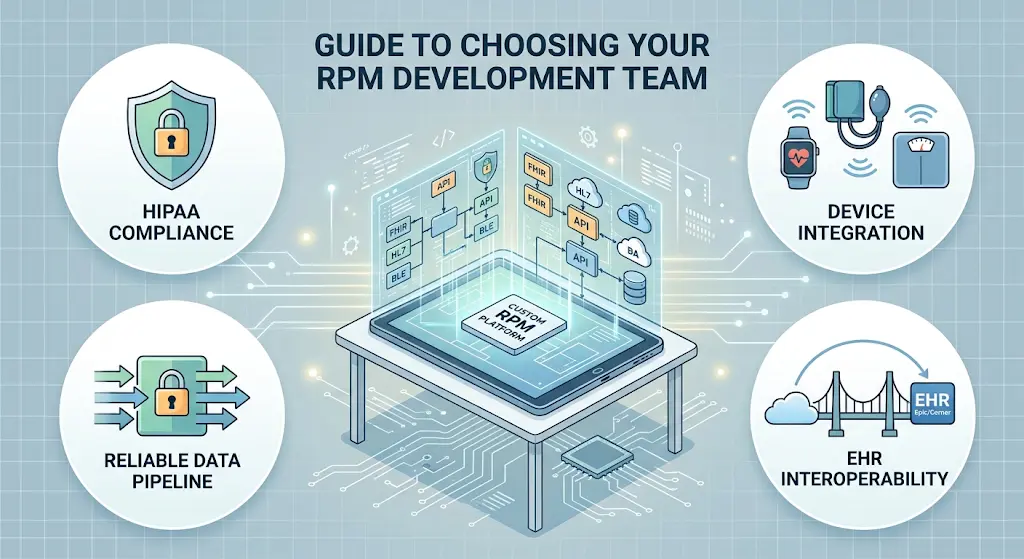
An RPM demo that looks good on one device tells you little about production. Before you commit, confirm:
- Business Associate Agreement (BAA): Will they sign one, and does it cover every cloud service, IoT platform, and third-party tool in the stack?
- Device integration breadth: Ask which specific wearables and medical devices they have integrated before. Each new device family (BLE profile, data normalization) is real engineering effort, not a checkbox.
- Data pipeline reliability: RPM fails quietly when readings drop. Ask how they handle dropped connections, retries, and data integrity under load.
- EHR write-back: If vitals need to land in Epic, Cerner, or Athena, confirm they have done that FHIR integration before, it is often the most expensive part.
- Reimbursement awareness: RPM has specific CPT billing codes, each with its own documentation requirements. A partner who understands reimbursement workflows will build something your customers can actually get paid for.
Comparison Table: HIPAA Focus, Device Integration Depth, Delivery Model
Here is how these remote patient monitoring software development companies compare side by side:
| Company | HIPAA Focus | Device Integration Depth | Delivery Model |
|---|---|---|---|
| Technology Rivers | Signs BAAs, HIPAA compliance from day one | Cellular-enabled devices, real-time alerts | Full-cycle, US-based team, strategy to production |
| Intellias | HIPAA-compliant by design | LOINC/SNOMED/FHIR clinical data mapping | Data-engineering-heavy, global delivery |
| Altoros | HIPAA-aware cloud architecture | Wide wearable/IoT ingestion, AI anomaly detection | High-throughput, large-data-volume builds |
| Artezio | HIPAA-compliant, 20+ years healthcare | Wearable integration, AI/ML diagnostics | Chronic-care-focused, full-cycle builds |
| Acquaint Softtech | HIPAA-compliant cloud infrastructure | IoT data pipelines, real-time alerting | Cost-competitive, 1,300+ projects delivered |
| KMS Technology | HIPAA, HITRUST alignment | Modernizing and scaling existing RPM systems | Onshore leadership, offshore delivery teams |
| Vinfotech | HIPAA-compliant collaboration | Medical device and wearable integration | Engagement-centric, coordinated care focus |
| Fortune Soft IT | HIPAA, HL7, FHIR embedded by default | Fitbit, Apple Health, Garmin, Dexcom integration | Interoperability-first, since 2009 |
| Sigma Software | HIPAA-compliant video and data consults | Remote monitoring within a broader care platform | Large global engineering organization |
Frequently Asked Questions
How do I vet an RPM software development company for HIPAA compliance? Beyond the BAA covered above, request specifics on how device data is encrypted in transit and at rest, and confirm with a reference from another RPM or connected-health client, not just a generic healthcare reference.
What does it cost to hire an RPM software development company? Costs vary widely by device breadth and integration depth. Each additional wearable family and each EHR integration adds meaningful cost and time, so scope those explicitly. Get itemized quotes from at least three vendors and make sure device integration and EHR write-back are line items, not vague inclusions.
What is the difference between an RPM development company and an RPM vendor? As covered above, a development company builds you a custom platform, while a vendor sells you their existing one. The practical trade-off: a vendor gets you live faster, but you’re locked into their feature roadmap and data model. A development partner takes longer up front but the resulting platform, and the differentiation it enables, is yours.
Do I need HL7/FHIR support for an RPM platform? If your RPM data needs to flow into an EHR or other clinical systems, yes. FHIR is the current standard for that exchange, and building without it usually means an expensive retrofit later.
Ready to build an RPM platform that survives a HIPAA audit and scales past the pilot? Schedule a free consultation with a team that has taken remote monitoring products from device integration through production.