Dedicated hosting is a type of web hosting where a server is fully allocated to one business. In a dedicated hosting environment, all the resources, such as CPU, RAM, storage, and bandwidth, are reserved for that single client.
This guide compares the best dedicated hosting providers for businesses, from global cloud platforms to compliance-focused hosts.
Which Dedicated Hosting Provider Is Best for Your Business?
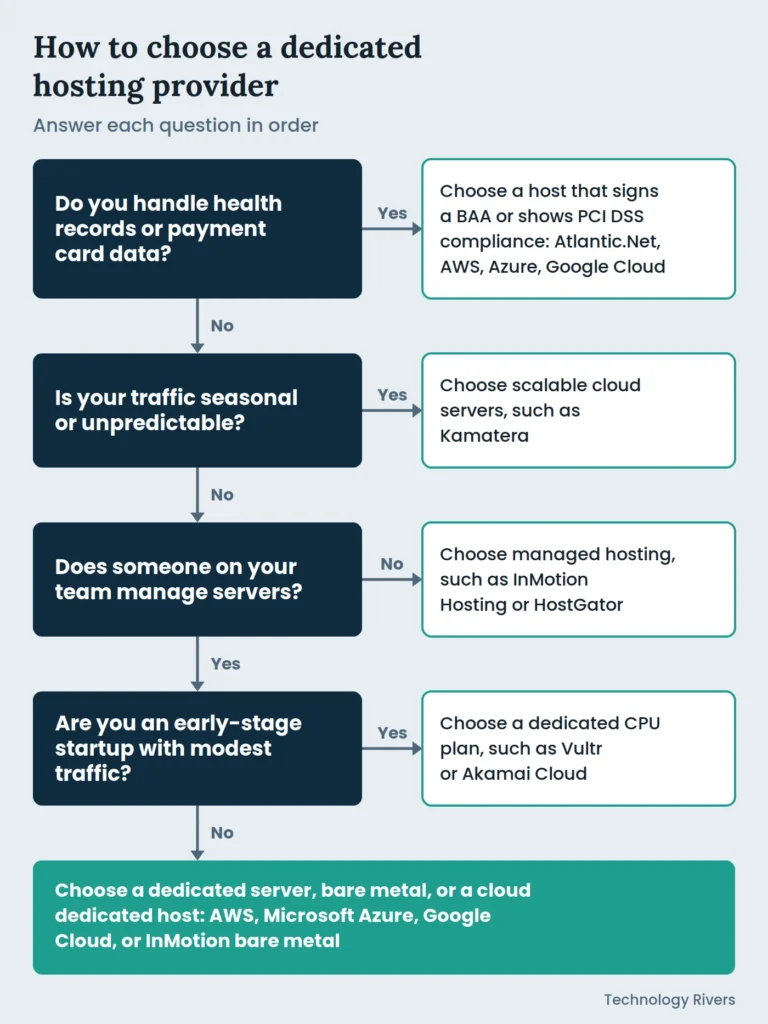
There is no single best option among dedicated hosting providers for businesses; the right choice depends on your workload. If you handle health records or other regulated data, start with HIPAA-compliant options such as Atlantic.Net, AWS, Microsoft Azure, or Google Cloud. Choose Azure for Microsoft-based environments, Google Cloud for AI and data-heavy workloads, and AWS for global SaaS scale. For simpler needs, InMotion Hosting and HostGator suit small business websites, Kamatera fits seasonal traffic, Akamai Cloud (formerly Linode) suits developer environments, and Vultr works well for latency-sensitive apps.
Dedicated Server vs. Bare Metal vs. Dedicated Host vs. Dedicated CPU
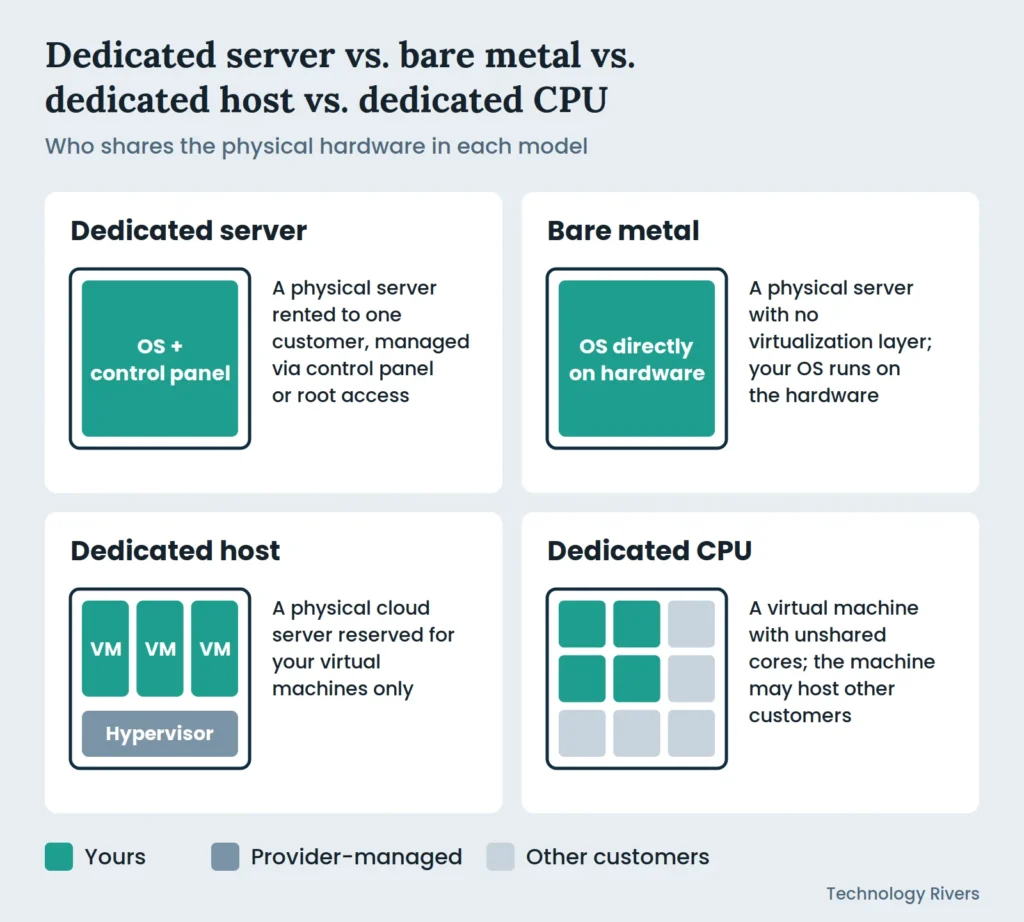
Providers use these terms differently, so it helps to know what you are actually getting:
- Dedicated server: A physical server rented to one customer, usually managed through a control panel or root access.
- Bare metal: A physical server with no virtualization layer, giving you direct access to the hardware.
- Dedicated host or sole-tenant node: A physical server inside a cloud platform that is reserved for your virtual machines only. AWS and Azure call these Dedicated Hosts; Google Cloud calls them sole-tenant nodes.
- Dedicated CPU: A virtual machine with CPU cores that are not shared with other customers, although the physical server may still host other customers’ workloads.

Why Use Dedicated Hosting?
If you are still deciding between cloud and dedicated infrastructure, our guide on
how to choose a cloud hosting provider covers the cloud side of that decision.
Consistent Resource Availability
In dedicated hosting, since all server resources are allocated to a single client, performance remains stable even during periods of heavy traffic.
Enhanced Security
No other organizations share the server, which reduces the risk of cross-tenant breaches and strengthens both data protection and regulatory compliance.
Custom Configuration
Clients have complete control over the server, which enables them to choose operating systems, install specialized software, and fine-tune settings for specific workloads.
High Reliability
Exclusive access to processing power and bandwidth ensures maximum uptime, making it suitable for mission-critical applications.
Ideal for Demanding Applications
Dedicated resources make this hosting option more suitable for high-traffic e-commerce platforms, sensitive enterprise systems, and computationally intensive operations.
Best Dedicated Hosting Providers for Businesses
Below is a brief discussion about the best dedicated hosting providers for businesses. Some offer physical dedicated servers, while others offer dedicated hosts or dedicated-CPU instances on cloud infrastructure.
How we chose these providers: We selected them based on dedicated or single-tenant options, global data center coverage, compliance support, management options, and pricing transparency. Technology Rivers builds and deploys custom software for clients, and you can see examples in the
healthcare and SaaS products we’ve built.
Amazon Web Services (AWS)
AWS provides compute options, such as Dedicated Hosts and bare metal instances, for businesses that require high performance, compliance, and detailed control. Its extensive global infrastructure and wide range of integrated services make it suitable for scalable, multi-region deployments.
Key Features
- EC2 Dedicated Hosts for single-tenant environments with license portability
- Bare metal instances (e.g., C8i, M8i, and R8i metal sizes) offering direct hardware access
- 39 launched AWS Regions and 124 Availability Zones worldwide (as of 10/2026)
- Advanced security: IAM, encryption, compliance frameworks (ISO, SOC, FedRAMP)
- Infrastructure as Code via AWS CloudFormation; Terraform is widely adopted
- Pricing: Hourly On-Demand, with Reserved Instances and Savings Plans offering up to 72% discounts
Use Case
AWS suits SaaS companies with global operations requiring low latency, regulatory compliance, and flexible scaling. For example, a customer engagement platform can deploy across multiple AWS regions to ensure high availability and fast response times while integrating with services like Amazon S3, Lambda, and RDS. For a closer look at how AWS compares with Azure and Google Cloud, see our
AWS vs. Azure vs. Google Cloud comparison for SaaS apps.
Watch out for: You pay for the entire Dedicated Host by the hour, however many instances you run on it, and pricing across AWS services gets complex quickly.
Google Cloud
Google Cloud offers dedicated infrastructure through sole-tenant nodes, giving physical isolation for sensitive workloads. Its high-quality global network ensures low-latency performance, and its built-in AI tools help support scalable innovation.
Key Features
- Sole-tenant nodes for compliance-sensitive deployments
- Premium global network with private fiber backbone
- Managed AI tools: Vertex AI, BigQuery ML, Gemini models
- Distributed Cloud for hybrid and edge use cases
- Enterprise-grade security: IAM, encryption, DDoS protection
- Pricing: Pay-as-you-go with per-second billing; Committed Use Discounts of up to 55% on most machine types and up to 70% on memory-optimized machines with a three-year commitment; Sustained Use Discounts of up to 30% on eligible machine families (as of 10/2026)
Use Case
Google Cloud is a better option for AI startups handling private data and large-scale models. For example, a company developing customer sentiment tools can use sole-tenant nodes for privacy, Vertex AI for deployment, and Spot VMs to reduce training costs.
Watch out for: A sole-tenant node bills for all of its vCPU and memory from the moment you create it, plus a 10% sole-tenancy premium.
Microsoft Azure
Microsoft Azure provides dedicated hosts and hybrid cloud features that work well with the Microsoft ecosystem. It supports enterprise workloads with flexible deployment options, making it suitable for organizations using Windows Server, SQL Server, and Active Directory. Azure’s hybrid tools help businesses extend on-premises infrastructure to the cloud without redesigning legacy applications.
Key Features
- Azure Dedicated Hosts for single-tenant physical server isolation
- Deep integration with Active Directory and Microsoft Entra ID
- Hybrid cloud tools: Azure Arc, Azure Stack, ExpressRoute, and Azure Site Recovery
- Enterprise SLAs with high availability and fault domain control
- Compliance offerings: ISO/IEC 27001, SOC, GDPR, and HIPAA support for in-scope services
- Pricing: Pay-as-you-go and Reserved VM Instances (up to 72% discount)
Use Case
Azure is a good option for financial companies that need hybrid cloud flexibility and Microsoft licensing benefits. For example, a bank can run SQL Server and Windows workloads on Azure Dedicated Hosts, stay compliant, and connect its data center securely using Azure Arc and ExpressRoute.
Watch out for: The deepest discounts require a one- or three-year Reserved VM commitment, and you pay for that capacity even if your needs change.
Atlantic.Net
Atlantic.Net provides dedicated servers and cloud hosting with complete resource isolation to ensure strong performance and security. Its global data centers offer fast connectivity and high uptime. The platform meets rigorous compliance standards and is suitable for regulated industries like healthcare and finance.
Key Features
- HIPAA, HITECH, SOC 2/3, and PCI-DSS compliance
- Up to 128 vCPU, 1 TB RAM, 32 TB NVMe storage (custom builds)
- SSD-backed storage with optional daily backups
- Data centers in multiple U.S. regions and globally
- Encrypted VPN, intrusion detection/prevention, managed firewalls
- 24/7 US-based support with optional managed services
- Pricing: Dedicated servers from $247/month; cloud VPS starts at $8/month (36-month term)
Use Case: Atlantic.Net is ideal for healthcare organizations requiring HIPAA-compliant infrastructure. For instance, a medical billing firm can deploy its software in a secure, audited environment with encrypted VPN, IDS/IPS, with daily backups to ensure data protection and uninterrupted service.
InMotion Hosting
InMotion Hosting offers physical dedicated servers for small and mid-sized businesses, with a choice between managed plans and unmanaged bare metal. Its cPanel-based managed plans make it a practical step up for businesses moving off shared hosting or a VPS.
Key Features
- Managed dedicated servers, with Premier Care plans that include cPanel and Launch Assist onboarding and server setup
- Unmanaged bare metal servers for teams that want full control
- Choice of US and EU data center locations on bare metal plans
- Dedicated server plans from $99.99/month on a 12-month term; Premier Care managed plans from $218.98/month (as of 10/2026)
Use Case
A growing e-commerce business moving off a VPS can choose a managed InMotion server with cPanel, keeping a familiar control panel while InMotion handles server setup.
Watch out for: Bare metal plans are unmanaged, so updates and maintenance fall to your team.
HostGator
HostGator offers affordable dedicated hosting with both Linux and Windows options. It is built for speed and flexibility, making it a practical choice for developers and agencies managing multiple websites.
Key Features
- Up to 32 AMD EPYC CPU cores, 128 GB DDR5 RAM, and 3 TB NVMe storage
- RAID 1 storage for data protection
- DDoS protection and built-in firewall
- cPanel and Plesk support
- Starts at $141.19/month on a 36-month term, renewing at $188.79/month (as of 10/2026)
Use Case
HostGator suits web agencies with high-traffic client sites. For example, an agency can host multiple WordPress or e-commerce sites and manage them easily with cPanel, backed by strong performance and uptime.
Watch out for: There are only three server configurations, and prices rise at renewal.
Kamatera
Kamatera is a flexible cloud hosting provider that lets you customize your server setup, including CPU, RAM, storage, and more. It is easy to scale up or down as needed.
Key Features
- Custom server specs: CPU, RAM, SSD/NVMe storage, bandwidth
- Vertical and horizontal scaling in minutes via the management console
- 25 data centers across North America, Europe, the Middle East, Asia, and Australia (as of 10/2026)
- 99.95% uptime guarantee and Intel Xeon Scalable (Ice Lake) processors
- Hourly and monthly billing with pay-as-you-go pricing
Use Case
Kamatera suits startups with seasonal or bursty workloads. For example, an event ticketing platform can instantly scale up server capacity during peak sales and scale down afterward, avoiding overprovisioning and keeping costs predictable.
Watch out for: These are cloud servers, not physical dedicated servers. Only the dedicated CPU server types keep your CPU threads unshared, and servers are unmanaged unless you add managed service.
Akamai Cloud (formerly Linode)
Akamai Cloud, formerly Linode, is a developer-friendly hosting provider known for its straightforward pricing and reliable performance. It is excellent for teams that want full control and easy automation.
Key Features
- G8 Dedicated CPU plans from 2 to 256 vCPUs and 4 GB to 512 GB RAM
- 99.99% monthly uptime SLA on Dedicated, Shared, and High Memory compute plans
- 25+ core compute regions worldwide
- Tools for automation: REST API, CLI, and Terraform support
- Built-in backups, monitoring, and object storage
- One-click app marketplace for quick deployments
- G8 Dedicated CPU plans start at $0.07/hour for 2 vCPUs and 4 GB RAM (as of 10/2026)
Use Case
Akamai Cloud works well for developers testing APIs or running isolated environments. For example, a small software team can spin up test servers, automate setup with Terraform, and keep costs predictable across regions.
Watch out for: Dedicated CPU plans give you your own CPU cores, not your own physical server.
Vultr
Vultr is a global cloud hosting provider offering dedicated vCPU and bare metal servers with straightforward pricing and firm performance. Its wide network of edge locations makes it ideal for apps that need low latency.
Key Features
- Dedicated vCPU and bare metal servers with full root access
- 33 cloud data center regions across six continents (as of 10/2026)
- Pricing starting at $2.50/month for shared vCPU, $28/month for dedicated CPU, and $120/month for bare metal (as of 10/2026)
- NVMe SSDs and Intel/AMD CPUs for fast performance
- Hourly and monthly billing with no long-term contracts
Use Case
Vultr is suitable for latency-sensitive apps like online gaming. For example, a gaming company can host servers near player hubs to reduce lag and improve responsiveness.
Watch out for: The lowest advertised price is for shared vCPU, so budget from the dedicated CPU or bare metal tiers.
Compliance: What to Check Before You Choose a Host
If your application handles regulated data, compliance should narrow your shortlist before performance or price does.
HIPAA
If you store or process electronic protected health information (ePHI), your hosting provider must sign a Business Associate Agreement (BAA), and patient data must stay inside the services that BAA covers. You still need encryption, access controls, audit logging, and backups configured correctly. To see where patient data can slip outside those controls, read our guide to
developing HIPAA-compliant healthcare software.
PCI DSS
If you process, store, or transmit payment card data, choose a provider that can show PCI DSS compliance for the infrastructure it manages. You remain responsible for securing your own application and configuration.
SOC 2
A SOC 2 report shows that an independent auditor has reviewed a provider’s security controls. Ask for the provider’s current report during vendor review, especially if your own customers will ask you for one.
This section is for general information and is not legal advice. Confirm your compliance requirements with your legal or compliance advisor.
Not sure which host fits your compliance requirements? Talk to our team about the right infrastructure for your application.
Comparison of Dedicated Hosting Providers
| Provider |
Management Model |
Workload Focus |
Pricing Model |
Notable Strengths |
| Atlantic.Net |
Fully managed |
Regulated industries, general apps |
Flat monthly |
Substantial compliance, secure infrastructure |
| AWS |
Self-managed |
Scalable apps, SaaS, and databases |
Usage-based |
Global reach, deep service integration |
| Azure |
Self-managed |
Enterprise workloads, hybrid cloud |
Usage-based |
Microsoft ecosystem, hybrid tools |
| Google Cloud |
Self-managed |
AI, data-heavy workloads |
Usage-based |
AI tools, low-latency global network |
| InMotion Hosting |
Self-managed or managed |
SMB websites, e-commerce |
Flat monthly |
cPanel-based managed plans, bare metal option |
| HostGator |
Managed or semi-managed |
Multi-site hosting, WordPress |
Flat monthly |
Affordable, cPanel/Plesk support |
| Kamatera |
Self-managed |
Seasonal/bursty workloads |
Usage-based |
Flexible scaling, custom specs |
| Akamai Cloud (formerly Linode) |
Self-managed |
Developer environments |
Usage-based |
Straightforward pricing, developer-friendly tools |
| Vultr |
Self-managed |
Low-latency apps, gaming |
Usage-based |
Global edge locations, bare metal options |
Frequently Asked Questions
Should I choose a dedicated server, a VPS, or cloud hosting?
Choose a dedicated server when you need consistent performance, full control over the hardware, or strict data isolation. A VPS works for growing sites and apps with moderate traffic, and you can move to dedicated hosting later as load increases. Cloud hosting fits workloads that rise and fall, because you can scale capacity up or down without changing servers.
What’s the best dedicated server for startups?
It depends on your stage. If you are early and traffic is modest, a dedicated CPU plan from Vultr or Akamai Cloud gives you consistent performance for far less than a physical server, and you can move to bare metal or dedicated hosts as load grows. If your traffic spikes seasonally, Kamatera lets you scale capacity up and down. If your product will handle health data, choose a host that will sign a BAA before you launch.
How does dedicated hosting support compliance-heavy industries like healthcare and finance?
Dedicated hosting keeps your workloads on hardware no other customer shares, which makes data isolation, access control, and audits easier to prove. Healthcare applications that handle ePHI also need a host that signs a Business Associate Agreement, and finance applications that handle payment card data need a provider that can show PCI DSS compliance for its infrastructure. Dedicated hardware supports compliance, but your configuration and processes still determine whether you meet the requirements.
Do I need a dedicated server for HIPAA compliance?
No. HIPAA does not require dedicated hardware. It requires administrative, physical, and technical safeguards for electronic protected health information (ePHI), plus a signed Business Associate Agreement (BAA) with any hosting provider that stores or processes it.
Should I choose managed or unmanaged dedicated hosting?
Choose managed hosting if you do not have an in-house team to handle patching, monitoring, backups, and security updates. Choose unmanaged hosting if your team has the skills and time to run the server and wants full control over its configuration.
What affects the cost of a dedicated server?
Cost depends on the hardware configuration, the level of management, the data center location, the contract term, and add-ons such as backups, monitoring, and compliance support. Regulated workloads usually cost more because they need features like encrypted backups and audit logging.
The Bottom Line
Dedicated hosting is a reliable choice for businesses that require stable performance, strong security, and complete control over infrastructure. Choosing among the best dedicated hosting providers for businesses comes down to compliance requirements, scalability, cost, and ease of management.
Sectors with strict regulatory needs can benefit from providers such as Atlantic.Net, which offers robust compliance support, predictable cost structures, and strong customer service.
At Technology Rivers, we help businesses design and deploy
secure, scalable, and compliant hosting environments tailored to their needs. Whether you’re building a healthcare app, SaaS platform, or enterprise solution, we focus on uptime, performance, and data protection from the start.
Ready to discuss the right hosting strategy for your organization? Contact our team.