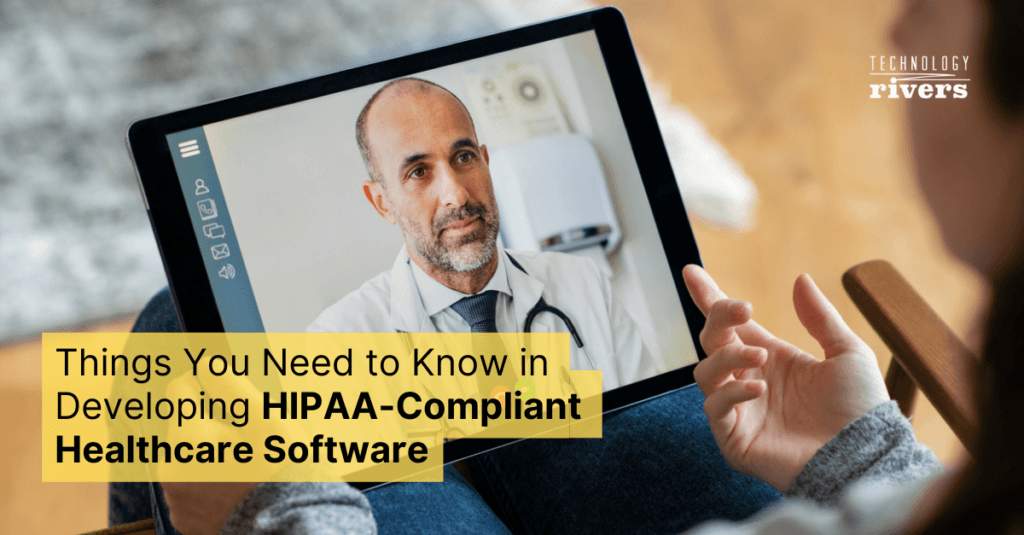

Blogs » Things You Need to Know in Developing HIPAA-Compliant Healthcare Software
Despite massive technological and digital transformations in industries across the globe, healthcare is still finding its footing, especially for those venturing into developing HIPAA-compliant healthcare software. Digital record adoption is one of the clearest signs of how much further the industry still has to go: only around 5% of US hospitals have reached Stage 7, the highest tier of the HIMSS Electronic Medical Record Adoption Model (EMRAM), out of roughly 6,000 hospitals nationwide.
That gap isn’t a technology problem. According to McKinsey, the largest barrier to healthcare’s digital transformation isn’t technology, cost, or implementation, it’s governance, the structures and accountability that decide how software actually gets built, approved, and maintained inside a hospital system. Creating a spectacular healthcare app that drives innovation requires besting that governance challenge before the technology itself becomes the easy part.
The Current Healthcare Software Space
Healthcare apps come in all shapes and sizes, and the pressure to digitize accelerated sharply during the COVID-19 pandemic. While usage has settled well below its pandemic peak, telehealth has become a permanent part of how care gets delivered. From Oracle Health’s CareAware Connect (the platform formerly branded under Cerner, which Oracle acquired in 2022) to MyChart Mobile, which allows patients to access past care history, apps are disrupting the healthcare experience in the best kind of way. Telehealth adoption in particular illustrates just how permanent this shift has become:
- Telehealth made up just 9% of patient interactions before the pandemic.
- Usage spiked past 50% at the height of the pandemic in 2020, then declined as care returned in person.
- As of 2026, telehealth has settled into a steady 6% to 7% of primary care visits, though roughly a third of US adults will use it at least once this year.
- Mental health remains the exception: over half of patients with a telehealth claim in early 2026 were seeking mental health care.
We’re not talking about just patient-facing apps, either. Digital tools and automation are a growing part of how healthcare organizations catch preventable harm before it happens: research estimates that 28% to 71% of adverse drug events are preventable in the first place, and digital pharmacovigilance systems are increasingly used to flag risky drug interactions earlier.
Additionally, there’s a growing number of physicians looking at how they could provide remote services to their patients. Indeed, the scale and variety of such software are staggering, and workflow automation, patient care assistance, digital records management software, and triage assistance platforms are all starting to mature in the market alongside it. Of course, building HIPAA-compliant healthcare software means complying with standards and law, and the regulatory landscape of healthcare is anything but small.

The Regulatory Landscape Surrounding Healthcare Software
Building best-in-class healthcare solutions requires careful adherence to a seemingly never-ending wave of healthcare regulations. These include massive compliance laws like The Health Insurance Portability and Accountability Act (HIPAA).
To put it simply, HIPAA compliance isn’t something you can accomplish after a cup of coffee and a “Become HIPAA Compliant” course.
It is a broad, complex, and expansive standard that’s built into virtually every layer of healthcare applications, and HIPAA regulations grow in complexity regularly.
Some companies simply spend their time adhering to the HIPAA Security Rule (technical safeguards, physical safeguards, and so on).
That’s a good start, but it’s only one part of HIPAA’s overall requirements.
If you want to build robust, compliant software, you need to invest in specialists who deeply understand HIPAA requirements and protected health information.
HIPAA violations carry real financial consequences, not because HHS wants to make an example of anyone, but because the enforcement structure is designed to reward organizations that treat compliance as part of the build process rather than something bolted on after the fact. HHS applies graduated penalty tiers based on culpability, from unintentional gaps that get corrected quickly to willful neglect that never gets addressed at all.
The gap between those tiers is the whole point: the system is set up to separate organizations that are actively trying to do right by patient data from those that aren’t. In addition, healthcare apps must comply with The Health Information Technology for Economic and Clinical Health Act (HITECH Act).
Along with incentives to use electronic health records (EHR), HITECH contains various software, cybersecurity, and communication requirements (as well as breach notification rules) that must be met.
Again, these rules get granular, so it’s best to work with professionals who understand the nuanced nature of HITECH.
But that’s just the beginning. All of the following currently have (or are being repurposed to contain) guidelines surrounding protected health information, data security, and data privacy, as part of the broader digital health regulations landscape:
- The Patient Protection and Affordable Care Act (ACA), which expanded HIPAA’s administrative simplification rules, adding requirements like standardized electronic transactions and unique health plan identifiers
- The Medicare Access and CHIP Reauthorization Act of 2015 (MACRA), which ties Medicare reimbursement to reporting on quality measures through certified health IT
- The Food and Drug Administration Safety and Innovation Act (FDASIA), which established the risk-based framework FDA uses to decide how closely a given health IT function, including mobile medical apps, gets regulated
- The 21st Century Cures Act
These aren’t interchangeable checkboxes, and they don’t all regulate the same thing. HIPAA and HITECH govern how you protect health data. FDA oversight is a separate, function-dependent question: if your software crosses from simply organizing or displaying patient information into clinical decision support, recommending a specific diagnosis, treatment, or drug based on patient data, FDA’s Clinical Decision Support Software guidance determines whether that function is regulated as a medical device at all. The 21st Century Cures Act created this carve-out: some CDS functions are excluded from the device definition, others aren’t, and which side of that line your software falls on affects premarket review requirements, not just data handling.
So, how do you possibly create HIPAA-compliant healthcare software in this sea of regulation?
Navigating HIPAA, HITECH, and Beyond Doesn’t Have to Slow You Down
The practical takeaway: figure out early which of these actually apply to your specific product, HIPAA and HITECH for data handling, FDA for certain software functions, rather than discovering it mid-build. The list above isn’t exhaustive, and it keeps growing, but you don’t have to map it alone.

Designing HIPAA-Compliant Healthcare Software
Healthcare providers should pay attention to a few core features when designing health-centric applications and should future-proof these solutions against shifting digital health regulations by using regulatory-agnostic frameworks. Going above and beyond current requirements means your architecture is easier to adapt as regulations shift, rather than needing to be rebuilt every time a new requirement lands. Here are three areas founders should address when designing healthcare software.
Data Privacy
In today’s digital ecosystem, data privacy is one of the most critical components of building a successful application. Here are a few notable stats:
- 53% of consumers say they will not purchase from an organization they don’t trust with their data.
- 73% of Americans feel they have little or no control over how companies use their personal data, down from 81% in 2019.
- 144 countries now have data protection or privacy laws in force, covering roughly 82% of the world’s population.
In short, data privacy is the glue that builds patient trust. When it comes to app design, your goal is to be clear, consistent, and restricted by:
- Collecting as little data as necessary
- Being transparent with data collection routines
- Performing regular risk analysis and risk management
- Using existing regulatory guidelines to shape data collection methods
- Having plans in place to mitigate data privacy friction
Data Security
Healthcare data breaches now average $6.64 million per incident, making healthcare the costliest industry for data breaches for the 13th year in a row. It’s not too surprising that data security consistently ranks among the top concerns for healthcare organizations. When it comes to data security and electronic protected health information (ePHI), don’t just follow guidelines, build in healthcare data security best practices from the start.
Aim beyond the minimum. A serious breach is costly and disruptive to recover from, which is exactly why security works better as an architecture decision made early than as a response bolted on after an incident.
HIPAA and HITECH have very clear and precise rules for your post-breach reaction.
HIPAA’s omnibus rule requires you to do post-breach risk assessments.
HIPAA’s security rules exist to help address security gaps before they become breaches.

Your app should be built on a foundation of healthcare data security best practices that goes beyond basics like access controls to prevent unauthorized access, encryption of data at rest and in transit, audit controls, and administrative safeguards.
User Experience and User Interface
While UX/UI may seem unrelated to compliance, it ties directly into how users access, use, and interact with your application, as well as how it may affect compliance. The stakes are concrete: Kaiser Foundation Health Plan reported a breach affecting 13.4 million individuals to HHS in 2024 after tracking technologies embedded in its websites and apps transmitted member data to third-party vendors, not through a backend hack or stolen credentials. Most compliance scans check backend systems and miss what happens inside the browser or app interface itself, which is exactly why interface-level decisions belong in a compliance conversation.
The user interface for HIPAA-compliant healthcare software should be limited to absolute necessity. Caching PHI locally in the browser, common in JavaScript-heavy interfaces, means that data isn’t captured by server-side audit logs and can persist on the device after the session ends, which is exactly the kind of gap standard compliance scans don’t catch. A well-built UI with a strong user experience can:
- Guide users to the right locations
- Minimize data share
- Maximize outcomes
- Prevent unnecessary data leakage
For example, you don’t want poor navigation to cause users to accidentally enter private information in an open notes field. On the backend, that data might land in general-purpose cloud storage, like an S3 bucket, that wasn’t configured with the same access controls and audit logging as the rest of your HIPAA-compliant infrastructure, not because cloud storage is inherently less secure, but because it’s easy to overlook when it sits outside your primary, carefully governed data flow. There are many other HIPAA software compliance considerations worth covering in more depth another time, including:
- Data storage on the cloud or on-premise servers
- Data caching and storage on web browsers and mobile devices
- Data in transit when exchanged between server and application front end
- Audit logging
As part of our healthcare application development work, including telehealth software development, we have built numerous HIPAA-compliant software applications, including cloud-based applications, on-premise applications, web applications, and mobile apps connected to private and public cloud backends. We understand that technology is the bridge between your healthcare facility and the future. The way patients access care is changing, and digital transformation isn’t the differentiator it was several years ago. Now, it’s a competitive necessity. We use a regulatory-agnostic approach to designing and developing industry-leading, HIPAA-compliant healthcare software that goes above and beyond current compliance requirements without sacrificing value or function.
Looking for a Scalable, Healthcare-Focused Software Solution?
As a leading custom software development firm, we specialize in healthcare software development, mobile and web app development, and scalable cloud-based applications for healthcare providers and healthtech companies. Our team brings deep experience in HIPAA-compliant development, EMR/EHR system builds, and secure, scalable architecture.