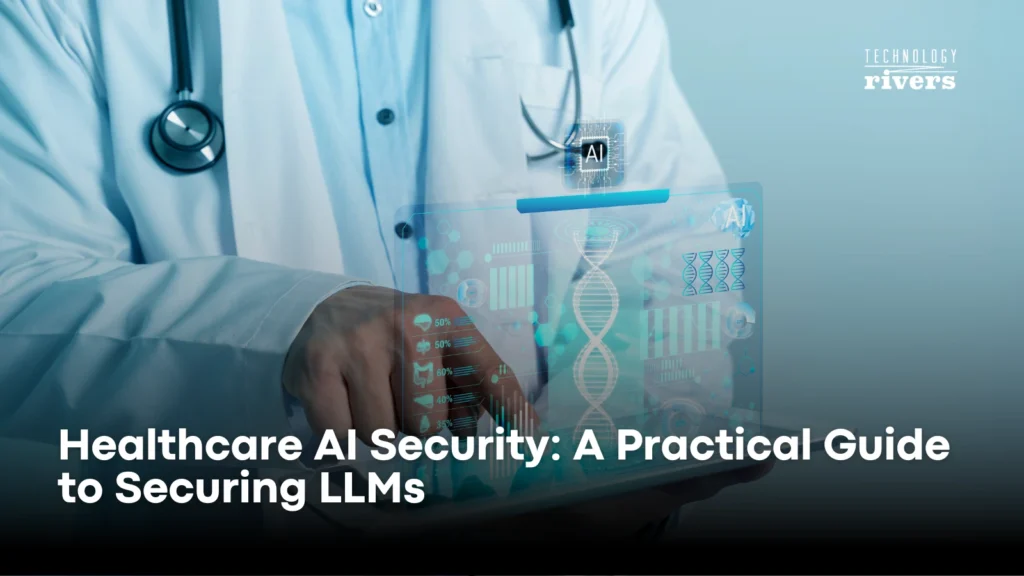
Artificial intelligence is quickly becoming part of modern healthcare software. Care teams are exploring AI assistants for documentation, patient communication, care coordination, triage support, medical education, administrative automation, claims workflows, and operational decision support. As adoption grows, healthcare AI security has become a design requirement, not an afterthought.
The value is clear. AI can help healthcare organizations reduce manual work, improve patient engagement, summarize complex information, and make clinical and administrative workflows more efficient. The World Health Organization has noted that AI can support areas such as surveillance, drug development, administration, diagnosis, treatment, and patient care, while also emphasizing the need for governance, privacy, and appropriate safeguards.
That second part matters.
In healthcare, AI systems often operate close to sensitive data: protected health information, personally identifiable information, payment details, insurance records, appointment histories, clinical notes, and internal business data. When a healthcare application uses a large language model, the prompt itself becomes a new input channel, and the model response becomes a new output channel that must be secured.
Traditional application security controls still matter, but healthcare AI security introduces risks a standard web checklist doesn’t cover. Authentication, authorization, encryption, secure APIs, audit logging, vendor review, and HIPAA-aligned governance are not optional. LLM applications introduce additional risks on top of them.
That is where the OWASP LLM Top 10 becomes useful.
Why OWASP Matters for AI Applications
OWASP has long been a trusted reference for application security. Its traditional web application Top 10 helps teams think about risks such as broken access control, injection, misconfiguration, cryptographic failures, authentication failures, and logging gaps.
For AI applications, OWASP also maintains the Top 10 for Large Language Model Applications. This list gives engineering, security, compliance, and product teams a shared vocabulary for the most important risks in LLM-powered systems, especially for LLM security in healthcare and other regulated industries.
The key lesson is simple: an AI feature is still a software feature. It needs the same secure engineering discipline as any other application, plus additional controls for prompts, model outputs, retrieval systems, agents, and tool access.
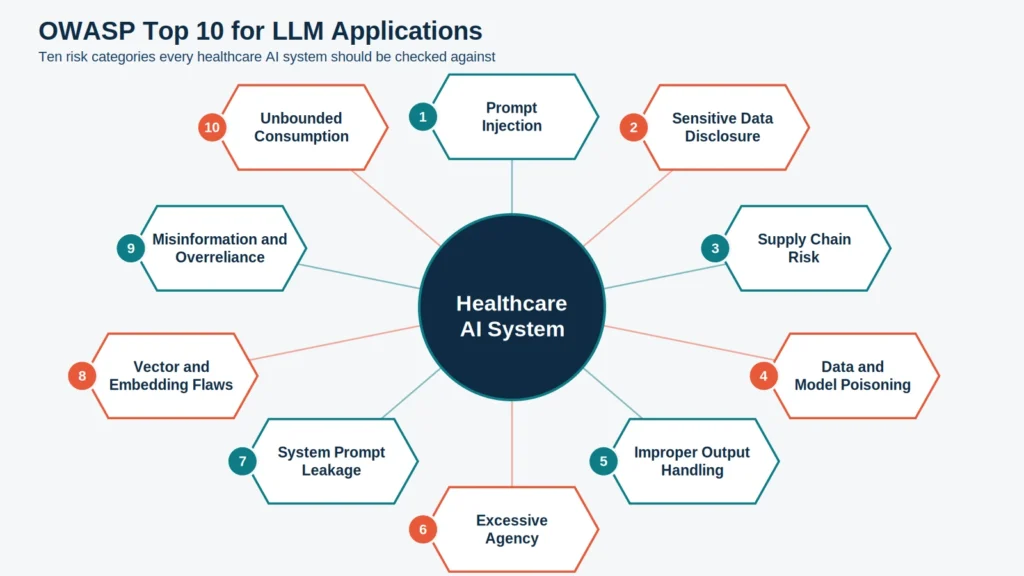
Below are the major OWASP LLM security risks and practical mitigation strategies, with special attention to healthcare AI security.
1. Prompt Injection
Prompt injection happens when a user, document, website, file, or tool output contains instructions designed to override the application’s intended behavior.
In a healthcare application, this could look like a user trying to make the assistant ignore its safety instructions, reveal hidden policies, expose a patient record, or misuse a connected tool.
Indirect prompt injection can be even harder to catch. For example, an AI assistant might summarize an uploaded document that contains hidden instructions telling the model to leak data or call a tool.
Mitigation Strategies
Treat all user input, uploaded documents, retrieved content, and tool responses as untrusted.
Separate system instructions from user-controlled content. Do not rely only on prompt wording such as “never reveal sensitive data.” Use technical controls around what the model can access and return.
Add runtime prompt scanning before sending content to the model. An LLM gateway such as SentinelGuard security framework can sit between the application and the model provider, inspect prompts for injection or jailbreak patterns, and block risky requests before they reach the model.
Use least-privilege tool access. If the model does not need access to a patient record, billing system, email account, or scheduling API for a specific workflow, do not expose that tool.
Require human approval for high-impact actions such as modifying clinical records, sending patient messages, changing prescriptions, approving payments, or deleting data.
2. Sensitive Information Disclosure
Sensitive information disclosure occurs when an LLM application exposes information it should not reveal. In healthcare, that may include PHI, PII, insurance data, internal notes, credentials, payment card data, or proprietary business information.
This risk can happen in several ways:
- A user pastes sensitive data into a chatbot.
- A model response repeats a secret or private patient detail.
- A retrieval system returns documents from the wrong tenant or patient.
- Logs capture raw prompts that contain PHI or payment data.
- A system prompt contains internal instructions or secrets.
Mitigation Strategies
Never place credentials, API keys, database passwords, or private tokens in prompts or system messages.
Apply access control before retrieval. A model should only receive documents the current user is authorized to access.
Use data minimization. Send only the minimum information required for the task. Technology Rivers’ Document Extraction Engine processes files using local models instead of routing them through a third-party API, which limits exactly this kind of vendor and data-exposure risk.
Scan both prompts and model outputs for PII, PHI, secrets, and PCI-related data. SentinelGuard, when deployed as an LLM gateway, can inspect inbound prompts and outbound responses to help detect and block or redact sensitive data before it leaves the controlled application boundary.
Avoid storing raw prompts and responses by default. If logs are required for audit or troubleshooting, use privacy-safe logging with request IDs, risk categories, scanner names, and hashed user or tenant identifiers instead of full chat content.
3. Supply Chain Risk
AI applications often depend on many components: model providers, open-source packages, vector databases, embedding models, prompt templates, orchestration frameworks, browser tools, plugins, and deployment pipelines.
A weakness in any of these components can affect the security of the entire AI system.
Mitigation Strategies
Review dependencies and keep them updated. Use software composition analysis and vulnerability scanning.
Pin model and package versions where appropriate, especially in regulated environments.
Review third-party model providers, data retention settings, business associate requirements, and contractual obligations before sending healthcare data to external services, this is where HIPAA AI compliance gets tested first. For a broader look at vendor risk and AI governance obligations under HIPAA, see our related breakdown of HIPAA compliance non-negotiables for HealthTech teams. Technology Rivers treats every model provider and AI vendor as a security review, not a signup form, before it touches PHI.
Separate development, testing, and production environments. Synthetic data should be used for testing whenever possible.
Monitor model behavior after updates. A model, prompt template, retrieval configuration, or gateway policy change should trigger regression tests.
4. Data and Model Poisoning
Data poisoning happens when bad data is inserted into training data, fine-tuning data, retrieval documents, or feedback loops. In healthcare, this can be dangerous because users may rely on AI-generated summaries, recommendations, or operational insights.
For example, if an attacker can influence a knowledge base used by a clinical support chatbot, they may be able to alter what the assistant says later.
Mitigation Strategies
Validate and approve data before adding it to retrieval systems or fine-tuning datasets.
Track data lineage. Teams should know where training, retrieval, and knowledge-base content came from.
Use document-level access control and content moderation for RAG pipelines.
Maintain rollback capability for vector indexes, embeddings, and knowledge-base updates.
Evaluate model outputs with known test cases after data changes.
5. Improper Output Handling
Improper output handling occurs when the application trusts model output too much. A model response might include unsafe HTML, code, SQL, links, commands, or instructions that downstream systems execute without validation.
This is especially important when AI is connected to tools or workflow automation.
Mitigation Strategies
Treat model output as untrusted until validated.
Use strict output schemas where possible. For example, require JSON with expected fields instead of free-form responses when the output drives application logic.
Validate and sanitize all model-generated HTML, Markdown, links, files, database queries, and tool arguments.
Do not let model output directly execute commands or change records without policy checks.
Use an LLM gateway to scan model responses before returning them to users or downstream systems. This helps detect unsafe output, secrets, sensitive data leakage, and policy violations before the response is delivered.
6. Excessive Agency
Excessive agency happens when an LLM is given too much autonomy. The more tools an AI agent can use, the larger the blast radius if something goes wrong.
In healthcare, this could include tools that send patient messages, update appointments, access EHR records, create claims, change billing information, or trigger external workflows.
Mitigation Strategies
Grant the model only the tools needed for the current workflow. Technology Rivers built its Clinical Records Summarizer to read and structure clinical documents rather than modify them, an example of the scoped, read-only design this mitigation calls for.
Use scoped permissions and short-lived credentials.
Add confirmation steps for sensitive actions.
Keep humans in the loop for clinical, financial, legal, or safety-impacting decisions.
Log tool calls separately from model text so teams can audit what the AI attempted to do.
Add authentication and authorization at the gateway layer. When SentinelGuard is used as an LLM gateway, it can add a client authentication layer so only approved applications or users can send model traffic through the protected endpoint.
7. System Prompt Leakage
System prompt leakage occurs when the model reveals hidden instructions, internal policies, routing logic, or sensitive configuration details.
The system prompt should not contain secrets, but it may still reveal business logic or security assumptions that make future attacks easier.
Mitigation Strategies
Do not put secrets, passwords, API keys, or confidential implementation details in system prompts.
Keep system prompts concise and policy-focused.
Test whether the model reveals internal instructions when asked directly or indirectly.
Scan outputs for system prompt leakage patterns.
Use gateway controls to block requests that attempt to extract hidden instructions and to block responses that appear to reveal internal prompt content.
8. Vector and Embedding Weaknesses
Many healthcare AI applications use retrieval-augmented generation, or RAG. RAG allows the application to retrieve relevant documents and pass them to the model as context.
This can make AI more useful, but it also creates risks:
- The wrong patient’s data may be retrieved.
- Cross-tenant documents may leak.
- Embeddings may expose sensitive meaning.
- Retrieved documents may contain malicious instructions.
- Search results may include outdated or unapproved content.
Mitigation Strategies
Use document-level authorization before retrieval and again before sending retrieved content to the model.
Separate tenant and patient data where appropriate.
Filter retrieved documents for prompt injection and sensitive data before model use.
Track which documents were used in each response.
Give users citations or source references when appropriate, especially in clinical or administrative decision-support workflows. For a deeper look at how RAG can be paired with sandboxing and anonymization to reduce this kind of exposure, see our related guide on safe innovation in healthcare AI. Technology Rivers applies the same document-level authorization and retrieval safeguards when it builds RAG systems for healthcare clients.
9. Misinformation and Overreliance
LLMs can generate confident but incorrect answers. In healthcare, overreliance can be especially risky if users treat AI output as clinical truth.
Even when an AI assistant is not making clinical decisions, misinformation can affect patient communication, care navigation, billing, operations, and user trust.
Mitigation Strategies
Clearly define what the AI system is allowed and not allowed to do.
Use retrieval from approved knowledge sources instead of relying only on model memory.
Require human review for clinical, legal, financial, or high-risk content.
Display confidence, limitations, or source references where useful.
Create evaluation tests for accuracy, hallucination, unsafe advice, and refusal behavior.
Monitor user feedback and incident reports after launch.
10. Unbounded Consumption
Unbounded consumption happens when attackers or accidental misuse drive excessive model usage. This can lead to high cost, latency spikes, rate-limit exhaustion, or denial of service.
LLM requests can be expensive because long prompts, large contexts, repeated retries, and complex agent workflows consume tokens and compute.
Mitigation Strategies
Set prompt size limits, output limits, rate limits, and per-user quotas.
Use authentication before allowing access to model endpoints.
Monitor model usage by tenant, user, application, and route.
Add timeout controls and fallback behavior.
Use a gateway layer to centralize rate limiting, policy enforcement, and model routing. A shared enforcement point can authenticate, scan, and monitor requests before forwarding them to upstream model providers.
That’s ten distinct risk categories, and most healthcare AI teams are carrying exposure in more than one of them at once. If you want a second set of eyes on where these apply to your specific architecture, schedule a security review before your next release.
Why Healthcare AI Security Requires Design From Day One
Healthcare AI applications are not ordinary chatbots. They often touch sensitive workflows, regulated data, and vulnerable user populations. A small design mistake can create privacy, compliance, safety, and trust problems. The goal is not to block AI adoption. The goal is to adopt AI safely.
Secure healthcare AI requires several layers:
- Strong identity and access management.
- Role-based authorization.
- HIPAA-aware data handling.
- Encryption in transit and at rest.
- Secure EHR and third-party integrations.
- Vendor and model-provider governance.
- Prompt and output inspection.
- Audit logging without unnecessary sensitive data retention.
- Human review for high-impact workflows.
- Continuous evaluation and monitoring.
These layers do not run themselves. Someone has to own each one. For a breakdown of which roles typically cover clinical, compliance, security, and data concerns, see our related guide on governance roles every healthcare AI team must have. Technology Rivers assigns these roles explicitly on every healthcare AI engagement instead of leaving governance implicit.
This is where an LLM gateway becomes valuable. Instead of asking every application team to build its own prompt scanning, output scanning, authentication, telemetry, redaction, and provider-routing logic, organizations can place a shared gateway between applications and model providers.
For healthcare teams, a runtime gateway layer can be important because it gives security and engineering teams a practical place to enforce policies for prompts, outputs, secrets, and sensitive data before information moves further through the AI workflow. It should sit alongside secure application design, HIPAA compliance work, EHR authorization, vendor review, and human oversight.
Consider a feature that automates Explanation of Benefits (EOB) processing for patients. Before it reaches production, someone needs to define what data can enter the prompt, turn on scanning, lock down access to claims and billing systems, add human review for anything that touches a payment decision, and only then launch with monitoring in place.
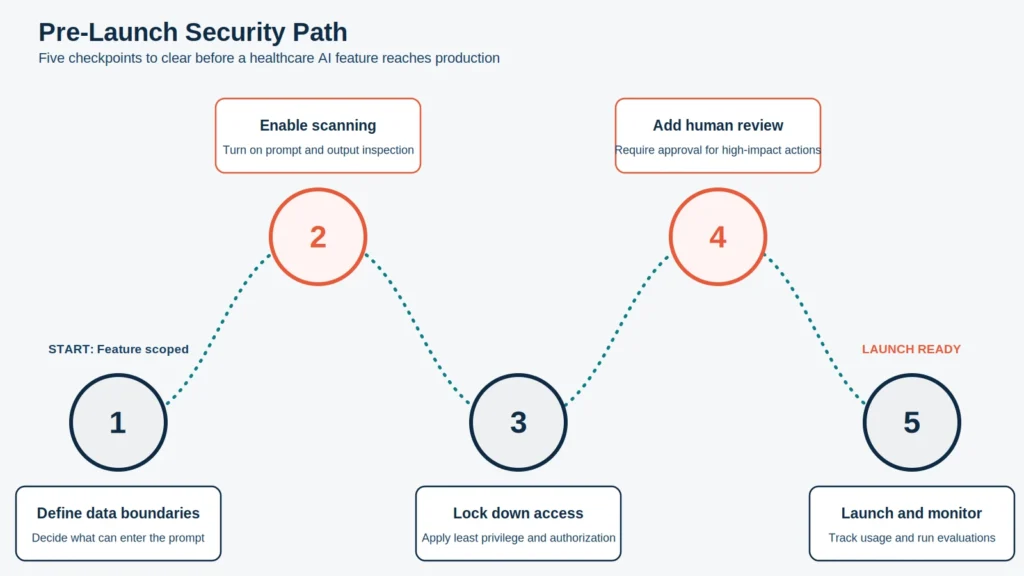
Security Questions Healthcare Teams Should Ask
Before launching an LLM-powered healthcare feature, teams should ask:
- What data can enter the prompt?
- Can users paste PHI, PII, payment details, or credentials?
- Is prompt and output scanning enabled?
- Are model responses validated before being displayed or used by downstream systems?
- Does retrieval enforce document-level authorization?
- Are tools and agents limited by least privilege?
- Are high-impact actions approved by a human?
- Are raw prompts and responses excluded from normal logs?
- Is model traffic authenticated and rate-limited?
- Are there alerts for prompt injection, secrets, PII, blocked outputs, and abnormal usage?
- Are AI providers reviewed for data retention, privacy, security, and compliance requirements?
- Are evaluation tests run before every major prompt, model, retrieval, or policy change?
Conclusion
Healthcare AI security isn’t a blocker to adoption. Done right, it’s what makes AI more useful, more efficient, and more responsive. AI can help teams summarize information, automate administrative work, support patient engagement, and improve operational decision-making, but the same qualities that make it powerful also create new security responsibilities.
The OWASP Top 10 for LLM Applications gives healthcare and software teams a practical framework for understanding those risks. Prompt injection, sensitive information disclosure, insecure output handling, excessive agency, vector weaknesses, misinformation, and unbounded consumption are not theoretical problems. They are design issues that must be addressed before AI moves deeper into production workflows.
The safest path is layered: secure application architecture, strong identity, access control, privacy-aware data handling, evaluation, monitoring, and runtime guardrails. Teams building this kind of system often benefit from a partner with direct AI and machine learning development experience, not just general application security knowledge.
An LLM gateway such as SentinelGuard can be one useful part of that architecture. By inspecting prompts and responses, helping protect PII and PCI-related data, detecting attacks, adding client authentication, and centralizing policy enforcement, a gateway helps organizations move from experimental AI to safer, production-ready AI systems.
Ready to build healthcare AI security by design from day one? Get in touch to talk through your project.