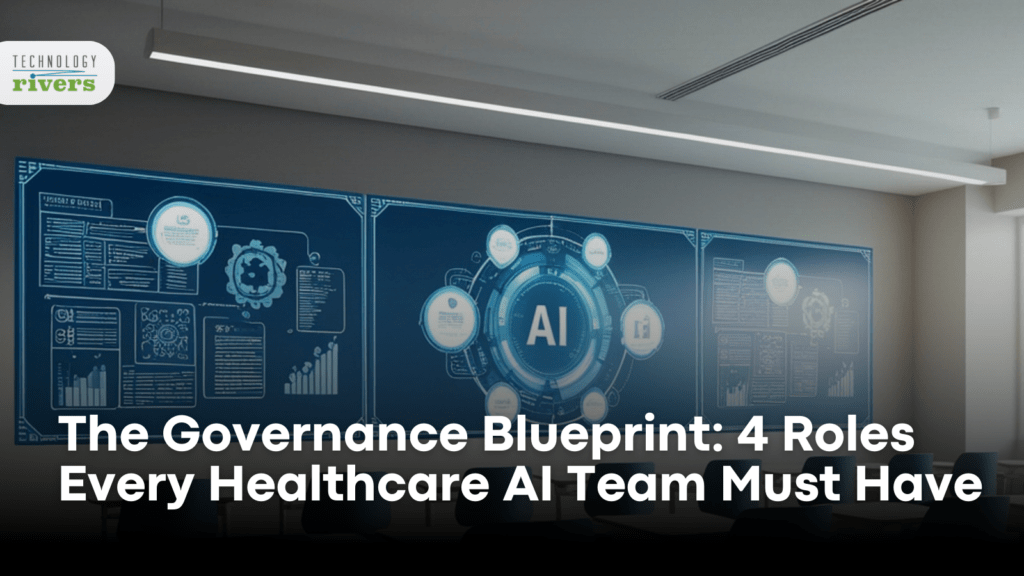
Building a responsible AI framework that ensures compliance, safety, and operational excellence
When an AI system fails in healthcare, the first question is not what went wrong; it is who was responsible. And too often, no one has a clear answer. IT assumes clinical operations are monitoring outcomes; clinical operations thinks the vendor handles model performance; regulatory expects data science to catch drift; data science believes compliance is tracking the metrics.
The result is a patchwork of assumptions where everyone owns a piece, and no one owns the whole.
This is not a technology problem. It is an organisational design problem, and solving it requires more than assigning AI oversight to a single role or department. Effective healthcare AI governance demands a team with four distinct areas of expertise working together: clinical operations, regulatory compliance, IT security, and data science. Together they form a framework that catches problems before they reach patients and ensures clear accountability when they do.
Why Healthcare AI Governance Cannot Be a Single Role
One of the most common mistakes organisations make is treating AI governance as a single position or isolated department. This fundamentally misunderstands the cross-functional nature of AI risk.
“Governance should be thought of like operations or project management. It’s a broad system for decision-making, not a single job. It’s the way in which your organisation sets policies and assigns accountability, how you manage risks in the way that you develop and maintain your AI.”
This reframes governance from a checkbox exercise to an operational capability. Just as you would not assign project management to a single individual while expecting organisation-wide coordination, you cannot expect a lone compliance officer to navigate the technical, clinical, legal, and ethical dimensions of AI deployment.
The complexity of AI and machine learning in healthcare demands diverse perspectives. Clinical systems interact with patient data, technical infrastructure, regulatory frameworks, and operational workflows simultaneously, and no single discipline can govern all these dimensions alone.
The Four Essential Roles in Your AI Compliance Team
An effective AI compliance team requires four distinct areas of expertise. Whether these responsibilities are distributed across four individuals or consolidated among fewer people in smaller organisations, all four perspectives must be represented when making significant decisions about AI systems.

Role 1: Clinical Operations Leadership
The clinical operations representative ensures that AI systems align with actual care delivery, bridging the gap between technological capability and clinical reality.
- Patient safety assessment
- Clinical workflow integration
- User training and adoption
- Human factors analysis
This role matters because AI in healthcare operates in high-stakes environments where errors have immediate consequences. The clinical operations leader serves as the patient advocate within the governance structure, ensuring that technological enthusiasm does not override clinical judgment.
“The most important is the human in the loop. I assign the highest risk, ambiguous input, and complex situations which require empathy and judgment to require humans in the loop.”
Role 2: Regulatory and Legal Compliance
The regulatory compliance specialist navigates the complex landscape of healthcare regulations, determining which rules apply to specific AI implementations and how to demonstrate compliance throughout the system lifecycle.
- Classification structure analysis
- Regulatory expectation interpretation
- Contract and data processing agreement management
- Data privacy enforcement (HIPAA, state laws, AI regulations)
Compliance must be embedded early. As explained in how to build HIPAA-compliant healthcare apps, retrofitting compliance is expensive and disruptive.
This role also owns vendor evaluation. Transparency is critical, especially for HIPAA documentation, audit logs, and retention policies.
Role 3: IT Security and Infrastructure
The IT security and infrastructure lead owns the technical foundation upon which AI systems operate.
- Identity and access management
- Network architecture and encryption
- Logging and audit trail management
- Version control and integration architecture
As noted in Security and HIPAA Compliance in EHR Integrations, audit logging is not optional. Healthcare AI must meet the same standards as any other critical infrastructure.
Role 4: Data Science and Analytics
The data science and analytics leader owns the AI models themselves, their development, validation, versioning, and ongoing monitoring.
- Model performance tracking
- Sensitivity, specificity, and accuracy metrics
- Reproducibility of results
- Bias detection and mitigation
Bias remains one of the most under-addressed risks in healthcare AI. Without continuous monitoring, ethnicity bias, gender bias, or vendor bias can quietly undermine outcomes.
Compliance by Design: Building Governance into Your Architecture
The most effective healthcare AI frameworks embed compliance into system architecture from the start. This aligns with AI-driven development best practices where governance, security, and traceability are integrated into the build process.
Not every AI system carries equal risk. Governance intensity should scale with potential patient impact.
Technical Foundations That Enable Governance
Data Protection Through RAG and Anonymisation
Retrieval-Augmented Generation (RAG) allows AI systems to operate on sensitive healthcare data without exposing protected health information to large language models.
Learn more in our guide to RAG applications in healthcare.
Comprehensive Audit and Traceability
Version control and detailed logging support HIPAA, GDPR, SOC 2, and FDA compliance requirements. Without traceability, governance cannot function.
Ongoing Performance Monitoring
Monitoring operational efficiency ensures AI systems improve hospital workflows instead of increasing review burdens.
Implementation: Start Narrow, Scale Deliberately
Healthcare AI initiatives should begin with a narrow scope. Deploy one workflow, validate results, and expand deliberately.
This incremental governance mirrors the approach outlined in AI-driven MVP development.
Evaluating Vendors: Transparency as a Litmus Test
If vendors claim HIPAA compliance, ask for proof: BAAs, data processing agreements, retention policies, and audit logs. Transparency today prevents regulatory crises tomorrow.
For Startups: Build Governance into Your Roadmap Now
Governance maturity increasingly influences enterprise purchasing decisions. Startups that embed governance early reduce risk, attract investor confidence, and scale faster.
Governance Is Your Competitive Advantage
The four AI governance roles, clinical operations, regulatory compliance, IT security, and data science, are not bureaucratic overhead. They are essential infrastructure for responsible AI deployment.
Organisations that build governance proactively scale AI initiatives faster and maintain trust. Those that treat governance as an afterthought accumulate technical debt and regulatory risk.
Go Deeper: Watch the Full Discussion
This article draws on insights from our webinar, Health AI Agents: What Does It Take to Succeed?. The full recording covers workflow automation, RAG implementation, and multi-agent system design.
Build Your Governance Framework Before You Need It
Every healthcare AI deployment will face scrutiny. The organisations that answer confidently are the ones that built governance from the start.
Technology Rivers works with healthcare organisations and digital health startups to design AI solutions with governance, compliance, and accountability built into the architecture. If you are planning an AI initiative and want to get the structure right from day one, let’s talk.