Building software has become faster than ever. AI coding tools can generate interfaces, write functionality, produce documentation, and turn ideas into working prototypes in hours rather than weeks. For SaaS founders, that creates an opportunity to test ideas without committing to months of development. But it also introduces a new problem: when building becomes easier, deciding what is worth building becomes more important.
AI-assisted SaaS development is changing how products are created, but it doesn’t guarantee that those products will succeed. In a conversation with Jeff Mains on the SaaS Fuel podcast, Ghazenfer Mansoor, Founder and CEO of Technology Rivers, discussed why founders get caught in the feature race, how AI is changing development workflows, and what separates a working prototype from software that customers continue to use.
Watch the Full Episode: Building Solutions, Not Features: The New Mindset for SaaS Founders
Why the SaaS Feature Race Doesn’t Work
When founders enter an established SaaS market, they often start by comparing their product against the competition. They examine existing platforms, identify missing functionality, and begin building features to close the gap.
The problem is that established competitors usually have more resources, larger development teams, and years of product improvements behind them. Trying to match every feature can turn a promising product into an expensive development project without giving customers a compelling reason to switch.
During the podcast, Ghazenfer discussed how this happens in markets such as CRM and electronic medical records (EMR) software. A founder might see a mature platform and decide to build an alternative with similar functionality. But recreating an entire product category isn’t necessarily what the market needs.
A more practical opportunity may lie in solving a specific problem that existing platforms handle poorly.
One example is integrating EMR data into telehealth applications, where the opportunity lies in improving access to patient information rather than replacing the existing records system.
This changes the question from “How many features do we need to compete?” to “What problem can we solve better than the alternatives?”
That distinction matters because more functionality doesn’t automatically translate into more customer value. Every additional feature also introduces development work, testing requirements, maintenance, and potential complexity for users.
A smaller product that reliably solves an important problem can be more valuable than a larger application that tries to serve everyone.
The challenge is identifying that problem before development begins.
Start With Customer Problems, Not Feature Requests
Customers are an essential source of product feedback, but their requests don’t always describe the actual problem they need solved.
A customer might ask for a calendar integration, a reporting dashboard, or a new CRM feature. The immediate response may be to add that functionality to the roadmap. Yet the requested feature could be only one possible solution to a broader operational problem.
Ghazenfer emphasized the importance of understanding what customers are trying to accomplish before deciding how to build it.
Consider a customer requesting calendar functionality. They may not need an entirely new scheduling module. Their real problem could be that appointments aren’t reaching the right people, existing systems don’t communicate, or staff members spend too much time coordinating schedules manually.
Those problems could require very different solutions.
This is why product discovery should go beyond collecting feature requests. Founders need to understand the workflow, identify where users experience friction, and determine what a successful outcome would look like.
During the discussion, Jeff Mains reinforced this distinction between features and outcomes. The point is particularly important for early-stage SaaS companies, where development resources are limited and every product decision carries a cost.
Once the underlying problem is clear, founders can make better decisions about what belongs in the initial product and what can wait.
Early releases create opportunities to observe how customers actually use the software, gather feedback, and determine whether the solution provides enough value for people to pay for it.
This approach makes SaaS feature prioritization for startups less about ranking a long list of requested capabilities and more about identifying the smallest useful solution that delivers a meaningful result.
AI-assisted SaaS development can make that experimentation faster and less costly. But when teams can build more possibilities in less time, disciplined prioritization becomes even more important.
How AI-Assisted SaaS Development and Vibe Coding Are Changing the Build Process
One of the biggest changes in software development is how quickly an idea can become something people can see and interact with.
AI-powered development tools can now help teams generate application interfaces, create functionality, write documentation, and test early concepts without following every step of a traditional development workflow.
Ghazenfer described how Technology Rivers has incorporated tools such as Cursor, Claude Code, Replit, Lovable, Bolt, and UX Pilot into different parts of its development process.
These tools serve different purposes. Some help developers write and modify code, while others make it easier to create interfaces, explore product concepts, or produce early prototypes.
For founders, this speed makes it easier to test ideas before committing to full-scale development, as demonstrated in our Replit healthcare app prototype.
During the conversation, Ghazenfer shared examples of healthcare scheduling and home care applications that his team was able to prototype in a matter of hours.
The significance isn’t simply that AI can generate code quickly. It’s that development teams can explore an idea, demonstrate a workflow, and gather feedback much earlier than before.
For a founder evaluating a new product, that can change how development investments are made. Instead of spending weeks building an initial concept before anyone can review it, a team can use AI-assisted software development for startups to test assumptions sooner.
Technology Rivers is also applying AI beyond code generation.
Ghazenfer discussed using AI to help with requirements gathering, user stories, Jira documentation, mockups, and other development activities. These tasks traditionally require significant manual effort, particularly when teams are translating business needs into technical specifications.
However, the ability to generate software quickly changes what developers need to be good at.
When AI can produce substantial amounts of code, the developer’s responsibility increasingly involves understanding the problem, defining the right requirements, evaluating the proposed solution, and making architectural decisions.
A tool can generate a feature from a prompt. It cannot independently establish whether that feature belongs in the product, whether the underlying requirements are correct, or whether the resulting architecture will support future needs.
This is where the shift from a coding-focused mindset to an architectural and product-focused mindset becomes important.
Teams need to think about how components interact, how information moves through the application, and what happens when the product grows beyond its initial use case. Founders choosing between AI development tools can explore our Cursor vs. Replit vs. Claude Code comparison.
Vibe coding for SaaS applications can be valuable for exploring ideas and accelerating early development. But speed becomes an advantage only when someone remains responsible for the decisions behind the generated software.
And those decisions become even more consequential when a prototype moves toward production.
Why Fast Prototypes Still Need Production-Ready Foundations
A prototype that works during a demonstration isn’t necessarily ready to support real customers.
AI development tools can produce impressive results in a short period. A founder may be able to generate an interface, connect a database, and demonstrate a complete user journey without spending months on development.
That achievement is useful. It shows that the concept can be implemented and gives stakeholders something concrete to evaluate.
But Ghazenfer made an important distinction during the podcast: building an initial application is only part of the software development process.
A production application must continue working as users interact with it, data accumulates, business requirements change, and new functionality is introduced.
Code generated quickly still needs to be understood, tested, maintained, and improved.
This is particularly relevant when teams are considering how to make AI-generated code production-ready. A successful demonstration doesn’t establish that an application can handle unexpected inputs, changing workloads, or operational failures.
Before launch, development teams still need to evaluate areas such as application architecture, data handling, security, testing, deployment, and ongoing maintenance. The specific requirements depend on the product and the environment in which it will operate.
In the interview, Ghazenfer compared software development to building a house. Completing the initial construction doesn’t eliminate the need for upkeep, repairs, or future improvements.
Software follows a similar pattern.
Customers discover new requirements. Integrations change. Dependencies need updates. Features that worked for a small group of users may need to be redesigned as adoption increases. Our article on scaling a startup product beyond its MVP explores what that transition involves.
AI may reduce the time required to implement certain changes, but it doesn’t eliminate the responsibility to manage them.
There is also a cost to building unnecessary functionality. Each new feature expands the application and creates additional code that must be supported.
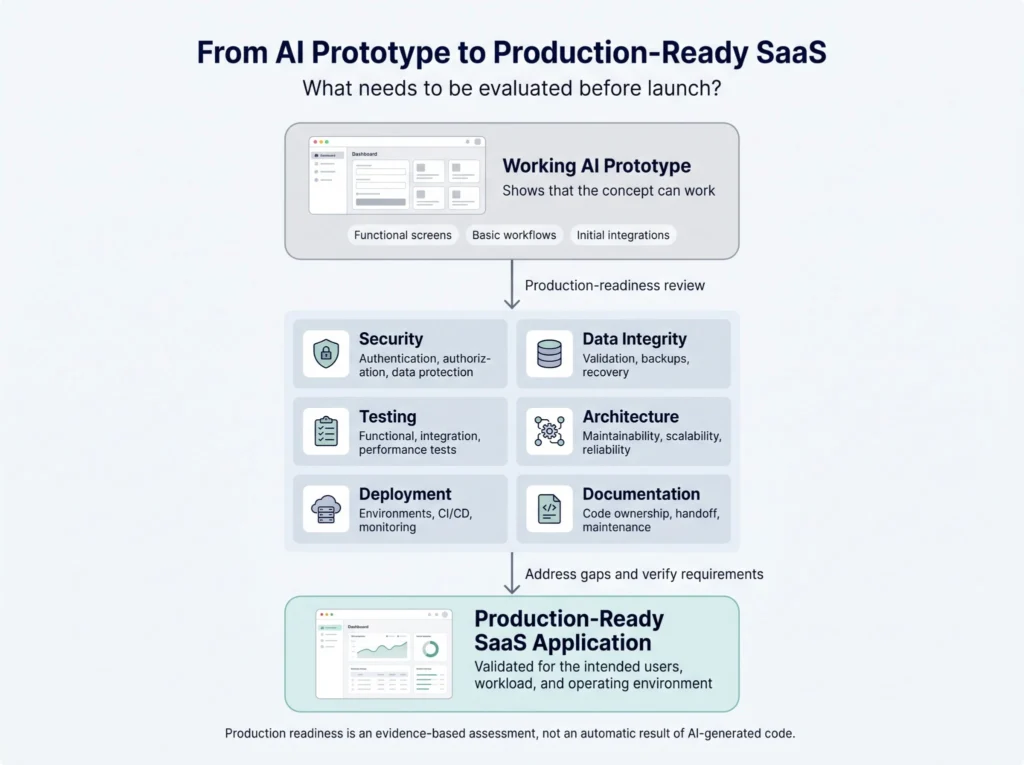
For founders, the practical lesson is that AI-assisted SaaS development should reduce uncertainty through rapid prototyping, not replace the engineering work required to launch and operate a dependable product.
Once that distinction is clear, the next question becomes where AI can create value beyond development speed.
The 10x Mindset: AI Agents and Business Process Automation
AI’s value isn’t limited to writing code. It can also help businesses rethink how work gets done.
During the podcast, Ghazenfer discussed what he described as a 10x approach: examining business operations, identifying bottlenecks, and exploring how AI can improve the processes that consume time and resources.
The starting point is the business problem, not the technology.
A company might struggle with repetitive administrative work, disconnected systems, or processes that require employees to move information manually between applications.
Adding an AI chatbot to the business won’t necessarily solve those problems.
A more useful approach is to examine the workflow, understand why it is inefficient, and determine whether automation can reduce unnecessary steps.
This is where AI agents for business process automation become relevant. For a closer look at practical applications, see Technology Rivers’ guide to AI-powered automation.
An AI agent can potentially support a sequence of tasks rather than respond to a single prompt. Depending on the systems involved and the controls in place, agents may help retrieve information, prepare documentation, coordinate activities, or assist employees with repetitive operational work.
The opportunity is especially interesting for SaaS businesses because software products often sit at the center of existing workflows.
Instead of introducing another isolated feature, founders can look for opportunities to make those workflows more efficient.
Ghazenfer’s emphasis on practical value also provides a useful way to evaluate new AI capabilities.
Before introducing an AI-powered feature or agent, a business should be able to explain what problem it solves, which part of the workflow it improves, and how the result will be measured.
That might involve reducing manual processing time, improving access to information, or allowing employees to focus on work that requires more judgment.
The term “10x” describes an ambition to achieve substantial improvements, not a guaranteed result from implementing AI.
AI tools are most useful when they support a clearly defined operational objective. Without that objective, automation can simply add another layer of complexity.
And even when a product or automation works well technically, its long-term value depends on whether people actually use it.
Build Products People Actually Use
A successful launch is an important milestone, but it isn’t the same as building a successful product.
Founders often measure early progress through completed features, development milestones, and the number of people who sign up or download an application.
Those metrics can show initial interest. They don’t necessarily reveal whether the product has become valuable enough for customers to keep using it.
Drawing on his experience in mobile application development, Ghazenfer discussed the difference between getting an app downloaded and making it part of someone’s routine.
This is also a central theme of his book, Beyond the Download, which explores what happens after an application reaches its users.
The underlying lesson applies to SaaS products as well.
Customers return to software because it helps them accomplish something important. A product that saves time, removes friction, or makes an essential task easier has a stronger reason to become part of an established workflow.
By contrast, a product with numerous features may still struggle to retain users if those features don’t address meaningful needs.
This is why product development can’t stop at launch.
Teams need to observe how customers use the application, understand where they encounter difficulties, and improve the experience based on what they learn. Our mobile app retention strategies offer practical examples of this approach for mobile product teams.
For SaaS founders, the goal isn’t to maximize the number of features delivered in each release. It’s to create a product that customers find useful enough to continue using.
That brings the discussion back to the decisions made before development began: identifying the right problem, understanding the customer, and choosing which capabilities genuinely contribute to the solution.
AI can help teams move through development faster, but sustained adoption still depends on delivering value.
Faster Development Only Matters When It Creates Value
AI-assisted SaaS development has changed what founders and development teams can accomplish with limited time and resources. Ideas can be tested earlier, prototypes can be created faster, and many development activities can be streamlined.
But the fundamentals of building a successful software product haven’t disappeared.
Founders still need to understand their customers, prioritize meaningful problems, make sound technical decisions, and invest in the ongoing work required to maintain and improve their products.
As Ghazenfer’s conversation on SaaS Fuel illustrates, the real opportunity isn’t simply to use AI to build more software. It’s to use faster development and better automation to solve problems that matter.
For founders exploring a new product or evaluating an existing application, the most valuable starting point is a clear understanding of the problem the software needs to solve.
Technology Rivers works with organizations on software product development, modernization, and AI-enabled solutions. The next step is to evaluate which product decisions and technical foundations matter most for the problem being solved.