Vibe coding has changed how quickly an idea can become working software.
Learning how to vibe code starts with one shift in mindset: you let AI write the code while you focus on what to build. This has changed how quickly an idea can become working software.
You can describe an idea to AI coding tools such as Replit, Lovable, Base44, Bolt, Emergent, v0, or another AI development platform and have a working application surprisingly quickly.
Developers are using Claude Code, Codex, Cursor, and other AI coding tools to accomplish in hours what previously took days or weeks.
That’s exciting.
But there is an important distinction:
Building an application that works is not the same as building an application that is ready for production.
And if you’re building for healthcare:
Production-ready doesn’t automatically mean HIPAA-ready.
The journey increasingly looks like this:
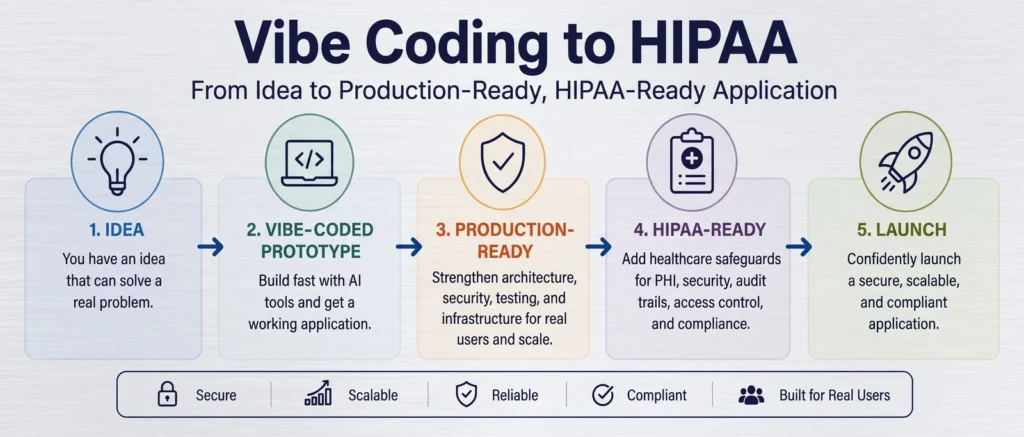
This guide walks through that entire journey.
Whether you’re a non-technical founder building your first MVP, a developer using AI to accelerate development, or a healthcare organization experimenting with AI, the goal is the same:
‘Move fast without creating a technical foundation you’ll regret later.’
Prefer a Step-by-Step Tutorial?
We’ve created a complete series of practical vibe-coding tutorials for platforms including Replit, Lovable, Base44, Emergent, Bolt, v0, Claude Code, Codex, and others.
For each platform, we cover four stages:
- How to Build the App
- How to Make It Production-Ready
- How to Make It HIPAA-Ready
- How to Build It Production-Ready + HIPAA-Ready From the Start
If you already know which platform you’re using, you can jump directly to the tutorial library later in this guide.
Already Built Your App?
If you already have a vibe-coded application and you’re trying to determine whether it’s ready for production or healthcare, you don’t have to guess.
We can assess what you’ve built and help determine what should be kept, fixed, replaced, or rebuilt.
Building specifically for healthcare?
Explore Our HIPAA-Compliant Vibe Coding Solution
What Is Vibe Coding?
Vibe coding is an AI-assisted approach to software development where you describe what you want to build and AI generates much of the underlying code.
Instead of manually writing every component, database query, API call, or user interface, you work with AI conversationally.
You might say:
Create a patient intake form with name, date of birth, contact information, insurance details, and medical history.
The AI can generate the interface, database structures, validation, and application logic.
You review the result, ask for changes, add features, and continue iterating.
This dramatically lowers the barrier between an idea and working software.
Vibe Coding vs Traditional Software Development
Traditional software development typically involves requirements, architecture, design, coding, testing, deployment, and ongoing maintenance.
Vibe coding doesn’t eliminate those things.
It changes how quickly you can execute them and who can participate in the process.
AI can generate:
- User interfaces
- Database schemas
- Application logic
- APIs
- Authentication flows
- Tests
- Documentation
- Infrastructure configuration
- Integrations
- Refactoring suggestions
But someone still needs to make decisions about what should be built, how the system should work, how data should be protected, and whether the generated implementation is appropriate.
That’s especially important as the application becomes more complex.
Popular Vibe Coding and AI Development Tools
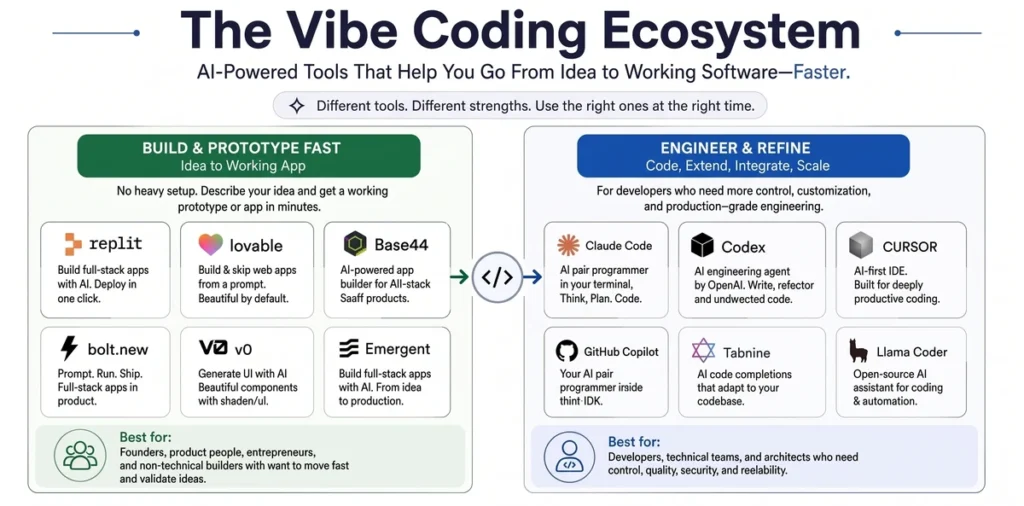
The ecosystem is evolving quickly, but several tools are commonly being used to build applications with AI.
These include:
- Replit
- Lovable
- Base44
- Emergent
- Bolt.new
- v0
- Claude Code
- Codex
- Cursor
They don’t all solve exactly the same problem.
Some make it easy for non-technical users to create applications through natural language. Others are more engineering-focused and help experienced developers work directly with an existing codebase.
Increasingly, teams use several tools together.
A founder might create the initial application using Lovable or Replit, for example, and later use Claude Code or Codex as engineers take the application further.
The tool matters.
But ultimately, the quality of the application it produces matters more.
What Vibe Coding Is Great At
Vibe coding is particularly powerful for getting from an idea to something tangible.
It works well for:
- Rapid prototypes
- MVPs
- Internal tools
- SaaS applications
- CRUD applications
- Dashboards
- Customer portals
- Workflow applications
- AI tools
- Proofs of concept
- Testing product ideas
- Exploring user experiences
Instead of spending weeks discussing what an application might look like, you can often build something and put it in front of users.
That changes product development.
You can learn faster. You can test assumptions earlier. You can iterate based on something users can actually see and use.
But speed creates a new challenge.
It’s easy to keep building because every new feature feels inexpensive.
Eventually, you may have a surprisingly sophisticated application without having made some of the engineering decisions that would normally have happened earlier in a traditional software development process.
Not All Vibe Coding Is the Same
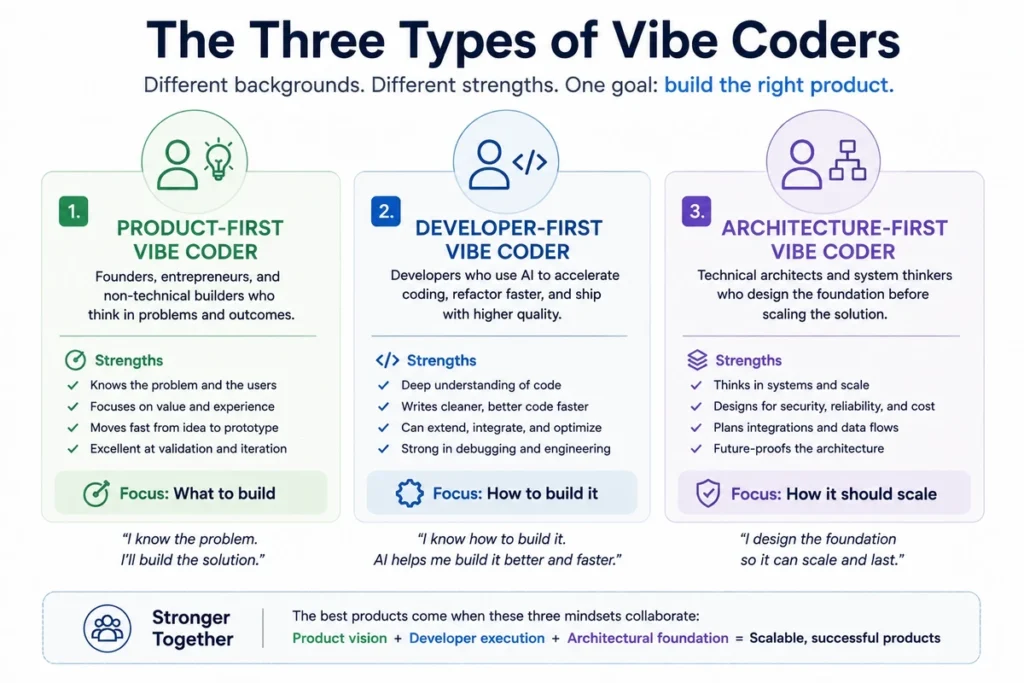
We’ve noticed three common approaches to vibe coding.
Understanding the difference helps explain why two applications built with the same AI tool can have dramatically different technical foundations.
1. The Product-First Vibe Coder
Product people and non-technical founders can build surprisingly good MVPs with AI.
Why?
Because they understand the problem.
They often provide excellent context around:
- Who the user is
- What problem they’re solving
- What the workflow should look like
- What information the user needs
- What should happen next
- What a successful experience looks like
They’re good at telling AI:
Here’s what I want you to build.
As a result, the user experience can be surprisingly polished.
The challenge may be underneath the interface. The application can work extremely well while the architecture, database, security, or code structure still needs significant engineering before production.
2. The Developer-First Vibe Coder
Developers can move incredibly fast with AI.
But speed can create another problem.
It’s tempting to jump directly into implementation.
Build the feature → Prompt AI again → Add another feature → Prompt again → Fix the bug → Add another integration
The application keeps working, so development continues.
But without enough product context, architecture planning, and consistent engineering instructions, the codebase can evolve one prompt at a time.
Eventually, it may become difficult to understand, maintain, test, or extend.
3. The Architecture-First Vibe Coder
This is where we’ve seen one of the biggest differences.
An experienced solution architect thinks about both:
What should we build?
and
How should it be built?
Before asking AI to generate significant portions of the application, the architect establishes engineering guardrails.
Those might include:
- Application architecture
- Database design
- Data models
- Naming conventions
- Project structure
- Authentication patterns
- Authorization and roles
- Cloud functions
- API patterns
- Coding standards
- Security practices
- Logging
- Error handling
- Testing expectations
Now AI isn’t simply generating code.
It’s generating code inside an engineering framework.
Better Prompts Aren’t Enough
There is a lot of discussion about prompt engineering in AI development.
Prompt quality absolutely matters.
But we’ve found it is only part of the equation.
A strong product prompt tells AI:
Here’s what I want you to build.
Strong engineering instructions tell AI:
Here’s how I want you to build it.
That difference becomes increasingly important as an application grows.
Database Design
Instead of allowing AI to create tables and fields whenever a new feature needs them, establish the core data model.
Think about entities, relationships, data types, naming conventions, indexing, data ownership, and access patterns.
Poor database decisions can become expensive to undo later.
Project Structure
Tell AI how the codebase should be organized.
Define expectations around components, services, modules, functions, utilities, configuration, tests, and shared code.
Without these instructions, an AI-generated project can become increasingly inconsistent as features accumulate.
Architecture
Establish boundaries. What belongs in the frontend? What belongs in the backend? What belongs in the database? How should external services be accessed? Which responsibilities should be separated?
AI can implement an architecture remarkably quickly when you give it one.
Authentication and Authorization
Authentication answers: Who are you?
Authorization answers: What are you allowed to do?
Those are very different questions. They should be designed intentionally, especially when applications involve different users, organizations, administrators, customers, clinicians, patients, or employees.
Cloud Functions and APIs
A prototype may start with simple backend functions.
Structure them thoughtfully and those functions can evolve into APIs and services as the application grows. Let them develop randomly and you may eventually need substantial refactoring.
Coding Standards
Give AI consistent expectations for naming, structure, documentation, error handling, validation, reusability, testing, and maintainability.
AI performs better when it understands the rules of the environment it’s working within.
The takeaway: Better prompts create better output. Better engineering instructions create a better system.
Our Approach: Product + Architecture + AI + Production + Healthcare
Vibe coding works best when AI isn’t working in isolation.
At Technology Rivers, we combine five disciplines to help move applications from an idea to software that can actually be used in production.

1. Product Thinking
Before deciding how to build something, we focus on what should be built and why.
That includes:
- The business problem
- Target users
- User journeys
- Core workflows
- MVP priorities
- Product requirements
- Success metrics and expected outcomes
AI can build remarkably fast, but building the wrong thing faster doesn’t create a better product.
Goal: Build the right thing.
2. Solution Architecture
We give AI an engineering framework rather than allowing the architecture to emerge one prompt at a time.
That may include:
- Application architecture
- Database design and data models
- APIs, integrations, and services
- Authentication and authorization
- Roles and permissions
- Cloud and infrastructure architecture
- Security considerations
- Coding standards and best practices
- Project structure
- Data flows
This gives AI better guardrails for generating code that can continue evolving as the application grows.
Goal: Design it the right way.
3. AI-Assisted Development
With the product direction and engineering foundation established, AI becomes a powerful development accelerator.
We use AI throughout the development lifecycle to help with:
- UI and application development
- Code generation
- Refactoring
- Testing
- Debugging
- Code review
- Documentation
- DevOps
- Development automation
The goal isn’t simply to generate more code.
It’s to use AI to build better software faster.
Goal: Build it faster.
4. Production Engineering
A working application still needs to be prepared for real users, real traffic, and real-world failures.
That means addressing areas such as:
- Code quality and maintainability
- Automated testing
- Security hardening
- Vulnerability checks
- Logging and monitoring
- CI/CD
- Production infrastructure
- Performance
- Scalability
- Caching
- Backups
- Recovery
- Disaster readiness
- Ongoing maintainability
This is the layer that helps turn a working prototype into a production-ready application.
Goal: Make it reliable and scalable.
5. Healthcare & HIPAA
When healthcare data is involved, we add another layer.
Depending on the application, that may include:
- PHI data flows
- Data classification
- Encryption in transit and at rest
- Access controls
- Role-based access
- Least-privilege access
- Audit logging
- Activity tracking
- Secure infrastructure
- Network controls
- Vendor and BAA considerations
- Healthcare integrations
- AI and RAG data handling
- HIPAA technical safeguards
Our focus is on building the technical foundation designed to support the organization’s HIPAA compliance requirements.
Goal: Make it ready for healthcare data.
Five Disciplines. One Development Approach.
- Product Thinking
Build the right thing. - Solution Architecture
Design it the right way. - AI-Assisted Development
Build it faster. - Production Engineering
Make it reliable and scalable. - Healthcare + HIPAA
Make it ready for sensitive healthcare data.
The speed of vibe coding. The discipline of software engineering. The additional safeguards healthcare requires.
The result is a development approach designed to create software that is faster to build, stronger in production, and ready for the additional responsibilities that come with healthcare.
How to Build Your First Vibe-Coded Application
If you’re wondering how to vibe code your first real application, resist the temptation to start by saying: ‘Build my entire application. Instead, establish context first.
Step 1: Start With the Problem
Before choosing a platform or generating code, answer:
- Who is the user?
- What problem are we solving?
- Why does this problem matter?
- What does the user do today?
- What should be easier after using the application?
AI needs product context just as a human development team does.
Step 2: Define the MVP
Decide what absolutely needs to exist in the first version.
Separate Must Have from Nice to Have.
Vibe coding makes features inexpensive to generate, which can make scope creep even easier. Just because AI can build another feature doesn’t mean your product needs it.
Step 3: Define the User Flows
Describe what happens from the user’s perspective.
Create Account → Complete Profile → Submit Information → Receive Result → Take Next Action
Think through edge cases too. What happens when information is missing? What happens when a user doesn’t have permission? What happens when an external service fails?
Step 4: Define Your Data
Before creating dozens of screens, think about the information behind them.
What are the main entities? How do they relate? Who owns each record? Who can view it? Who can modify it? How long should it exist?
This becomes especially important when sensitive data is involved.
Step 5: Establish Enough Architecture
Don’t overengineer an MVP. But don’t let architecture happen accidentally either.
Define enough structure so AI understands where frontend code belongs, where backend logic belongs, how the database should work, how authentication and permissions work, how integrations should be structured, and how errors should be handled.
The goal isn’t enterprise architecture on day one. The goal is to avoid obvious architectural debt.
Step 6: Give AI Both Product and Engineering Context
Now start building.
Give AI both sides of the problem:
Product context: What should happen?
Engineering context: How should it be implemented?
This combination tends to produce much stronger results.
Step 7: Build in Small, Testable Pieces
Build a workflow. Test it. Build the next workflow. Test again.
Don’t wait until the application has dozens of features before examining what AI has actually created underneath.
Building with Replit? → Replit Guide
Building with Lovable? → Lovable Guide
Your App Works. Now What?
This is where many vibe-coded projects reach an important transition.
The application looks good. The workflows work. People can log in. The database contains data. Maybe you’ve even shown it to customers.
So is it ready to launch?
Maybe.
But functionality alone doesn’t answer that question.
A Working App Is Not the Same as a Production-Ready App
What you see on the screen is only part of an application.
Before putting real users and real data into the system, you may need to review:
- Architecture: Is the application structured in a way that can grow?
- Code Quality: Can another engineer understand and safely modify the code?
- Authentication: Are users being securely identified?
- Authorization: Are permissions actually enforced in the backend, or just hidden in the interface?
- Database Security: Can users access data they shouldn’t?
- API Security: Are APIs authenticated, authorized, validated, and protected?
- Secrets: Are API keys, credentials, or other secrets exposed?
- Testing: Do you know what happens when something breaks?
- Error Handling: Does the application fail safely?
- Logging and Monitoring: Will you know when production problems occur?
- Backups and Recovery: What happens if data is lost or corrupted?
- Infrastructure: Is the hosting environment appropriate for the application?
- CI/CD: Can changes be deployed reliably?
- Performance: What happens when usage increases?
- Dependencies: What third-party libraries and services does the application rely on?
This is why it’s dangerous to say every working vibe-coded application is “80% finished.”
Some might be. Some might be much further along. Others might have a beautiful interface sitting on top of an architecture that needs significant work.
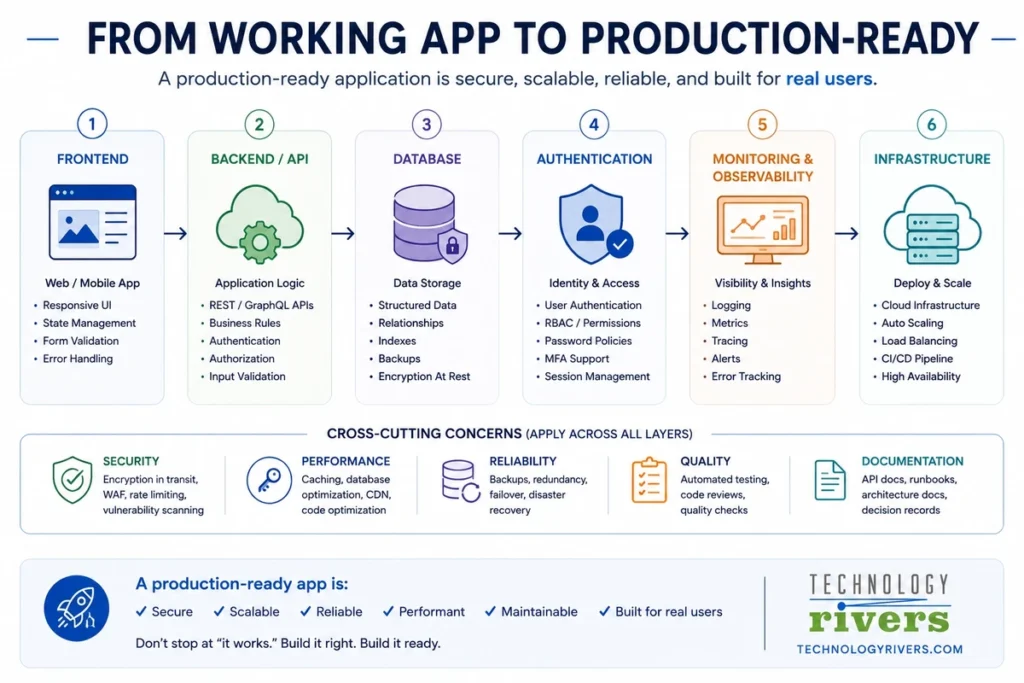
You need to evaluate what was actually built.
Should You Keep It, Fix It, Replace It, or Rebuild It?
One of the first questions founders often ask is: “Do I need to rebuild my vibe-coded app?”
Not necessarily.
AI-generated code isn’t automatically bad code. Traditional code isn’t automatically good code.
Evaluate the application itself.
KEEP
What is already solid? Good code doesn’t need to be rewritten simply because AI generated it.
FIX
What can reasonably be improved? Perhaps the structure needs refactoring, security needs strengthening, or testing needs to be added.
REPLACE
Are certain components inappropriate for production? This could include libraries, third-party services, authentication approaches, database components, integrations, or infrastructure.
REBUILD
What genuinely needs to be rebuilt? Sometimes rebuilding a particular area is safer and less expensive than repeatedly patching it.
But rebuilding should be a technical decision based on evidence, not a reaction to the words “AI-generated.”
Not sure what you have? Our Application Assessment helps determine what can stay, what needs improvement, and what, if anything, should be rebuilt. Get Your Application Assessed →
When Healthcare Changes the Requirements
Now suppose your application works and you’ve addressed production readiness.
Can you put patient data into it?
That’s a different question.
Production-ready doesn’t automatically mean HIPAA-ready.
When protected health information enters the application, you need to think differently about architecture, access, infrastructure, integrations, vendors, logging, and data flows.
Building for healthcare? See how we help take AI-built applications from prototype to production with the technical foundation needed to support HIPAA requirements. Explore HIPAA-Compliant Vibe Coding →
Start by Understanding Where PHI Goes
Ask:
- Where does PHI enter the application?
- Where is it stored?
- Where is it transmitted?
- Which systems process it?
- Which third parties receive it?
- Which users can access it?
- How is that access controlled?
This is why data-flow mapping is so important. You cannot protect sensitive information if you don’t understand where it travels.
What Changes When PHI Enters the Application?
Depending on the system, technical considerations may include:
- Authentication
- Authorization
- Role-based access
- Encryption at rest
- Encryption in transit
- Audit logging
- Secure databases
- Secure file storage
- API security
- Backups
- Recovery
- Monitoring
- Data isolation
- Vendor relationships
- BAAs
- Cloud infrastructure
- Data retention
- Secure development practices
It’s also important to understand that HIPAA compliance is broader than software.
It can involve administrative safeguards, policies, procedures, workforce practices, risk management, contracts, physical safeguards, and other organizational responsibilities.
A software application can be designed to support HIPAA compliance, but software by itself does not make an organization HIPAA compliant.
Vibe Coding + AI + Healthcare
Healthcare applications increasingly involve more than traditional databases and APIs.
They may also include:
- Generative AI
- RAG
- AI agents
- Vector databases
- Internal knowledge bases
- Medical content
- Patient information
- EHR data
- Healthcare APIs
- Clinical workflows
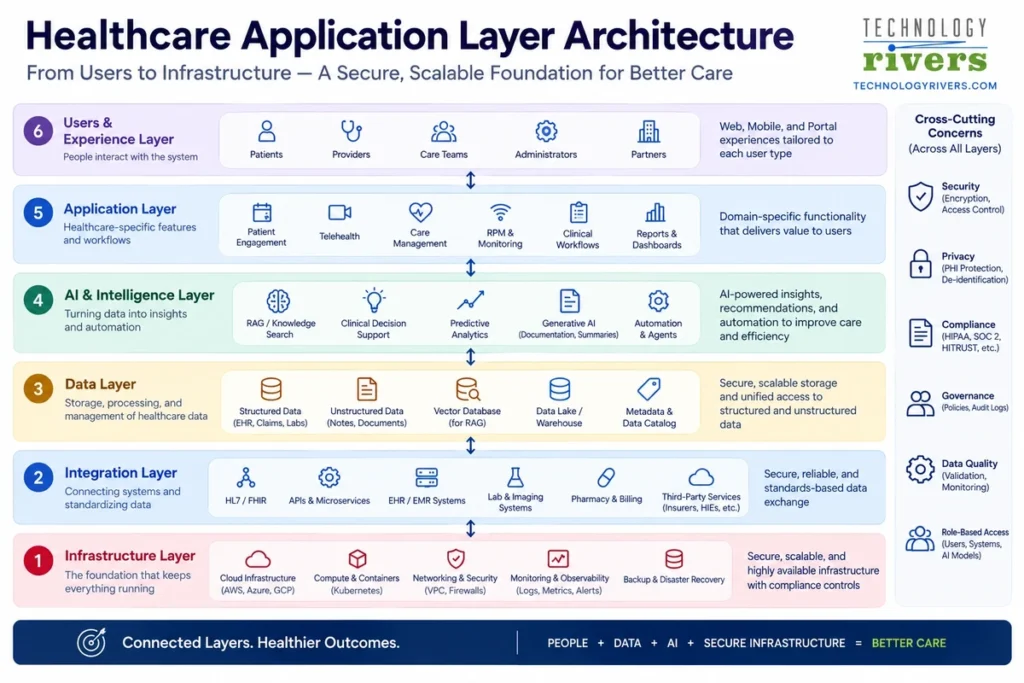
That creates another important question:
Where Is Your Data Going?
Imagine a user asks an AI assistant:
Summarize this patient’s recent history and identify information I should review.
The application might send information through several systems before generating an answer:
Application → Backend → Database → Vector Database → Retrieval System → LLM Provider → Response
You need to understand what data is being transmitted at every step.
RAG and Sensitive Healthcare Data
Retrieval-Augmented Generation, or RAG, allows AI to answer questions using information from your own data sources.
That can be extremely useful in healthcare.
An organization might connect policies, clinical documents, internal procedures, educational material, patient information, operational documentation, and research.
But retrieval creates its own security questions.
Just because information exists in the knowledge base doesn’t mean every user should be able to retrieve it.
Role-Based Retrieval Matters
Imagine the same AI assistant is available to patients, physicians, nurses, administrators, and support staff.
They shouldn’t necessarily receive the same information.
The retrieval layer itself needs to understand access.
That means permissions may need to apply before information is provided to the AI, not simply after the AI generates an answer.
This becomes particularly important when AI is being used as an interface to internal organizational knowledge or healthcare information.
Third-Party AI Providers
Healthcare AI applications may rely on external providers for language models, embeddings, vector storage, logging, analytics, monitoring, authentication, and cloud hosting.
You need to understand how those providers handle sensitive data.
Questions can include:
- What data is transmitted?
- Is data stored?
- Where is it stored?
- How is it encrypted?
- Is it used for model training?
- Who can access it?
- What contractual protections exist?
- Is a BAA required and available?
An AI feature should be evaluated as part of the complete data architecture, not as an isolated API call.
How to Make a Vibe-Coded Healthcare App HIPAA-Ready
Every application is different, but a typical technical process includes several steps.
Step 1: Identify PHI
Determine what protected health information the application handles.
Step 2: Map Data Flows
Understand where that information enters, moves, gets processed, and is stored.
Step 3: Review the Architecture
Determine whether the current architecture is appropriate for sensitive healthcare information.
Step 4: Review Third-Party Vendors
Identify every service that may receive, process, or store PHI.
Step 5: Review Authentication and Authorization
Make sure users are securely authenticated and only able to access information they’re authorized to see.
Step 6: Review Encryption
Protect sensitive data both in transit and at rest where required.
Step 7: Implement Auditability
Make sure relevant system and data access activities can be appropriately logged and reviewed.
Step 8: Review Infrastructure
Evaluate cloud hosting, databases, storage, networking, backups, monitoring, and recovery.
Step 9: Test Security
Review the application for vulnerabilities and inappropriate access paths.
Step 10: Document the Technical Environment
Document architecture, vendors, data flows, security controls, and operational processes.
The exact requirements depend on the application, data, organization, and use case.
Need help taking an existing vibe-coded healthcare application through this process?
Explore our HIPAA-Compliant Vibe Coding Solution →
Building Production + HIPAA Into the App From Day One
If you haven’t built your application yet, you have an advantage.
You can make important decisions before technical debt accumulates.
That doesn’t mean turning an MVP into a massive enterprise architecture project. It means establishing sensible guardrails early.
Product Requirements → User Flows → Data Model → Architecture → Engineering Instructions → AI-Assisted Development → Testing & Security → Healthcare Controls, When Required → Production
Move fast, but give AI guardrails.
Complete Vibe Coding Tutorial Library
We’ve created platform-specific tutorials to go deeper into each stage of this process.
Replit
- How to Build an App with Replit
- How to Make a Replit App Production-Ready
- How to Make a Replit App HIPAA-Ready
- How to Build a Production-Ready, HIPAA-Ready App with Replit
Lovable
- How to Build an App with Lovable
- How to Make a Lovable App Production-Ready
- How to Make a Lovable App HIPAA-Ready
- How to Build a Production-Ready, HIPAA-Ready App with Lovable
Base44
- How to Build an App with Base44
- How to Make a Base44 App Production-Ready
- How to Make a Base44 App HIPAA-Ready
- How to Build a Production-Ready, HIPAA-Ready App with Base44
Bolt.new
- How to Build an App with Bolt.new
- How to Make a Bolt.new App Production-Ready
- How to Make a Bolt.new App HIPAA-Ready
- How to Build a Production-Ready, HIPAA-Ready App with Bolt.new
v0
- How to Build an App with v0
- How to Make a v0 App Production-Ready
- How to Make a v0 App HIPAA-Ready
- How to Build a Production-Ready, HIPAA-Ready App with v0
Emergent
- How to Build an App with Emergent
- How to Make an Emergent App Production-Ready
- How to Make an Emergent App HIPAA-Ready
- How to Build a Production-Ready, HIPAA-Ready App with Emergent
Claude Code
- How to Build an App with Claude Code
- How to Make a Claude Code App Production-Ready
- How to Make a Claude Code App HIPAA-Ready
- How to Build a Production-Ready, HIPAA-Ready App with Claude Code
Codex
- How to Build an App with Codex
- How to Make a Codex App Production-Ready
- How to Make a Codex App HIPAA-Ready
- How to Build a Production-Ready, HIPAA-Ready App with Codex
Vibe Coding Checklist
If you’re building with AI, here’s a practical checklist to keep nearby.
Before You Build
Define the problem
Define the users
Define core workflows
Define the MVP
Define user roles
Define the data model
Establish basic architecture
Establish coding standards
Give AI product context
Give AI engineering instructions
Before Production
Review application architecture
Review code quality
Review dependencies
Review authentication
Review authorization
Review database security
Review API security
Remove exposed secrets
Add appropriate automated testing
Test failure scenarios
Add logging
Add monitoring
Configure backups
Test recovery
Establish production infrastructure
Establish CI/CD
Test performance and scalability
Before Handling PHI
Identify PHI
Map PHI data flows
Review authentication and authorization
Review role-based access
Review encryption
Review audit logging
Review databases and storage
Review APIs
Review cloud infrastructure
Review third-party vendors
Determine BAA requirements
Review backup and recovery
Review AI/RAG data flows
Review vector database access
Review LLM providers
Complete appropriate security and risk reviews
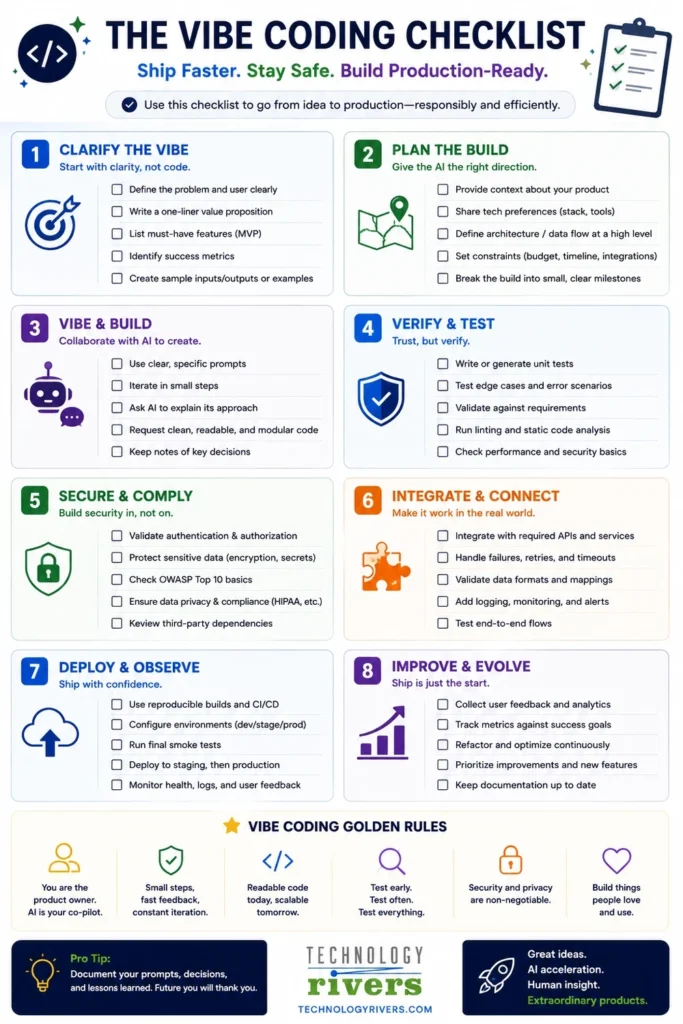
Vibe Coding Is the Beginning, Not the End
Vibe coding has made software development faster and more accessible than ever.
A founder can turn an idea into a working application without assembling a large development team first. A developer can accomplish dramatically more with AI. And experienced engineering teams can use AI throughout the development lifecycle to move faster.
But AI doesn’t eliminate the fundamentals of software engineering.
Architecture still matters. Security still matters. Testing still matters. Data design still matters.
And when healthcare is involved, understanding how sensitive information moves through the entire system matters even more.
The goal isn’t to choose between vibe coding and traditional software engineering.
It’s to combine the best of both:
The speed of AI + the discipline of software engineering.
Build quickly. Validate the idea. Learn from users. Then make sure the application underneath the experience is ready for the responsibility you’re about to give it.
Already Built Your App?
If you’ve already built an application with Replit, Lovable, Base44, Bolt, Emergent, v0, Claude Code, Codex, Cursor, or another AI development tool, you don’t need to guess whether it’s ready for production.
Assess what you built. Keep what’s solid. Fix what’s weak. Rebuild only where necessary.
Get Your Vibe-Coded App Assessed
Building for Healthcare?
Learn how Technology Rivers helps take vibe-coded applications from working prototypes to secure, production-ready applications with the technical foundation needed to support HIPAA requirements.
Want to Keep Building It Yourself?
Explore our platform-specific tutorials for building, productionizing, and preparing vibe-coded applications for healthcare.